Just be yourself.
I can’t count the number of times I heard that phrase when I was struggling with social anxiety. Whether it was before a party, a presentation, or a conversation I’d been dreading, people said it with genuine warmth, as though it were the one thing I needed to be reminded of.
But every time I heard that phrase, I felt a deep, quiet frustration. Not because what the person said was wrong, but the gap between the advice and my reality. I knew, intellectually, that being myself was the goal. I wanted to be myself. But the problem for me was that the moment other people were around, something in me shut down. The easy, natural version of me that existed when I was alone simply couldn’t show up.
For three and a half years, I thought that gap was evidence of something wrong with me. That I just wasn’t capable of the thing everyone else seemed to do effortlessly.
But what I eventually understood is that that gap wasn’t a character flaw. It was a symptom. And once I understood what was actually causing it, the whole idea of “just be yourself” stopped making sense, and a much more useful one took its place.
Where “Be Yourself” Actually Comes From
“Just be yourself” feels like a modern phrase, but its roots go back further than most people realize.
In the late 19th century, Ralph Waldo Emerson wrote about the idea self-reliance — that individuals should trust their intuition and inner voice rather than conforming to the expectations of society. It was a radical idea for the time, and a genuinely important one.
Decades later, psychologist Carl Rogers built on this foundation with the concept of congruence: the idea that psychological health involves a meaningful alignment between your inner experience and outer behavior. When who you are on the inside matches how you show up on the outside, something essential is right.
Over time, these rich philosophical and psychological ideas got compressed. The nuance got stripped away. And what remained was a three-word phrase: just be yourself.
And here’s the thing — as advice goes, it’s not wrong. For most people, the phrase is actually helpful advice.
The problem, in this context, is that it completely misreads the situation for someone with social anxiety.
If you’ve ever been told to “just be yourself” and felt it missed the point entirely — or even made things worse — you’re not imagining it. That disconnect is real, and it’s specific to how social anxiety actually works. Join the newsletter and I’ll send you a new post every week that explains why.
Why It Doesn’t Work for Social Anxiety
The reason “just be yourself” fails for someone with social anxiety isn’t that the advice is bad. It’s that it assumes a capacity that social anxiety specifically undermines.
Being yourself requires feeling safe enough to do it. For most people, that safety is already there and is a baseline assumption. They walk into a social situation with the assumption that they’re acceptable, and that whatever they say will probably be received well enough. Authenticity is easy when the ground beneath you feels solid.
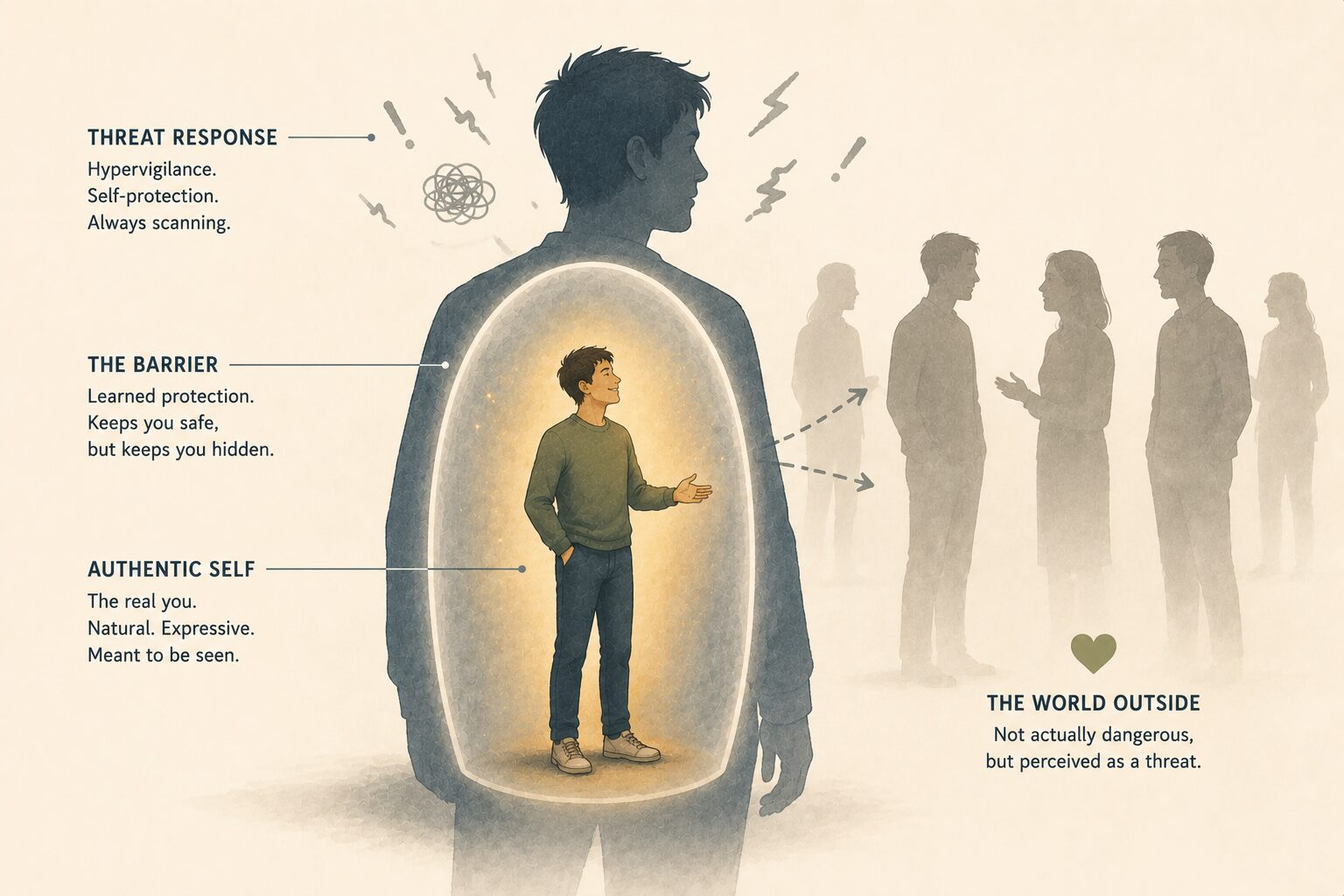
But for someone with social anxiety, that safety is exactly what’s missing. And what takes its place is something much more powerful: the association of authenticity with threat.
Think about this scenario. You’re with someone you know well, someone who has never given you a real reason to feel unsafe. And yet, without warning and without logic, your chest tightens. Your muscles tense. Your eyes dilate slightly. Your back hunches. And within seconds, the easy, natural version of you has gone completely offline. You’re standing there, next to someone safe, with no idea how to be yourself.
This social experience is a reflection of something deeper than anxiety. It’s a reflection of a nervous system that has learned, through accumulated experience, to treat the act of showing yourself to another person as a potential threat — regardless of who that person is or how safe they actually are.
I explored the deeper roots of this in my post on what social anxiety really is — specifically how shame becomes the engine underneath the fear, and why the condition is fundamentally about authentic self-exposure rather than judgment alone. If you haven’t read it, it gives important context to everything we’re talking about here.
The point is this: telling someone with social anxiety to just be themselves is like telling someone with a broken leg to just walk it off. The goal is right. The mechanism for getting there is completely unaddressed.
What’s Actually Going On
Here’s the reframe that changed everything for me.
Authenticity isn’t a performance. It’s not something you do or can be. It’s what’s left behind when you’re not in a state of threat.
When your nervous system is calm, your authentic self doesn’t need to be summoned or performed. It just shows up. The version of you that feels effortless when you’re alone, or with the rare person you feel completely safe around, is the version that emerges when your threat response system is calm.
The problem isn’t that your authentic self doesn’t exist. It’s that your nervous system keeps filing it away as unsafe to show.

This connects directly to what researchers studying the autonomic nervous system have found about social engagement and safety. According to work grounded in polyvagal theory, developed by neuroscientist Stephen Porges, our capacity for genuine social connection is directly tied to our nervous system’s sense of safety. When the nervous system is in a threat state, the social engagement system goes offline. We become guarded, contracted, and self-protective.
Social anxiety, through this lens, isn’t a failure to be yourself. It’s a nervous system that has learned to treat social exposure as dangerous — and is protecting you accordingly.
So, you don’t become yourself by trying harder. You become yourself by slowly, gradually teaching your system that it’s safe to be seen.
What Recovery Actually Looks Like Through This Lens
This reframe matters enormously for recovery, because it changes what you’re actually trying to do.
Most people believe that the solution for a lack of authenticity is to try harder. Push through the discomfort. Force the authenticity.
But if you understand that the problem is a nervous system that doesn’t feel safe, then the solution is completely different. It’s not about effort. It’s about safety. It’s about gradually accumulating experiences that teach you that showing yourself to other people doesn’t lead to the catastrophe it’s been predicting.
That process looks different for different people. It might look like therapy that specifically addresses the shame underneath the fear. It might look like slowly building relationships where you feel genuinely accepted. It might look like small acts of authentic expression — saying what you actually think in a low-stakes situation, letting someone see a real reaction rather than a performed one — and noticing that nothing terrible happened.
It’s slow. It’s nonlinear. There are moments where the old patterns snap back hard, and moments where something new and surprising comes through. But the direction is always the same: toward safety, authenticity, and the version of you that has been there all along.
What has your recovery process been like so far? I’d love to hear the experiences you’ve had in the comments below — especially if you’ve spent years feeling like your recovery hasn’t been progressing. You’re not alone in that. And knowing that matters.
You Were Never Failing — You Were Never Safe Enough
For a long time, I believed the problem with social anxiety was me. That I just lacked something other people had — some natural ease with themselves that I had simply been born without.
What I know now is that I wasn’t missing anything. My authentic self was there the whole time. It just couldn’t come out in an environment that my nervous system believed was dangerous. The problem was never my inability to be myself. The problem was that being myself had become, somewhere along the way, something my system had learned to fear.

That’s a very different problem. Because a missing capacity is permanent. But a learned association is something that can be changed.
That’s what this blog was made for. It’s not about teaching you to perform a better version of yourself in social situations, but helping you rebuild a sense of safety that allows the real version to come through on its own. That version is the one you deserve to live with.
It’s closer than you think. And it’s been there the whole time.
If you want to keep going deeper on this — the safety, the identity, the long slow work of letting yourself be seen — join the newsletter here. I write about all of it every week, and I’d love to have you along.

Hi, I’m Blake Baretz, the creator of Social Anxiety Haven. I write about my personal journey with social anxiety and share research-backed strategies to help others navigate it. If you’d like more encouragement and resources, join my weekly newsletter.
Leave a Reply