When I was struggling with social anxiety, I remember going to therapy sessions, sitting across from my therapist and believing I was doing everything right.
I had the worksheets. I was completing the thought records. Every time a negative thought came up, I was challenging it — writing down the distortion, finding the counter-evidence, doing exactly what I was supposed to do. I wanted to get better more than I’d ever wanted anything.
Yet I still wasn’t feeling any better. It felt like the more I tried to challenge my negative thoughts, the more pointless the recovery process became.
It took me years to understand that CBT wasn’t right for my treatment. And it didn’t have anything to do with me. It was something structural — a gap in the model we don’t talk about openly enough.
This post is about that gap.
What CBT Is Actually Doing
Before I explain what’s missing in CBT, I want to be clear that it isn’t nothing. I’m not going to completely dismiss it, and I don’t think you should either.
Cognitive Behavioral Therapy is built on a well-established premise — that our emotional experiences are heavily shaped by our thoughts.
CBT’s response to this is to target these thoughts directly. It proposes that if you identify the cognitive distortions and you challenge them with evidence, the anxiety responses reduce over time. For some people, with some presentations of anxiety, this genuinely works.
But for a specific subset of people — those with deeply entrenched social anxiety, people for whom the anxiety feels less like a situational fear and more like an identity — CBT produces limited relief at best. And at worst, it produces exactly what it produced in me: the feeling that something is fundamentally, unfixably wrong with you.
That outcome isn’t random. It isn’t about effort. It has a structural explanation.
If this is already landing differently than most things you’ve read about CBT — join my newsletter here. Every week I write about the mechanisms underneath social anxiety and what recovery actually looks like from the inside. I’d love to have you there.
The Identity Layer CBT Can’t Reach
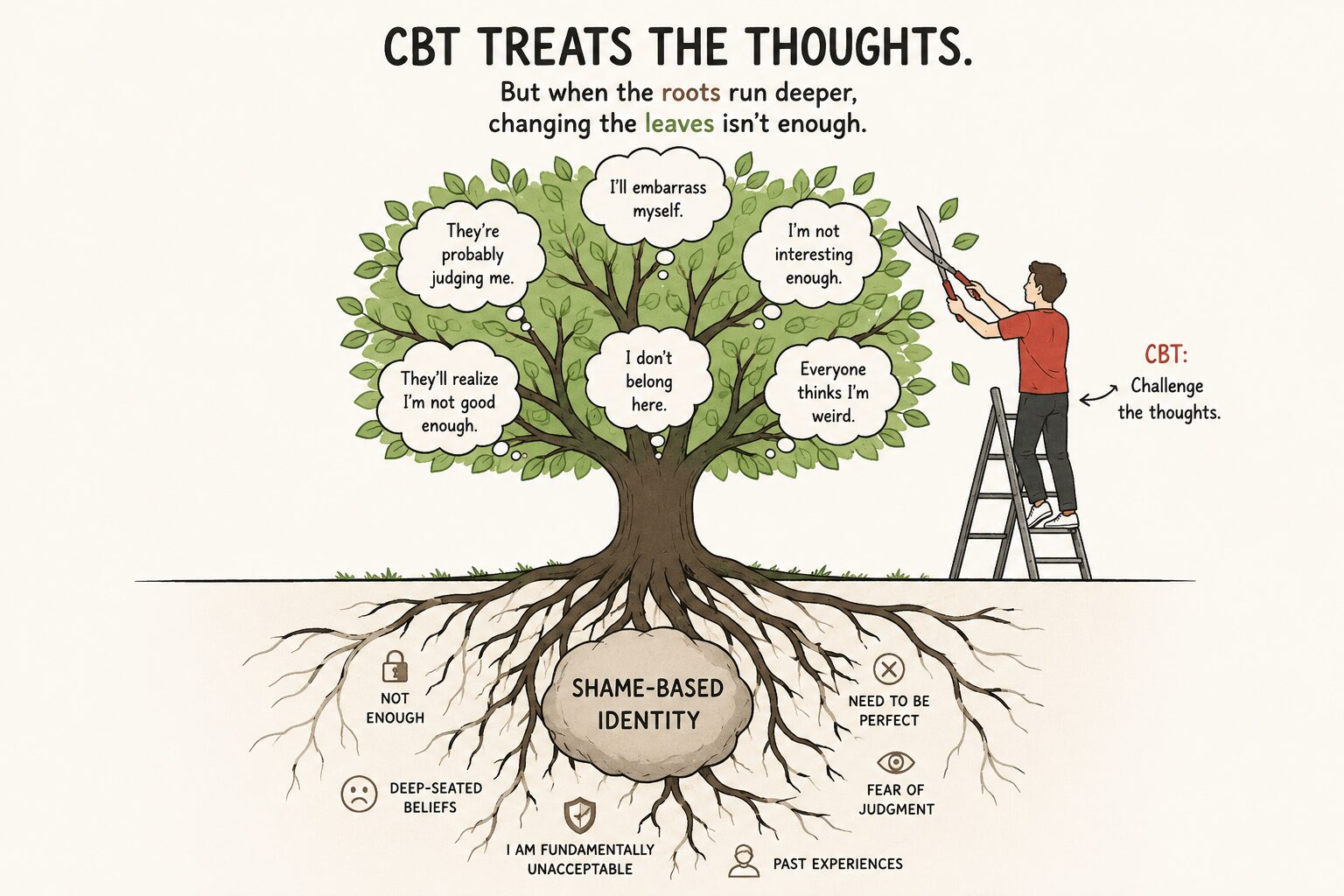
Here’s what CBT doesn’t fully account for in cases like mine: in severe social anxiety, the anxiety isn’t primarily being generated by your thoughts. It’s being generated by something deeper — a shame-based identity. A core set of beliefs about who you are in relation to other people.
And that identity has a protection system.
William Swann called this protection system self-verification, which explains how people actively seek out information that confirms their existing self-perception, even when that self-concept is negative. The identity doesn’t just sit there passively waiting to be updated. It filters incoming information to protect itself.
I experienced this constantly in CBT, though I didn’t have a name for it at the time. My therapist would say something genuinely positive — that I’d made a real contribution, that what I’d shared was insightful. And on the surface, I heard it. But something underneath immediately processed it differently.
She’s just being nice.
That’s an exception. It doesn’t count.
Anyone could have said that.
This wasn’t a thinking error I could identify and correct. It wasn’t an inner critic I could talk back to. It was the self-verification mechanism doing exactly what it was designed to do — protecting the coherence of my identity by neutralizing any evidence that contradicted it.

Why does the brain do this? Because certainty, even negative certainty, feels safer than not knowing who you are. A mind that is certain it belongs to a fundamentally unacceptable person is — from a survival standpoint — more stable than a mind that doesn’t know. The identity isn’t trying to make you suffer. It’s trying to keep you predictable to yourself.
This is exactly why thought challenges don’t work at the identity level. You can say the right things to yourself all day. You can generate every balanced counter-thought CBT prescribes. But if those counter-thoughts are being processed by an identity built around the belief that you are fundamentally unacceptable — they don’t reach the structure. They get neutralized before they arrive.
Think of it this way. Imagine trying to convince someone who genuinely believes they’re ugly that they’re beautiful. You can say it a hundred times. You can write it down. You can have other people say it. But the mirror they’re looking into doesn’t change. CBT gives you better things to say to the person in the mirror. It doesn’t change the mirror.
That’s the gap.
Why the Thoughts Don’t Reach the Structure
There’s a second problem underneath the first one, and this is the part that’s important to mention.
CBT doesn’t fully know what it’s even targeting. And in many cases, neither does the therapist delivering it.
“Challenge your negative thoughts” sounds like an instruction. But it’s actually a description of a surface behavior with no model underneath it. What thoughts? Where are they coming from? What is generating them? What maintains them between sessions?
The implicit answer CBT gives is: cognitive distortions. Inaccurate thinking patterns. And that framing locates the problem at the level of thought — which means the intervention also operates at the level of thought.
But in severe, chronic social anxiety, thoughts are downstream. They’re symptoms of something operating far below the surface — at the level of identity, which interacts with memory, physiological threat, and a belief system about social reality that was often built over years, sometimes starting in childhood. That system isn’t accessible through conscious thought challenges. It isn’t a thinking problem. It’s a structural one.

Once again, I’m not saying CBT is useless. I’m saying it has a ceiling, and that ceiling is predictable. If your anxiety is primarily situational — triggered by specific events, reducible through exposure and belief-updating — CBT can do real work. But if your anxiety is identity-level — if it feels less like a fear and more like a fact about who you are — then working at the level of thought is like trying to renovate a house by repainting the walls while the foundation is shifting underneath.
The Anxiety and Depression Association of America acknowledges that while CBT remains the first-line treatment for social anxiety disorder, outcomes vary significantly — and that for complex presentations, additional approaches targeting deeper belief structures are often warranted. That variance isn’t random. It maps almost perfectly onto the distinction I’m describing here.
If you want to understand more about the internal architecture that drives this — the thoughts, emotions, and physiological patterns that operate below conscious awareness — my post on internal social anxiety triggers goes deep on exactly this. It’s the best companion piece to what I’m laying out here.
What This Means for You
If CBT didn’t work for you — or if it made things worse — I want to say something directly.
You weren’t doing it wrong. You were inside a model that was asking you to work at a level that couldn’t reach what was actually driving your experience. And the fact that it felt like you were being asked to fight yourself rather than your anxiety? That feeling was accurate. You weren’t imagining it.
This matters for one specific reason: the story you’ve been telling yourself about your ceiling.
Most people who’ve been through CBT without results have internalized a version of one of two stories. Either I didn’t try hard enough, or I’m too broken for this to work. Both of those stories are wrong. And both of them are, in a strange way, products of the same self-verification mechanism I described earlier — the identity protecting itself by explaining its own persistence as evidence of permanence.
Understanding the structural gap doesn’t fix everything. But it does one thing that nothing else can do first: it gives you an accurate map of what you’re actually dealing with. And you cannot navigate toward recovery using a map that doesn’t match the terrain.

For me, that understanding was the beginning of everything. Not a technique. Not a new strategy. Just the first explanation of my own experience that actually made sense.
I’m curious where you are with all of this. If CBT has been part of your story — whether it helped, didn’t, or made things harder — I’d genuinely like to hear it in the comments below. You might find you’re less alone in what you experienced than you think.
There’s a Layer Underneath This
What I’ve covered today is the gap — the structural reason why CBT doesn’t reach the mechanism maintaining the anxiety for a specific profile of person.
What comes next is the harder, more important question: if thought challenges don’t work at the identity level, what does?
That’s what my newsletter is built around. Not more CBT reframes. Not symptom management. The actual architecture of what keeps social anxiety in place, and what it takes to build conditions under which that architecture actually changes. If what I’ve written here is the first explanation of your experience that has made sense — that’s where to go next.
Join the newsletter here. I write every week, and I’d love to have you there.

Hi, I’m Blake Baretz, the creator of Social Anxiety Haven. I write about my personal journey with social anxiety and share research-backed strategies to help others navigate it. If you’d like more encouragement and resources, join my weekly newsletter.
Leave a Reply