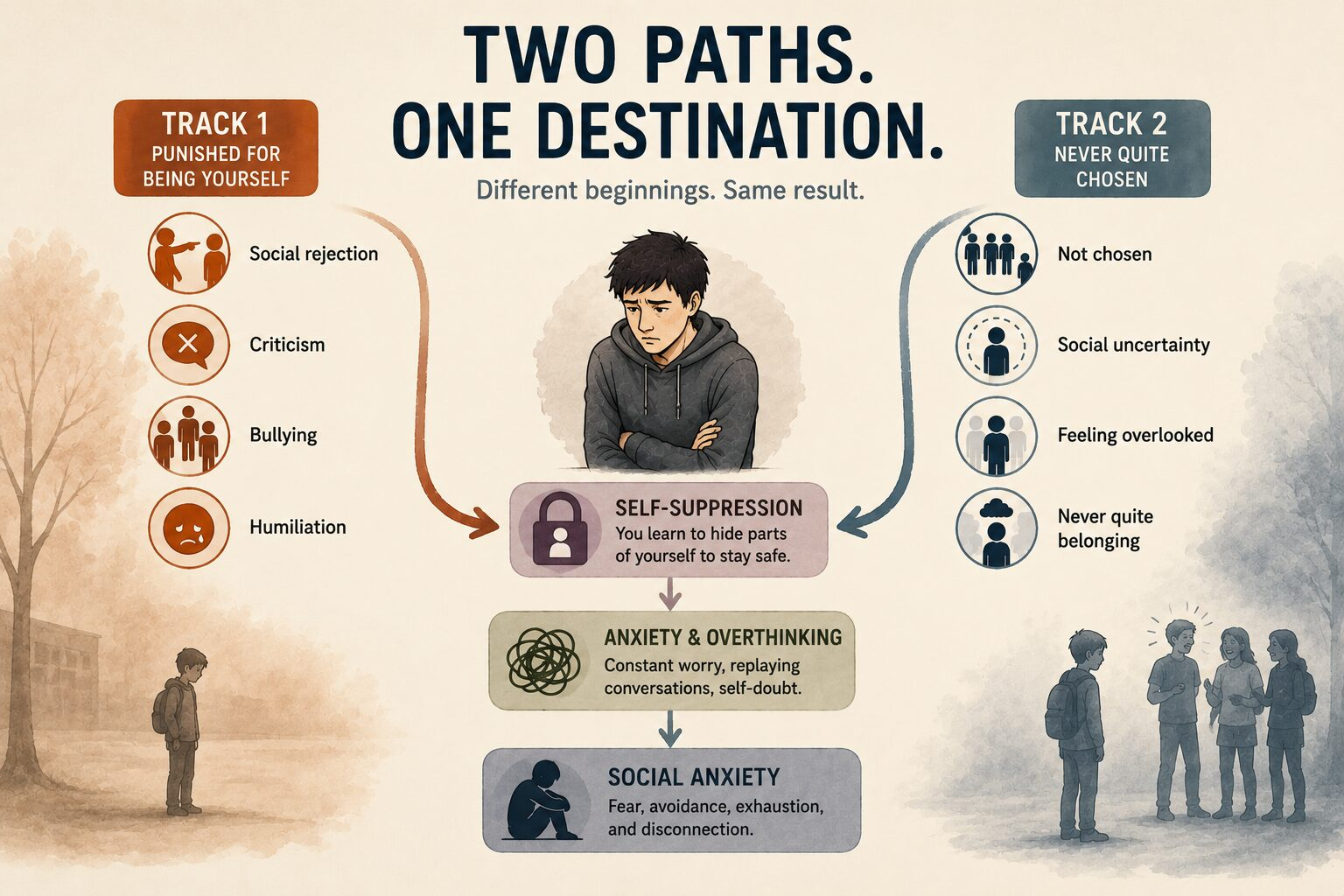
I used to think social anxiety was one thing.
You feel anxious around people. You overthink what you said. You replay conversations for hours. You can’t quite be yourself.
But the more I studied it, and the more I compared the research to my own experience, the more convinced I became that those symptoms don’t all come from the same place.
There are two distinct pathways that can produce social anxiety — and if you’ve never been shown which one you’re on, it becomes very hard to understand why your brain keeps doing what it’s doing.
The One Thing Almost Everyone With Social Anxiety Has in Common
Before we get to what’s different, it’s worth naming what’s the same.
No matter how your social anxiety developed, no matter what you’ve been through, there’s a good chance you’ve adopted one core strategy: at some point, you learned that suppressing yourself felt safer than being yourself. Maybe staying quiet protected you from being laughed at. Maybe hiding parts of your personality helped you avoid rejection.
Different stories. Same solution. You start holding parts of yourself back.

I call this self-suppression, and I think it’s one of the central mechanisms driving social anxiety. The tricky part is that almost nobody notices they’re doing it, because self-suppression hides behind its own consequences. What you notice is the anxiety, the overthinking, the exhaustion after being around people. What you don’t notice is the strategy quietly producing all of it.
What I find genuinely interesting is that people don’t arrive at self-suppression the same way. There are two separate pathways that teach your brain the exact same lesson — and understanding both is one of the more useful things I’ve come across in trying to make sense of my own recovery.
Track 1: When You’re Punished for Being Yourself
The first pathway starts with a specific moment. You express something real — an opinion, some excitement, a joke, a piece of your actual personality — and you’re punished for it.
The moment itself hurts. But what your brain learns from it matters more than the moment.
Your brain isn’t trying to understand who you are — it’s trying to keep you safe. So it draws two conclusions.
The first is about you: instead of “that interaction went badly,” it becomes “there’s something wrong with me.” The sting doesn’t stay attached to the moment. It spreads to your identity.
The second conclusion is about everyone else: if these parts of me are flawed, letting people see them will only lead to more rejection. Now your brain has a prediction running in the background — the more people see the real you, the more likely you are to be rejected.
So, without deciding to, you start hiding. You get quieter, more careful, more filtered. At first this doesn’t feel like a disorder — it feels like an adaptation. But over time, you’re no longer just avoiding certain situations. You’re avoiding authentic self-expression itself. And that’s the first step toward social anxiety.
I think about how easily this can start with something as small as a single afternoon. A kid raises their hand in class with a question that’s a little unusual and the whole room goes quiet in the wrong way. A few people laugh. Someone mutters that it was weird. And the next thing you know it, the same kid walks into the cafeteria expecting to sit with friends, and suddenly there’s “no room,” even though there’s an empty seat right there.
In this moment, the brain isn’t thinking like a psychologist. It’s thinking like a survival system, trying to answer one question: how do I make sure this never happens again? And it lands on the only conclusion that feels safe — expressing yourself is what caused this, so expressing yourself less is what prevents it happening again.
Track 2: When You’re Never Quite Chosen
The second pathway looks nothing like the first. There’s no single defining moment. Nobody explicitly humiliates you or rejects you outright.
Instead, it’s hundreds of ordinary moments that all seem to point the same direction. You show up as yourself. You try to make conversation. You put yourself out there. But somehow, friendships don’t seem to happen for you the way they happen for everyone else. You watch other people connect effortlessly while you feel like you’re always standing just outside of it. You’re there. You’re included, technically. But not quite.
Nobody’s telling you something’s wrong with you. But nobody seems especially drawn to you either.
Because there’s no single event to point to, your brain starts searching for an explanation on its own. What am I doing wrong? What do other people have that I don’t? What do I need to change?
This isn’t a response to rejection — it’s a response to uncertainty. And to solve that uncertainty, your brain does something specific: it starts watching you from the outside. Instead of just experiencing a conversation, you start observing yourself while you’re in it. How do I sound? Did that joke land? Am I talking too much?
Picture a kid who walks into school every day hoping today is the day it finally clicks. They say hi to people. They try sitting with different groups. They laugh along, they show up — and the friendships still never quite land the way they hope. Nobody’s mean. Nobody excludes them outright. They’re just never quite chosen for being who they are.
After enough days of that, the question stops being “what happened” and starts being “why.” Why does this seem so easy for everyone else? What’s missing? And slowly, that pattern convinces them that the person they’re naturally showing the world isn’t enough to create the connection they’re looking for.

If either of these tracks sounds like something you’ve lived, this is exactly the kind of thing I go deeper on in my newsletter: the psychology behind each pathway, why each one maintains anxiety differently, and what I think recovery actually needs to target depending on which one shaped you.
The Gap: Same Behavior, Two Different Blueprints
Here’s what I think is easy to miss. These two pathways start in completely different places, but they end in exactly the same one.
One person learns: if people see the real me, they’ll reject me. The other learns: the real me isn’t enough to create what I want. Different lessons. Same solution. Both people start hiding parts of themselves. And eventually, both end up with what we call social anxiety.
I don’t think the anxiety is the actual problem. I think it’s what shows up after years of suppressing who you are. The strategy comes first. The anxiety comes second.
Once you stop treating social anxiety as the problem and start seeing it as the downstream consequence of a strategy your brain learned years ago, the question behind it changes. It stops being “how do I get rid of my anxiety” and becomes “why did my brain decide that hiding parts of myself was the safest way to relate to people in the first place.” That second question is the one that actually leads somewhere.

Two Origin Stories, One Belief System
Research on how social anxiety develops backs this up more than I expected when I first went looking. According to the American Psychological Association, social anxiety disorder tends to form through a combination of genetic predisposition and environmental experience — particularly experiences involving criticism, bullying, or social rejection during formative years. That maps almost exactly onto Track 1. But the ambient, uncertainty-driven pattern behind Track 2 is just as real, even though it never shows up as a single “critical incident” you could point to.
In a future post, I want to look at the moment social anxiety stops being something you experience and starts becoming something you believe you are — because I think that’s the real turning point that takes temporary anxiety and turns it into a stable, self-maintaining identity. If you haven’t read it yet, I explored the identity side of this in more depth in what social anxiety really is, and it connects directly to everything above.

Hi, I’m Blake Baretz, the creator of Social Anxiety Haven. I write about my personal journey with social anxiety and share research-backed strategies to help others navigate it. If you’d like more encouragement and resources, join my weekly newsletter.
Leave a Reply