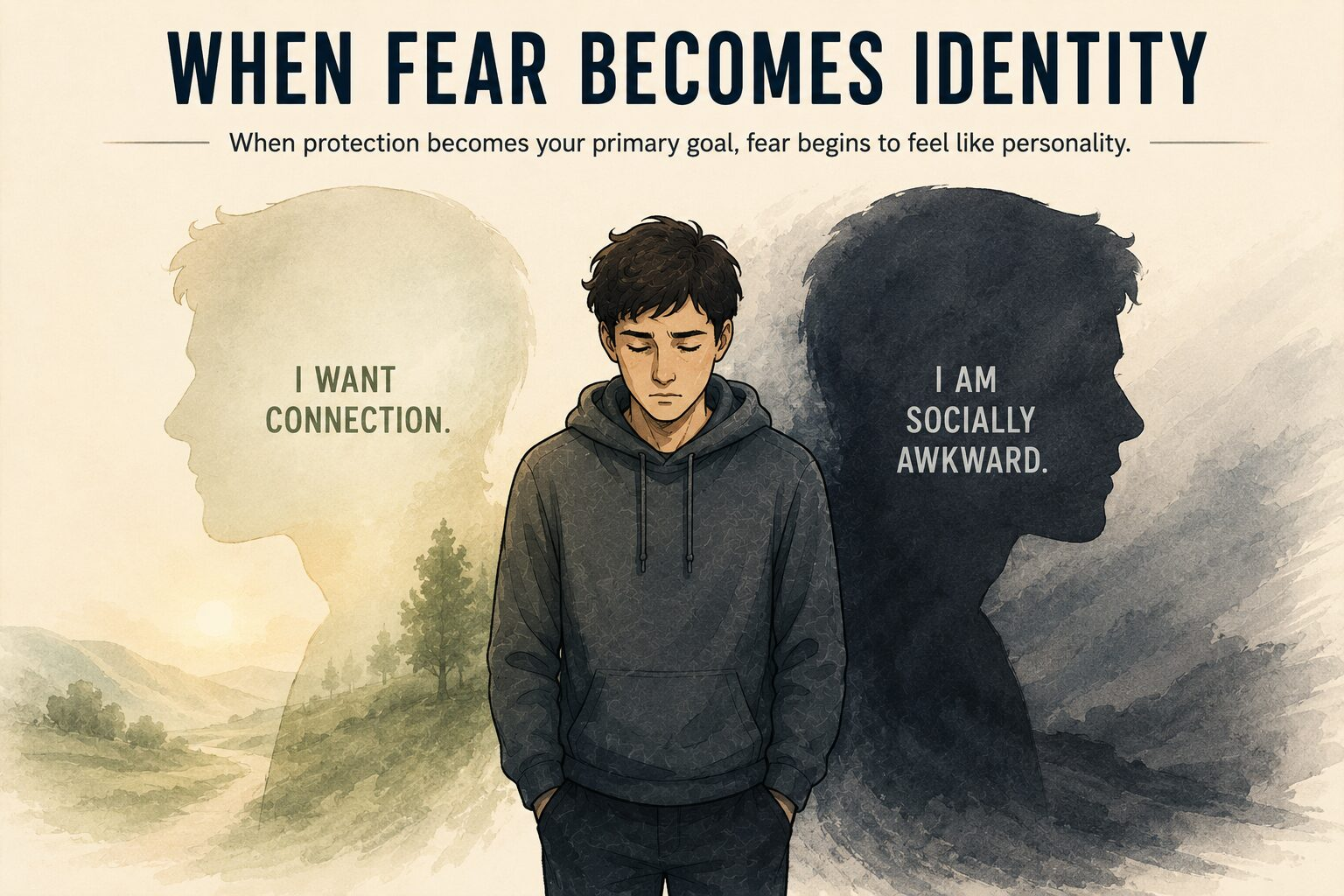
For years, I assumed social anxiety was just a fear response — a fear of judgment, of embarrassment, of saying the wrong thing.
Early on, that’s exactly what it feels like. But if you’ve lived with it for years, I don’t think that’s what it feels like anymore. At some point it stops feeling like something you’re afraid of, and starts feeling like something you are.
Not “I’m afraid people won’t like me,” but “I’m not an interesting person.”
That’s a meaningful difference. One is something you feel. The other is something you believe. And I think that shift — from feeling to believing — is one of the most important moments in how social anxiety develops.
It doesn’t happen by accident, and I don’t think it happens all at once. There’s a specific mechanism behind it: a point where your brain quietly stops organizing your life around finding connection, and starts organizing it around avoiding exclusion.
If you read my last post on the two developmental pathways behind social anxiety, this picks up exactly where that one left off. Both pathways converge on the same strategy — self-suppression. This post is about what that strategy does to you over time, and why it eventually stops feeling like a strategy at all.
Two Goals, One Brain
Here’s a question worth sitting with. Before social anxiety took hold, didn’t some part of you still believe friendship was possible? You still wanted people in your life. You still believed connection was something you could have. But by the time social anxiety developed, it was the anxiety that got in the way — a settled belief that connection wasn’t possible.
I think every person is running two goals at once, all the time, in every social situation. The first is connection — the genuine desire to belong, to be accepted, to be known for who you actually are. The second is protection — the desire to avoid rejection, embarrassment, exclusion. Both goals exist in everyone. The real question isn’t whether they’re there. It’s which one is actually organizing your behavior in a given moment.
Before social anxiety develops, connection is still the dominant goal. You might be afraid, but you’re still moving toward people. You’re still hoping they’ll like you, still hoping you’ll feel like you belong somewhere. That hope is doing the organizing.
What Self-Suppression Does Over Time
But every time you hold a part of yourself back, your brain is reconstructing the hope that you can change.
Self-suppression convinces your brain, slowly, that social exposure is dangerous. Each painful interaction, each moment of shame, each reason you find to hold back makes avoiding rejection feel more urgent.
Protection starts to outweigh connection as a priority. And here’s the part I think is easy to miss: this doesn’t mean you’ve stopped wanting connection. You probably want it more than ever. What changes is your belief that it’s actually achievable. You don’t stop wanting it — you stop expecting it’s possible.
Those two things are shifting at the same time. One goal rising quietly. The other falling quietly. Eventually, they cross.

This is exactly the kind of mechanism I go much deeper on in my newsletter, including the clinical model I’m building around it. I’d love to have you there.
The Crossing Point
At some point in the development of social anxiety, your brain stops organizing your social life around finding connection and starts organizing it around avoiding exclusion. I don’t think there’s a single moment where you consciously decide this. Nobody wakes up and thinks, “I’m never going to connect with people.” It happens too gradually to notice while it’s happening.
But the difference in how you move through the world, once it’s happened, is stark. Before, you walked into conversations hoping people would like you. Afterward, you walk in hoping nothing goes wrong. Before, your attention was on the other person. Afterward, your attention is on yourself — how you’re coming across, whether you’re saying the right thing, whether anyone’s noticing something off about you.

For me, this showed up as a kind of quiet certainty that if people saw who I really was, they wouldn’t like me. I’d walk into situations already assuming it was only a matter of time before I was found out and pushed away. That didn’t mean I didn’t want friends. It meant that before the interaction even began, the goal itself had already changed. I wasn’t walking in trying to connect. I was walking in trying not to get hurt.
Why It Starts Feeling Like Personality
This is the part that I think explains why social anxiety eventually stops feeling like anxiety at all, and starts feeling like an accurate description of who you are. Once your brain reorganizes itself around protection instead of connection, you stop experiencing yourself as someone who’s defending themselves. You start experiencing yourself as someone who simply is socially awkward, or simply is incapable of the kind of connection other people seem to have.
Those don’t feel like conclusions your brain reached under pressure. They feel like facts. And they feel like facts because your entire motivational system has been quietly reorganized around a single working assumption — that being seen authentically is dangerous. Once that’s the operating assumption, everything you experience gets filtered through it, which is exactly why it stops feeling like a belief and starts feeling like self-knowledge.

What This Changes About Recovery
If you’ve been living with social anxiety for years, there’s a good chance the condition you’re experiencing today isn’t the same one that first showed up. At first, your brain was trying to help you find connection while keeping you safe from getting hurt. Over time, protection quietly became the entire goal. That’s the moment everything changed.
That’s why social anxiety eventually stops feeling like fear and starts feeling like identity.
Once you see it this way, the question changes. It stops being “what’s wrong with me,” and becomes “what is my brain actually trying to accomplish right now.” Those are two very different questions, and I think they lead to two very different paths toward recovery. If you want to see how this identity-level shift connects to the shame underneath it, I explored that side of things in what social anxiety really is.
In the next post, I want to look at what happens after this reorganization — because once protection becomes the goal running the show, your brain doesn’t remember your social history the same way anymore. That’s the next piece of this model.
If these ideas are helping you make sense of your own experience, I go much deeper into the full clinical model in my newsletter — the research behind these mechanisms, how they connect, and the recovery framework I’m building from this work. I’d love to have you there.

Hi, I’m Blake Baretz, the creator of Social Anxiety Haven. I write about my personal journey with social anxiety and share research-backed strategies to help others navigate it. If you’d like more encouragement and resources, join my weekly newsletter.
Leave a Reply