There’s a particular kind of exhaustion with social anxiety that most people don’t talk about.
With most fears, you can manage your exposure. If you’re afraid of heights, you avoid tall buildings. If you’re afraid of flying, you drive. The fear has boundaries. You can see where it starts and ends.
Social anxiety doesn’t work that way. The fear you have surrounds you everywhere. It sits next to you in class, works beside you at the office, stands behind you in line at the grocery store. It’s at the dinner table. It’s in your phone.
And for a long time, this overwhelmed me. I wasn’t going through a specific fear I could name and work around. It felt like a constant, low-grade dread that followed me into every room I walked into. I couldn’t pinpoint what exactly was setting it off.
What changed for me was learning to get more specific. Because it turns out it was never really “people” triggering my anxiety. It was particular things about people — their energy, their behavior, the way they carried themselves — that my brain had learned to associate with danger.
Once I could see those specific qualities clearly, the fear stopped feeling like it was coming from everywhere at once. It started feeling like something I could actually understand.
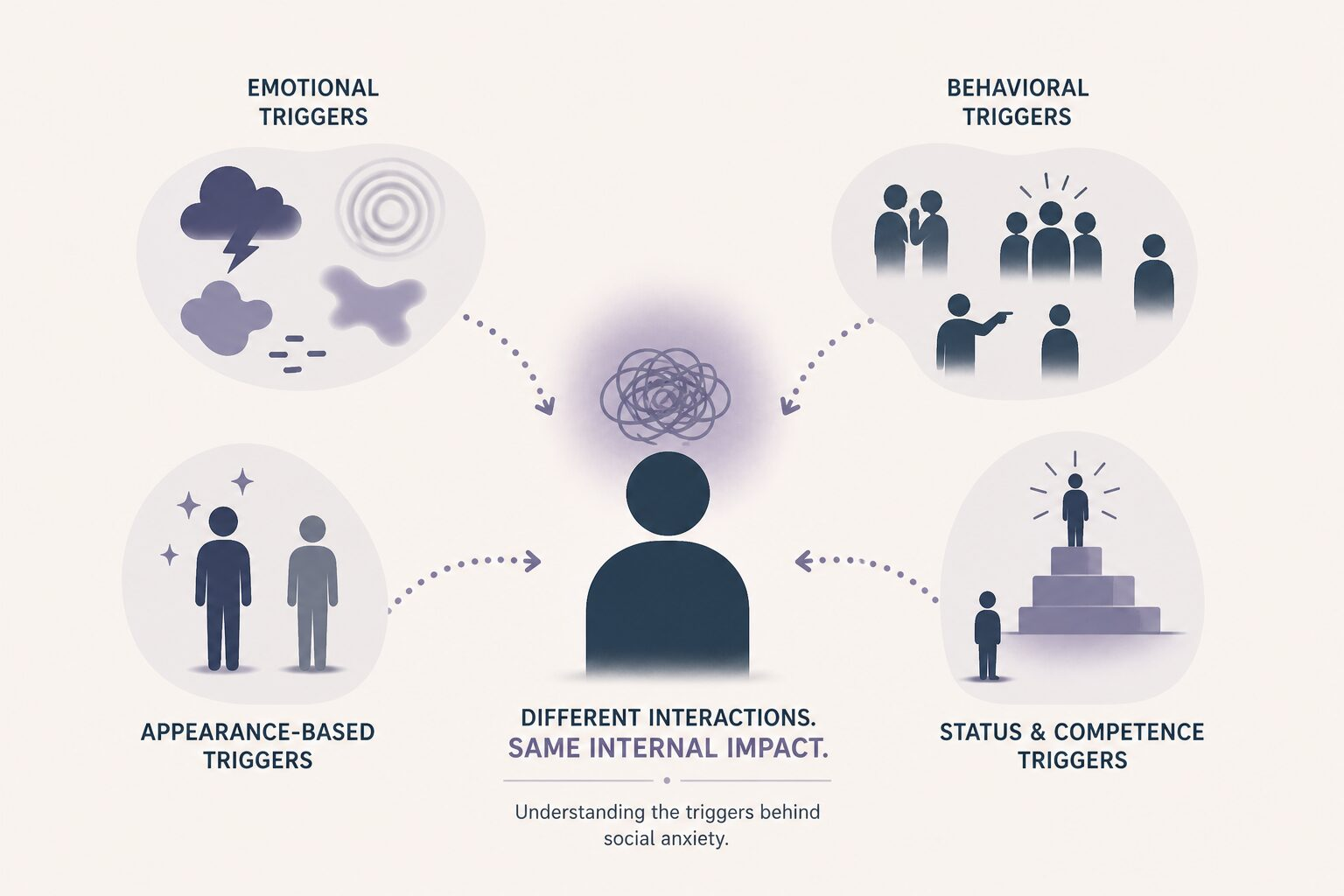
That’s what this post is about. We’ll walk through four categories of interpersonal social anxiety triggers — emotional cues, behavioral patterns, appearance-based signals, and status-driven comparisons — and look at why each one activates the threat response, and what your brain is actually responding to when it does.
If you haven’t read my post on what triggers social anxiety yet, that’s worth reading alongside this one — it covers the deeper psychological and biological roots of why these associations form in the first place.
Emotional and Energetic Cues
One of the most common interpersonal triggers is the emotional energy other people carry into a room.
The reason this can activate social anxiety is because our brains categorize emotional cues into information, and this information can remind us of past experiences that were threatening to us.
For example, let’s say when you were younger you were raised by someone who was angry when you voiced your personal opinions. Over time, your brain might learn to associate self-expression with danger, with anger becoming the trigger for those experiences. This can lead to an association where anger triggers past moments of negative experience, resulting in a threat response.

This demonstrates how, oftentimes, our anxiety isn’t rational but associational. It is our brain’s way of taking information and predicting whether or not it will lead to a certain outcome. One of the ways it does this is through classical conditioning, where we pair previous social experiences to information that reminds us of them.
I go more deeply into this in my post on situational social anxiety triggers, where I break down how the brain builds these associations over time. It’s worth reading alongside this one if you want a fuller picture of how your threat response actually works.
Down below, you will find a number of emotional cues that might trigger social anxiety. Look at them with a keen eye and try to find the ones that stand out most to you.
Examples of emotional cues that can trigger social anxiety
- Someone’s anger or frustration (might remind you of past rejection, criticism, or conflict)
- Coldness or disinterest (could trigger fear of being ignored, unimportant, or invisible)
- Loud, dominant, or overly confident energy (fear of being overpowered, dismissed, or unseen)
- Excessive enthusiasm or extroversion (could create pressure to perform or match their energy)
- Emotional inconsistency (could revive uncertainty of not knowing when connection will turn into rejection)
- Inauthenticity (feels unsafe if you’ve learned to distrust people who hide their true emotions)
- Shallowness or superficiality (might awaken fear of being unseen or unvalued for who you truly are)
- Irritation or impatience (triggers fear of being a burden or doing something wrong)
Behavioral Triggers
People’s behaviors are another powerful category of interpersonal social anxiety triggers — and in some ways the most insidious, because the behaviors that set off social anxiety are often completely neutral.
Few things activated my anxiety faster than the sound of people laughing at each other, or catching two people leaning in to gossip. It didn’t matter where I was or who they were. The moment I saw what they were doing, my brain believed they were talking about me and that I was doing something wrong.
Logically, I knew that wasn’t the case. People laugh and whisper for a thousand reasons that have nothing to do with me. But logic isn’t what’s running the show in these moments.
What’s running the show is a threat detection system that has been conditioned to treat ambiguity as danger. Like emotional cues, our brain attaches meaning to social behaviors based on past experiences. When someone acts in a way that reminds us of the way we were judged or criticized, those behaviors can automatically activate the same threat associations stored in our mind.

Over time, even neutral behaviors — a friend going quiet mid-conversation, a colleague not making eye contact, someone glancing away while you’re talking — can accumulate into evidence of something wrong. Not because anything is actually wrong, but because our brain connects those behaviors to older experiences of real rejection, exclusion, and criticism.
Once those associations are built, the behavior doesn’t need to be hostile to feel threatening. It just needs to resemble something that once was.
Common behavioral triggers include
- People laughing, whispering, or glancing around while you’re nearby
- Someone interrupting, talking over you, or ignoring what you said
- People bragging, showing off, or name-dropping
- Others effortlessly connecting or joking in groups
- Someone correcting or criticizing you in front of others
- Being excluded from a conversation or activity
- Someone dominating a discussion or taking control of the space
- Watching others receive praise, recognition, or admiration
- People showing impatience, sighing, or rolling their eyes
- Someone making inside jokes or referencing experiences you’re not part of
- People openly disagreeing or challenging your opinion
Appearance-Based Triggers
Visual cues are perhaps the most overlooked category of interpersonal triggers — and also the one people feel most uncomfortable admitting to.
It can feel strange, even shameful, to acknowledge that the way someone looks activates your anxiety. But it’s worth understanding why it happens before judging yourself for it. It isn’t really about the person in front of you. It’s about what your brain has learned to associate with certain visual signals over time.
Think about it through a conditioning framework. If you spent years in an environment where a certain type of person — confident, well-dressed, part of a particular social group — consistently made you feel excluded, inferior, or unsafe, your brain filed that as threatening information.
It built an association between those visual qualities and the emotional experience that followed them. Because of this, encountering someone who carries those same qualities triggers the same internal response — not because that person has done anything wrong, but because they resemble someone who once did.
Here are some of the visual cues that most commonly trigger social anxiety — and as with the other lists in this post, the value is in noticing which ones resonate with your own experience rather than assuming they all will:
Here are some appearance-based triggers
- Age (feeling inferior to older or more experienced people, or insecure around younger confident ones)
- Gender or sexuality (especially if you’ve faced judgment or exclusion from that group before)
- Physical attractiveness (could trigger feelings of comparison or inadequacy)
- Nationality or ethnic background (if you’ve experienced prejudice or felt different growing up)
- Fashion style (can evoke feelings of exclusion from a group)
These visual cues serve as implicit reminders for how safe or judged we feel in social situations. Even subtle details, like someone’s fashion style, can remind us of past social danger.

Acknowledging these hidden (often overlooked) cues from our mind is important, because it reveals an important principle of social anxiety: much of the anxiety we feel isn’t based in rational thought but on a set of associations our brain has built over time.
If you would like more information on how to identify these hidden associations and learn to combat them using informative psychological practices, feel free to sign up for my newsletter. Every week, you will receive social anxiety insights and mental health strategies delivered straight to your inbox. It would be great to have you on board.
Status and Competence Triggers
The final category of interpersonal triggers are the qualities we envy in other people. This can a sneaky one, because it doesn’t necessarily mean we view other people as direct threats. Rather, they trigger something from within that makes us insecure about our future.
Observing others who embody qualities we wish we could have triggers deep feelings of anxiety about our future — will I ever be accepted? Will I always be alone? How do I compare to everyone else?

Status and competence triggers arise when other people represent the qualities you feel you lack or might never have. Here is a list of status cues that could trigger social anxiety…
Common status and competence triggers
- Someone’s intelligence or education
- Career success or financial stability
- Charisma, social fluency, or popularity
- Calmness or confidence in social situations
- Leadership roles or authority
- Public speaking or presentation skills
- Ability to network or connect effortlessly
- Influence over others’ opinions or decisions
- Recognition from peers or social groups
- Problem-solving ability under pressure
- Creativity or talent in areas you value
- Reputation for being competent or reliable
For me, one of the most difficult parts of living with social anxiety was the constant social comparison. I used to always hyper-analyze my peers, measuring myself against their best qualities instead of recognizing that everyone has flaws — and that the people who truly mattered accepted me for mine.
But when I recognized these triggers for what they were — conditioned responses to a distorted comparison, not accurate verdicts of my worth — I saw that my anxiety mattered far less than I thought.
Over time, this process of self-awareness –> challenge –> change became the foundation for my recovery from social anxiety. I didn’t eliminate the triggers directly, but I transformed the way I interpreted them indirectly.
Next Steps: Understanding Your Interpersonal Social Anxiety Triggers
The people who surround you are not your enemies.
That sounds simple in theory. But when you’re living with social anxiety, it doesn’t feel that way. It feels like the world is full of people who are judging and comparing you. It feels personal — because the fear is personal.
But here’s what interpersonal social anxiety triggers teaches us: the people in front of you aren’t the source of the threat. They’re the reminder of it. Somewhere in your past, there were people who actually were threatening. Over time, your brain has built associations around those experiences — and now it applies them, automatically and indiscriminately, to anyone who carries even a faint echo of them.
This deeply matters for your recovery. Because if the threat truly was the person, there’s no solution except avoidance. But if the threat is an old association your brain built around a past experience — that’s something that can be understood, questioned, and changed.
You’re not afraid of people. You’re afraid of what people once made you feel. And those are two very different things.
If this post resonated with you, I’d love to hear which triggers feel most familiar in the comments below.
For a deeper look at how these associations form in the first place, my post on internal social anxiety triggers picks up where this one leaves off — it gets into the thought patterns and beliefs that keep the anxiety loop running long after the original experiences are gone.
For weekly writing on social anxiety and what recovery actually looks like, join the newsletter here

Hi, I’m Blake Baretz, the creator of Social Anxiety Haven. I write about my personal journey with social anxiety and share research-backed strategies to help others navigate it. If you’d like more encouragement and resources, join my weekly newsletter.

Leave a Reply