If you have social anxiety, you already know that it doesn’t confine itself to one type of situation.
It shows up in the obvious places — presentations, job interviews, crowded rooms. But it also shows up when you go home, in a text message you’ve been staring at for twenty minutes, in a conversation with someone you’ve known for years. Sometimes it shows up before anything has even happened, already running when you open your eyes in the morning.
But the most disorienting part isn’t the anxiety itself. It’s not knowing where it’s coming from.
When I was struggling with social anxiety, that was the part that got to me the most. My anxiety followed me everywhere — and because it was everywhere, I couldn’t understand where it was really coming from, the root behind it all.
What I didn’t realize at the time was that social anxiety primarily stems from an overactive threat response system — and that by understanding what triggers that threat response, and why, we can begin to interrupt the cycle rather than just endure it.
That’s what this post is about. We’ll cover what triggers actually are, how your brain and body process them, why they can feel completely irrational, and how to start identifying the specific patterns driving your anxiety.
What Triggers Social Anxiety?
To understand why social anxiety works the way it does, it helps to start with a basic definition of what a trigger actually is.
In psychology, a trigger is any piece of sensory information — something you see, hear, feel, think, or sense in your body — that provokes an emotional response from your brain. We tend to associate triggers with negative experiences like trauma or criticism, but they can also be linked to neutral or even positive events. A song that brings back a memory. A smell that transports you somewhere. The brain doesn’t only file painful associations — it files all of them.

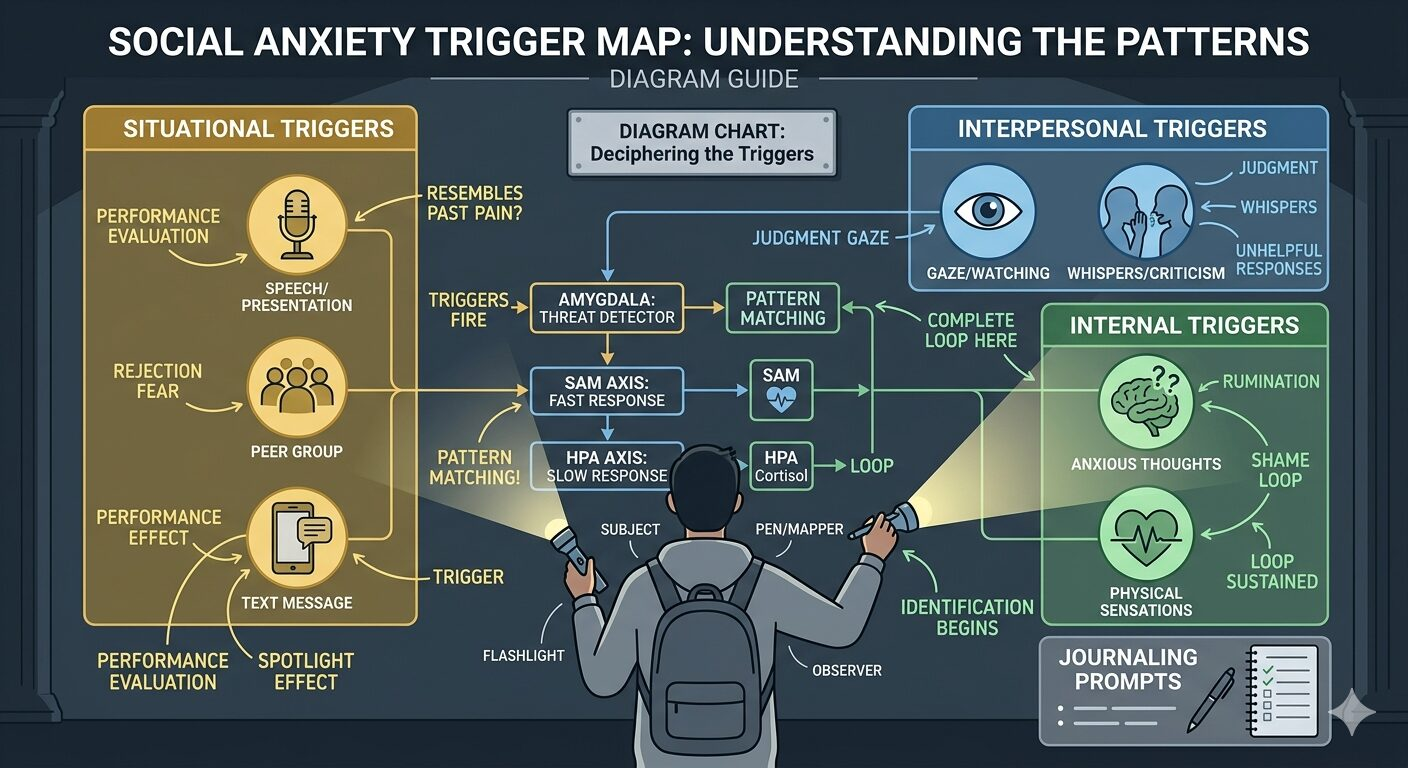
In the context of social anxiety, triggers are specifically pieces of information that activate your social threat response system. When that system is activated, your brain’s fight-or-flight response kicks in — flooding your body with stress hormones, narrowing your attention onto the perceived threat, and causing you to think and behave in ways that can feel completely irrational in social settings.
At the root of all these triggers is one underlying fear: that social exposure will lead to humiliation, criticism, or rejection. Not every trigger looks the same on the surface — some are situations, some are other people, some are thoughts and sensations firing from within. But underneath all of them is the same core belief that being seen, evaluated, or truly known by other people is dangerous and will lead to punishment. The triggers are just the different entry points into that fear.
The reason this happens isn’t because something is wrong with your brain. It’s actually doing exactly what it was designed to do — protecting you from perceived danger. The problem in social anxiety isn’t the protection mechanism itself. It’s that the mechanism has been calibrated too sensitively, firing in situations that don’t actually warrant it, based on associations that were built in a different time and a different context.
Understanding what activates that system — and why — is the foundation of everything else in this post.
How Social Anxiety Triggers Work Inside the Mind
When a trigger fires, the response doesn’t start with a conscious thought. It starts deep in the brain, before you’ve had a chance to assess the situation and logic has any say in the matter.
Here’s what’s actually happening.
The Amygdala: Your Brain’s Threat Detector
At the center of your brain’s fear response sits the amygdala — a small, almond-shaped structure whose primary job is to scan your environment for danger and prepare your body for threat when it finds something that matches a threatening pattern.
The amygdala doesn’t rationally judge situations. It pattern-matches. It takes the information coming in from your senses — what you see, hear, feel, and sense in your body — and runs it against a library of past experiences. If the current situation resembles something that was previously associated with pain or danger, the amygdala fires a threat signal instantly, triggering a cascade of biological responses.

This is why social anxiety feels so immediate and difficult to control. By the time your conscious mind has registered what’s happening, your amygdala has already made its assessment and set the response in motion. You don’t decide to feel anxious. The amygdala normally fires first — and the anxiety follows.
In social anxiety, the amygdala has been conditioned — through years of painful social experiences — to treat a wide range of social information as threatening. A shift in someone’s tone. A moment of silence in a conversation. Walking into a room full of people. None of these things are objectively dangerous. But the amygdala doesn’t evaluate objective danger. It evaluates resemblance to past danger.
Once this association is deeply enough established, even the faintest echo of the original experience is enough to trigger your mind’s alarm system.
The SAM Axis: The Fast Response
The moment the amygdala fires, it sends an immediate signal through the Sympathetic-Adrenal-Medullary axis — the SAM axis — which activates within seconds.
The hypothalamus signals the adrenal glands to release adrenaline and noradrenaline into the bloodstream. Within moments your heart rate increases, your breathing quickens, your muscles tense, and your attention narrows onto the perceived threat. Blood flow shifts away from digestion and toward the muscles. Your body is preparing to fight, flee, or freeze.

This is the physical experience of a trigger hitting. The racing heart, the tight chest, the sudden flood of self-consciousness — these aren’t signs that your brain is malfunctioning. They’re your SAM axis doing exactly what it’s supposed to do.
For someone with social anxiety, the SAM axis has become hypersensitive. It activates in situations where there’s no real danger at all, treating social uncertainty the way a healthy nervous system would treat genuine physical threat.
The HPA Axis: The Slow Response
After the initial SAM axis surge begins to fade, a second, slower system takes over: the Hypothalamic-Pituitary-Adrenal axis — the HPA axis.
The hypothalamus releases a hormone called CRH, which signals the pituitary gland to release ACTH into the bloodstream. ACTH then travels to the adrenal cortex, which releases cortisol — the body’s primary stress hormone. Where the SAM axis fires in seconds, the HPA axis unfolds over minutes and hours, sustaining alertness and vigilance long after the initial adrenaline rush has faded.

In a healthy system, cortisol levels drop once the brain perceives safety again. The threat passes, the body returns to baseline, and the stress response completes its cycle.
But in chronic social anxiety, that signal never fully arrives. Because triggers for social anxiety are everywhere — in conversations, in thoughts, in physical sensations — the brain rarely gets a clear message that it’s safe to stand down. The HPA axis stays activated. Cortisol levels remain elevated.
And over time, this chronic activation creates a new problem: the stress receptors in the body begin to lose sensitivity, making the system less efficient and harder to shut down. The body adjusts to a new baseline of tension and hypervigilance — one where even mild social situations can feel overwhelming because the nervous system is already running close to capacity.
This is why social anxiety can feel so exhausting even on days when nothing particularly difficult happens. It isn’t just the individual triggers that drain you. It’s the chronic state of activation underneath them — a body that never fully comes down from the last alarm before the next one fires.
The Loop
What makes this system so difficult to escape is that the amygdala, SAM axis, and HPA axis don’t just respond to external triggers. They respond to internal ones too — the thoughts, emotions, and physical sensations that the anxiety itself produces. The racing heart becomes evidence of threat. The self-critical thought deepens the cortisol response. The physical tension reminds the amygdala of past pain.
This is the mechanism underneath social anxiety. A biological feedback loop that was built to protect you — and has been running for too long in situations that don’t require it.
Understanding this loop is the first step toward interrupting it.
The Three Types of Social Anxiety Triggers
Now that you understand the mechanism — how the amygdala fires, how the SAM and HPA axes respond, and how the loop sustains itself — it helps to understand the specific categories of information that tend to activate that system in social anxiety.
There are three main types: external situational triggers, external interpersonal triggers, and internal triggers. Most people with social anxiety are affected by all three, though the specific triggers within each category vary from person to person depending on their history and the associations their brain has built over time.
Situational Triggers
Situational triggers are specific environments or social setups that your brain has learned to associate with threat. They aren’t about what any particular person does — they’re about the setting itself becoming a conditioned warning signal.
Common situational triggers include performance settings like public speaking or presentations, professional and academic environments where your competence is visible and open to evaluation, one-on-one conversations where there’s nowhere to redirect attention, large group settings where the fear shifts from judgment to public humiliation, and emotionally intimate relationships where being truly known feels like the ultimate risk.
What makes situational triggers particularly disorienting is that they can fire before anything has actually happened. You walk into the room and your fear activates — not because of anything anyone has said or done, but because the room itself matches a pattern your brain has learned to treat as dangerous.
I go much deeper into each of these categories in my dedicated post on situational social anxiety triggers.
Interpersonal Triggers
Interpersonal triggers are the specific qualities, behaviors, and characteristics of other people that activate your threat response. Unlike situational triggers, which are about where you are, interpersonal triggers are about who you’re with — or more precisely, what about them your brain has learned to flag as potentially dangerous.
These fall into four main categories. Emotional cues — the energy and emotional state someone carries, like anger, coldness, or dominant confidence — can fire the alarm when they pattern-match to people who were threatening in your past.
Behavioral triggers — whispering, laughing nearby, interrupting, excluding — can activate the threat response even when no harm is intended, because the behavior resembles something that once preceded real pain.
Appearance-based triggers — the way someone looks or presents themselves — can unconsciously remind your brain of people who made you feel unsafe or inferior.
And status triggers — someone’s confidence, social fluency, or effortless connection with others — can activate deep feelings of comparison and inadequacy that feed directly into the anxiety loop.
The key insight across all four categories is the same one running through this entire post: it isn’t the person themselves that’s the threat. It’s what they remind your brain of. For a full breakdown of each category and what’s actually driving the response, my post on interpersonal social anxiety triggers covers all of this in depth.
Internal Triggers
Internal triggers are the thoughts, emotions, and physical sensations that activate and sustain social anxiety from within — independent of what’s happening around you.
This is the category most people don’t expect. We assume anxiety needs an external cause — a situation, a person, something in the environment to set it off. But one of the most important things to understand about social anxiety is that the loop can run entirely on its own fuel. A self-critical thought fires shame. Shame tightens the chest. The chest compression reminds the nervous system of past anxiety. And the whole system activates — not because of anything outside you, but because the internal signals have become triggers in their own right.
Internal triggers fall into three types. Cognitive triggers are the thought patterns that keep the loop running — rumination after interactions, anticipatory anxiety before them, the spotlight effect, perfectionism, social comparison.
Emotional triggers are the feelings your brain has learned to suppress — vulnerability, anger, pride, sadness — where even the possibility of feeling or expressing them in front of others fires the threat response.
And physiological triggers are the body sensations themselves — the racing heart, the chest compression, the blushing — that have become so associated with the anxiety loop that they can initiate it independently, without any external prompt at all.
For a full exploration of how internal triggers work and why they can sustain anxiety even when you’re completely alone, my post on internal social anxiety triggers goes into all three categories in depth.
How to Identify Your Social Anxiety Triggers
When you’re living with social anxiety, the amount of triggers you experience can feel endless. Everywhere you look, everywhere you go, the anxiety is always there — and because it’s everywhere, it starts to feel like fighting it is impossible.
But what I found — and what research consistently supports — is that the act of identifying and naming your triggers is itself one of the most powerful things you can do. Not because naming them makes them disappear directly. But because it transforms them from a shapeless, overwhelming force into something concrete and specific that you can begin to work with.

When my anxiety felt like it was everywhere, it was partly because I had never stopped to map it. Everything felt threatening because I hadn’t yet learned to distinguish between the situations that genuinely activated my worst responses and the ones that were simply uncomfortable. Once I started writing it down, the anxiety started to feel like something I could manage and deal with.
The most effective tool for this process is journaling. Writing brings unconscious reactions into conscious awareness — which is where real change begins. You don’t need to analyze or fix anything at first. Just describe what happened and how it felt. The patterns will start to reveal themselves over time.
Here are some prompts to help you start:
- “What situations make me feel the most self-conscious or tense?”
- “What thoughts usually run through my mind before, during, and after these situations?”
- “What sensations do I notice in my body when I feel watched or judged?”
- “When do I tend to compare myself to others, and how does that affect my behavior?”
- “What do I usually do to feel safe in these moments — avoidance, silence, over-explaining, humor?”
As you write, look for recurring patterns — specific thoughts, feelings, or behaviors that tend to appear before or after your anxiety spikes. You might notice your anxiety rises most around authority figures, unfamiliar groups, or moments when you feel evaluated. These patterns are your personal trigger map — and building that map is the foundation of everything that comes next in recovery.
It can also be genuinely useful to explore these insights with a therapist, particularly one trained in cognitive behavioral therapy or exposure-based approaches. A therapist can help you spot blind spots, interpret what you discover in your journal, and safely explore the fears underneath your triggers.
Moving Forward
When I was struggling with social anxiety, the most overwhelming part wasn’t any single trigger. It was not knowing where the anxiety was coming from.
Waking up every morning already anxious, already stuck in my thoughts, with no clear explanation for why — that uncertainty was its own kind of suffering. Because when you can’t name something, you can’t work with it.
What this post has tried to give you is a name for it.
Your triggers aren’t random. They are the output of a threat response system that was built from real experiences of real pain — one that learned through years of reinforcement to treat a wide range of social situations as dangerous.
Once you realize this, the anxiety stops being a mysterious force that ambushes you without warning and starts being a process — one with a history, a logic, and a set of specific patterns that can be identified, mapped, and over time, interrupted.
If this post resonated with you, I’d love to hear your experience in the comments below — which triggers feel most familiar, or what shifted for you in reading this.
For deeper dives into each trigger category, my posts on situational triggers, interpersonal triggers, and internal triggers pick up exactly where this one leaves off.
For weekly writing on social anxiety and what recovery actually looks like from the inside, join the newsletter here.

Hi, I’m Blake Baretz, the creator of Social Anxiety Haven. I write about my personal journey with social anxiety and share research-backed strategies to help others navigate it. If you’d like more encouragement and resources, join my weekly newsletter.
Leave a Reply