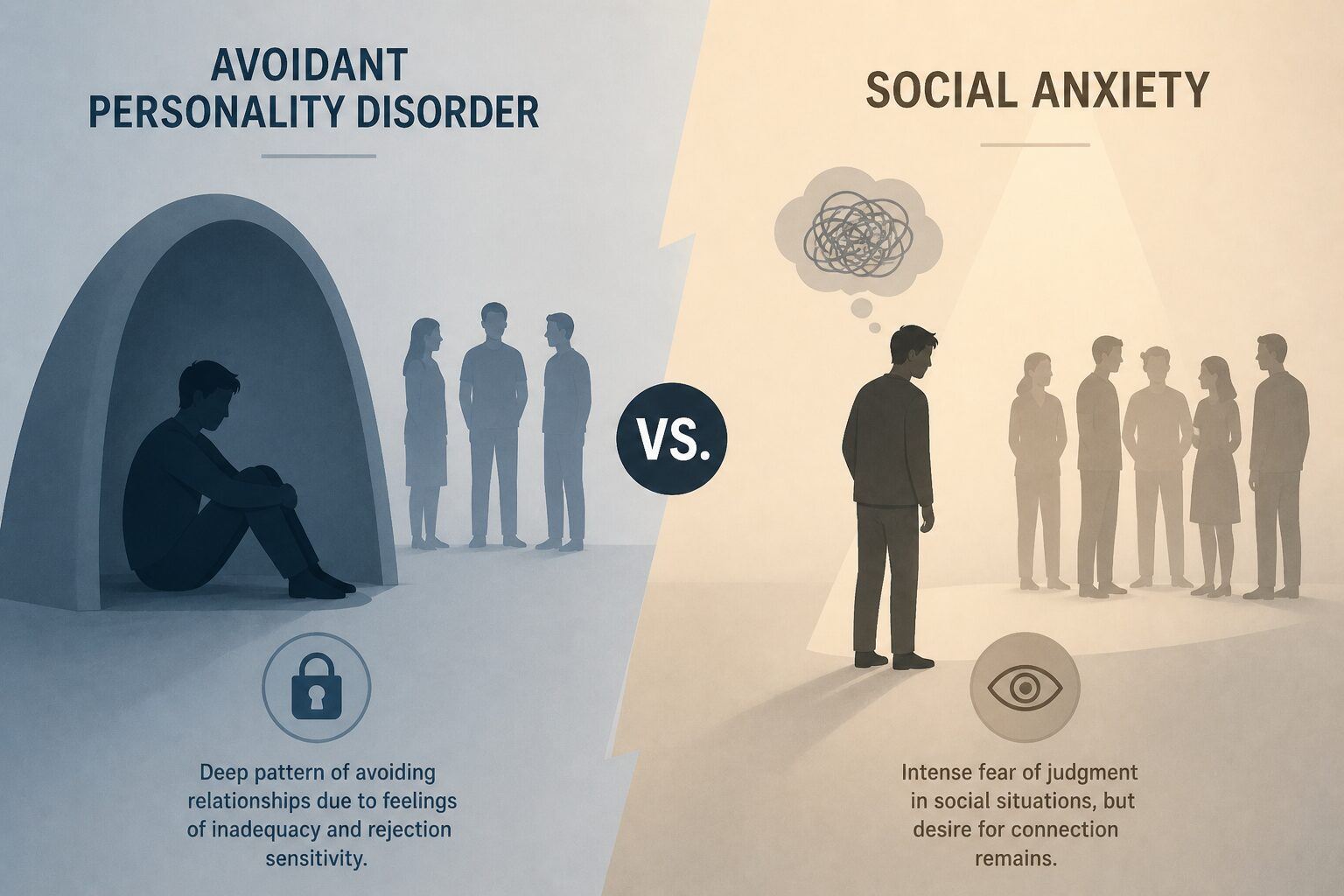
There’s a question that sits underneath the experience of social anxiety — one that quietly transforms how the condition is understood:
What if this isn’t something I have, but something I am?
Someone with social anxiety might feel incapable, but it doesn’t mean that they’ve always felt that way. They might believe that they are flawed, but they still have hope that they can recover.
This is what separates social anxiety disorder from avoidant personality disorder. It’s not about the symptoms themselves (which often look nearly identical from the outside); it’s about the relationship the symptoms have with your sense of self.
In social anxiety disorder, the symptoms you feel are largely ego-dystonic. The anxiety feels unwanted, like something happening to you that you want to go away. Avoidant personality disorder, on the other hand, is ego-syntonic. The avoidance feels like you — like a natural expression of who you are rather than a condition imposing itself on your life.
This distinction is a bedrock principle that will carry you through everything in this post. And by the end of it, you’ll understand not just how these two conditions differ, but which pattern is more likely driving what you’re experiencing — and why, in either case, change is more possible than it probably feels right now.
What Avoidant Personality Disorder (AvPD) Is
If you’ve read my posts on the DSM-5 and ICD-10, you already have a clear picture of what social anxiety disorder is. So rather than covering that ground again, let’s go straight to the condition that’s less understood — and more feared.
Avoidant personality disorder is not an anxiety disorder. It’s a personality disorder. Where social anxiety disorder is characterized primarily by fear in social situations, AvPD is characterized by something that runs deeper: an ingrained, pervasive belief that you are fundamentally defective, inferior, or unworthy of genuine connection.

The difference between the two becomes clearer when we look at the internal dialogue. SAD says, “I’m afraid people might judge me.” AvPD says, “People will reject me because of who I am.”
This shift from fear of what might happen to an ingrained negative belief about the self is what makes AvPD feel so different from the inside. It isn’t just that social situations feel threatening. It’s that the threat feels like confirmation of something you already know to be true about yourself.
Because AvPD is a personality disorder rather than an anxiety disorder, it tends to be more pervasive and more deeply woven into daily life. It doesn’t show up in specific situations — it shapes how a person moves through every relationship, opportunity, or moment where connection or visibility is possible. And because the avoidance feels ego-syntonic — like a natural expression of who you are rather than something imposed on you — you don’t feel like it’s confrontable. Why would you try to change something that feels like you?
That’s the central tragedy of AvPD. And it’s also the most important reason to understand it clearly.
Avoidant Personality Disorder vs. Social Anxiety: Comorbidity
Before we get into the differences, it’s worth acknowledging there is an overlap between the two conditions.
Research consistently shows that AvPD has one of the highest comorbidity rates with social anxiety disorder of any two conditions in the DSM. In other words, having one significantly increases the likelihood of having the other. And when both are present at the same time, the experience tends to be more intense, more identity-based, and more resistant to the kind of gradual exposure work that helps SAD on its own.
Here’s what that combination tends to look like in practice.
1. Chronic, pervasive shame
A person with SAD and AvPD oftentimes carries a core belief that something is fundamentally wrong with them. What this means is they separate the “good” parts of themselves from the “bad” parts of themselves.
There is a chasm inside of their identity that limits them from fully experiencing reality. Take, for example, making friends. People with avoidant personality disorder might rationalize to themselves that other people couldn’t possibly like them because “it’s only a matter of time before they see who I really am.” This justifies within them that friends are to be avoided, or that they shouldn’t have friends at all.
For people with social anxiety, however, these thoughts cause intense levels of anxiety. They want to make friends with other people, but because of their embedded beliefs that they are flawed, only the “good” side of them can fully experience the love and companionship of relationships.
2. Identity-level wounds
For someone with SAD alone, the anxiety feels like a problem they have. For someone with both conditions, it starts to feel like a reflection of who they are.
People with comorbid conditions might claim:
- “I am a socially anxious person”
- “I’m incapable of change”
- “I’m an unlikable person”
- “Friends are not for me”
Because they associate their anxiety with who they are, people with SAD and AvPD can struggle for years. To them, recovery isn’t just about overcoming a simple fear: it is about reshaping and transforming the perception of their very identity.
3. Extreme avoidance that has shaped your entire life
Most people with social anxiety avoid specific situations. People with SAD and AvPD often have avoidance as a defining feature of their biography — something that has shaped their relationships, career, and social history from early adulthood onward.
Here are classic examples of avoidance taking form in a person’s life:
- Avoiding friendships (not going out with friends because its too overwhelming)
- Avoiding romantic relationships (refusing to see a movie with your loved one because you have “too much work”)
- Avoiding opportunities at school or work
- Avoiding visibility, leadership, or anything that risks criticism
But it isn’t necessarily the avoidance that is so important–it is the reason why it exists internally. While many people with social anxiety associate avoidance with social withdrawal, avoidance (particularly for those with AvPD) can show up emotionally in the form of self-suppression, or the deliberate suppression of who you are out of fear of rejection.
Self-suppression can show up in many ways, including:
- Avoiding intimate situations and uncomfortable conversations to avoid feelings of rejection
- Hiding your emotions, even positive ones, to prevent drawing attention or criticism
- Pretending to share interests or opinions you don’t actually hold in order to fit in
- Silencing yourself in conversations, meetings, or social gatherings, even when you have something meaningful to contribute
For me, self-suppression was everything in sustaining my anxiety. Instead of simply withdrawing from social situations, my brain was sneaky.
It would tell me that I couldn’t say what I wanted to say to other people because it might expose parts of myself that needed to stay hidden. It would tell me that I shouldn’t be who I truly was because internally, there must have been something wrong.
It’s reasons like this that explain why people with social anxiety can be surrounded by people and still feel lonely. There’s an element of self-suppression involved that makes expressing your authentic opinion feel unbearable.
If this is resonating with you and you want to go deeper on the shame and identity side of social anxiety recovery, join the newsletter here — it’s what I write about most, because it was the hardest and most important part of my own recovery.
4. An extreme, chronic difficulty forming or maintaining relationships
Most people who have SAD and AvPD either have never had close friends in their life or have a significant difficulty in making them. This isn’t because of some deficit they are born with: they simply don’t have the experience.
Making friends is like any skill in life: it takes practice and vulnerability. And because people with AvPD tend to be so withdrawn, this can feel like a huge uphill battle. For them, it feels like “why should I open myself up around other people when all my life no one has done the same for me?”
The result is a self-fulfilling prophecy: because they avoid being vulnerable, they never give others the chance to reciprocate closeness or build trust, which makes them distance themselves from people even more.
Understanding these patterns is crucial because the emotional experience of someone with both SAD and AvPD can be significantly more intense, identity-based, and chronic than either condition alone.
Avoidant Personality Disorder vs. Social Anxiety: a DSM-5 Perspective
Now that we’ve covered where SAD and AvPD overlap, it’s worth understanding where they diverge — because the differences are what determine what recovery actually looks like for you.
The DSM-5 gives us the clearest framework for this. I covered the full DSM-5 criteria for social anxiety disorder in my post what is social anxiety disorder: a DSM-5 perspective, so I won’t repeat that here. What’s more useful for this comparison is understanding what the AvPD criteria look like — and what they reveal about the differences between the two conditions.

To receive an AvPD diagnosis, the DSM-5 requires a person to meet four or more of the following criteria:
- Avoids occupational activities involving significant interpersonal contact due to fears of criticism, disapproval, or rejection
- Unwilling to get involved with people unless certain of being liked
- Shows restraint in intimate relationships because of fear of shame or ridicule
- Preoccupied with being criticized or rejected in social situations
- Inhibited in new interpersonal situations due to feelings of inadequacy
- Views self as socially inept, personally unappealing, or inferior to others
- Reluctant to take personal risks or engage in new activities due to potential embarrassment
Reading those criteria alongside the SAD criteria, the surface similarities are obvious. Avoidance. Fear of judgment. Sensitivity to rejection. But look at the language more carefully and the difference becomes clear.
The SAD criteria describe a fear of what might happen. The AvPD criteria describe a belief about who you are.
That’s the ego-dystonic versus ego-syntonic distinction from the intro playing out in clinical language. SAD is organized around fear — an unwanted emotional response to social threat. AvPD is organized around identity — a settled, pervasive sense of personal inadequacy that avoidance feels like a natural response to.
Three other differences are worth naming directly.
- Scope. In SAD, avoidance tends to be situational — triggered by specific social or performance contexts. In AvPD, avoidance is pervasive, touching nearly all social, occupational, and intimate interactions regardless of the specific context.
- Chronicity. SAD can fluctuate over time, sometimes easing with experience, therapy, or changes in circumstances. AvPD symptoms are chronic, typically traceable to early adulthood, and deeply linked to personality structure rather than situational triggers.
- Core psychology. SAD centers on fear of negative evaluation in specific situations. AvPD involves a global sense of inadequacy — the belief that you are fundamentally unworthy of connection — that persists across every relationship and every context, regardless of how those interactions actually go.
In short: SAD is something that happens to you in certain situations. AvPD is something that shapes how you show up everywhere.
Which One Are You? Avoidant Personality Disorder vs. Social Anxiety
By this point, you should have a clear picture of both conditions. The natural next question is: which one are you actually dealing with?
The honest answer is that only a qualified mental health professional can tell you with certainty. But there are patterns worth reflecting on that can start to point you in a direction.
If your experience aligns more closely with SAD, you likely still hold onto the belief that a more confident, connected version of yourself is possible. The anxiety feels like an obstacle — painful and exhausting, but fundamentally separate from who you are. You want to overcome it. The avoidance tends to show up in specific situations rather than across your entire life. And when you imagine a version of yourself without the anxiety, that person still feels recognizable. Still feels like you.
If your experience aligns more closely with AvPD, the avoidance has likely been a defining feature of your life for as long as you can remember — not just in social situations, but in relationships, opportunities, and any context where being seen felt risky. The self-criticism isn’t situational. It’s global. And the avoidance doesn’t feel like something imposed on you. It feels like a reasonable response to the kind of person you believe yourself to be.
If you recognize yourself in both — that’s doesn’t mean something is off. As we covered in the comorbidity section, SAD and AvPD frequently coexist. Many people carry elements of both, and the balance shifts depending on context, history, and the depth of the identity wounds underneath the anxiety.
What matters most isn’t landing on the correct label. It’s understanding which pattern is driving your experience — because that is what points you toward the right kind of help. SAD tends to respond well to exposure-based approaches that gradually reduce the fear response. AvPD typically requires longer-term work focused on identity, self-worth, and the core beliefs that make avoidance feel necessary in the first place.
If you want to go deeper on self-assessment, my post on do I have social anxiety walks through the most useful tools available and how to interpret what they tell you.
Moving Forward
Let’s come back to the question from the beginning of this post.
What if this isn’t something I have, but something I am?
Here’s what I want you to take away from this post: even if the answer feels like the latter right now, that doesn’t mean it’s permanent. Personality disorders are not life sentences. Identity wounds, no matter how deep, are not fixed points. The belief that you are fundamentally unworthy of connection is a belief, not a fact. And beliefs, unlike facts, can change.
The difference between SAD and AvPD matters for treatment. But it doesn’t change the most important thing: both conditions are treatable. People recover from both. The version of you that sits underneath the endless anxiety and avoidance is still there. It hasn’t gone anywhere.
And understanding which pattern fits your experience is the first step toward finding the right path back to it.
If this post resonated with you and you want honest, experience-driven writing on what recovery actually looks like, join the newsletter here — I write about the identity side of social anxiety every week because it was the most important part of my own recovery.
And if you’re somewhere in the middle of figuring out which of these fits — or if reading this stirred something you haven’t had words for before — leave a comment below. I read every single one. Sometimes putting it into words for the first time is the thing that starts to move it.

Hi, I’m Blake Baretz, the creator of Social Anxiety Haven. I write about my personal journey with social anxiety and share research-backed strategies to help others navigate it. If you’d like more encouragement and resources, join my weekly newsletter.
Leave a Reply