To most people on the outside, social anxiety looks like shyness.
At best, it reads as someone who is quiet, reserved, maybe a little withdrawn. At it’s worst, people might read it as someone who is cold. Disinterested. Rude. The person who doesn’t make eye contact, who gives short answers, who leaves early or doesn’t show up at all. From the outside, none of that looks like fear. It just looks like someone who doesn’t particularly want to be there.
What’s invisible to everyone else is what’s actually happening on the inside. The excruciating pain before you even walk through the door. The constant mental rehearsal of every possible thing you might say. The hyperawareness of every expression, pause, flicker of reaction from the people around you. The exhaustion of managing all of that while also trying to appear normal — while trying to look like someone who is kind, friendly, and open.
For a long time, the invisibility of the pain behind social anxiety was a key reason it went so unrecognized. If the suffering doesn’t show, it’s easy to dismiss.
But in 1987, a researcher by the name of Dr. Michael Liebowitz set out to solve this problem when he created the Liebowitz Social Anxiety Scale. The LSAS was built on a simple but important premise: that social anxiety has verifiable, recognizable patterns — both in how it feels on the inside and how it shapes behavior on the outside — and that those patterns can be measured. Not just the fear, but the avoidance that follows it. Not just what happens internally when a social situation is entered, but how deeply that fear has reorganized a person’s life over time.
In this post, we’ll walk through what the LSAS is actually measuring, why it separates fear and avoidance, what its limitations are, and how to use it as a tool for clarity rather than a verdict on who you are.
What the Liebowitz Social Anxiety Scale Is and How It Was Developed
In 1987, social anxiety disorder was not yet widely recognized as a distinct clinical condition. People who carried it were routinely mischaracterized — labeled as shy, introverted, or avoidant without any deeper investigation into what was actually driving their behavior. The internal experience of social anxiety — the fear, the self-consciousness, the exhausting hypervigilance — was largely invisible to the clinicians treating them.
Dr. Michael Liebowitz recognized this as a serious problem. Not just for research, but for the people sitting across from him in clinical practice who were suffering in ways that weren’t being seen or measured. He understood that social anxiety’s invisibility wasn’t incidental — it was structural. Unlike panic disorder or OCD, there are often no obvious external markers of distress. Someone with severe social anxiety can appear completely calm and composed while their internal experience is one of near-constant threat.
Liebowitz’s solution was to build a scale that translated that invisible internal experience into measurable, observable patterns.
The result was the LSAS — a 24-item scale covering social interaction situations and performance situations, each rated on two dimensions: how much fear the situation triggers, and how often the situation is avoided. This two-dimensional structure was was Liebowitz’s way of insisting that social anxiety is both a psychological experience and a behavioral pattern — and that understanding it properly requires measuring both.
What Liebowitz created, in other words, was the first tool that took the invisibility of social anxiety seriously. That said — this is what makes the LSAS worth understanding clearly, both in terms of what it can tell you and what it can’t.
If you want weekly writing on how social anxiety operates beneath the surface and what recovery actually looks like, join the newsletter here — it’s where I go deeper on everything this blog covers.
How the Liebowitz Social Anxiety Scale Measures Social Anxiety
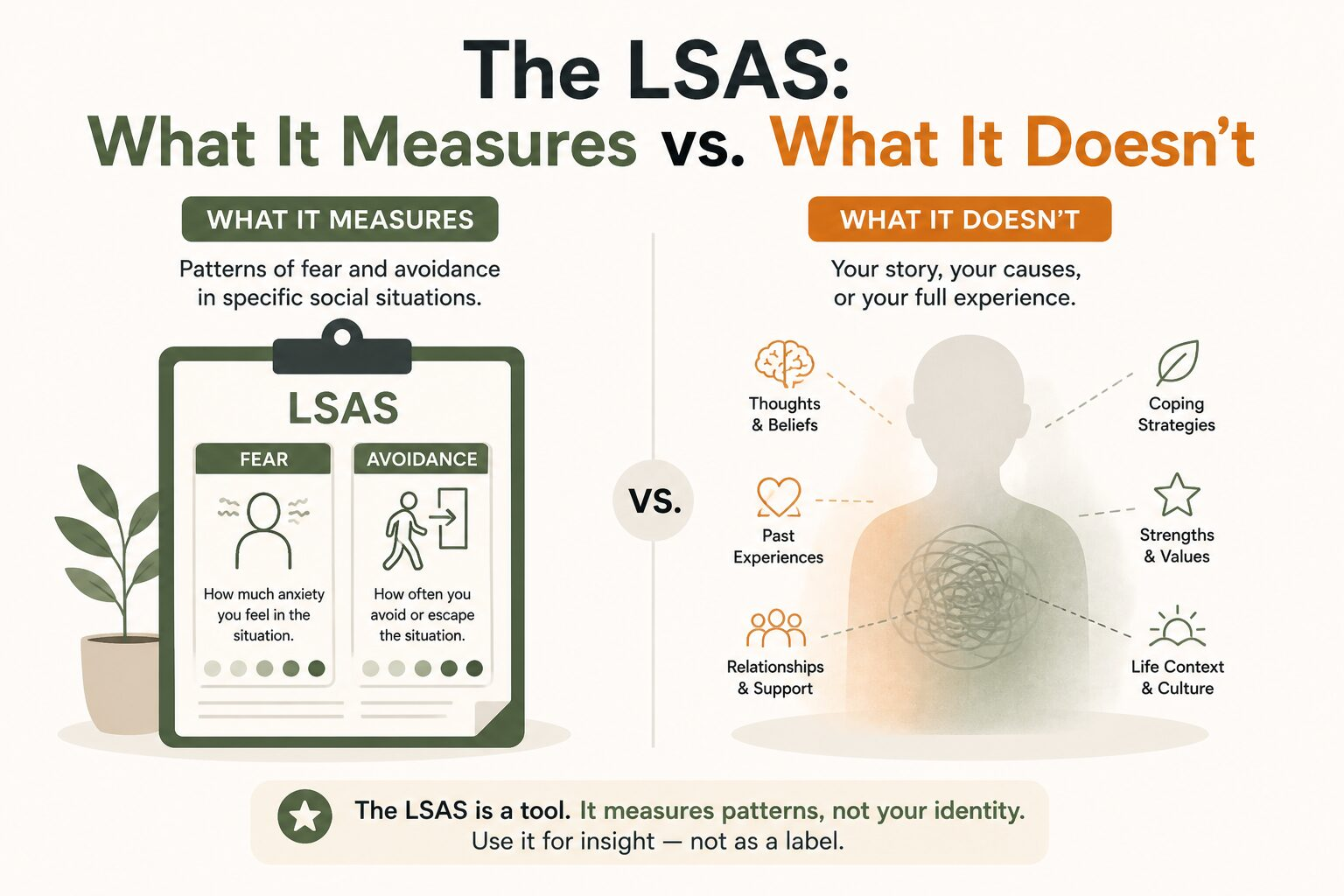
The LSAS measures social anxiety along two distinct dimensions: fear and avoidance. Understanding why Liebowitz separated them is what makes the scale genuinely useful rather than just another anxiety checklist.
Fear reflects what happens internally when a social situation is anticipated or entered. It captures the intensity of anxiety, self-consciousness, and distress that arises in the moment — the reactions that are often automatic and conditioned rather than deliberate or rational.
Avoidance reflects something different — and in many ways, something more consequential. It measures how often a person changes their behavior to prevent that fear from being activated in the first place. Declining invitations. Going quiet in meetings. Choosing routes through the day that minimize social visibility.

The reason this distinction matters is that fear and avoidance don’t always move together. Someone can experience intense fear in social situations and still push through them — managing the internal experience while appearing functional on the outside. Someone else might report moderate fear but have built such extensive avoidance patterns around it that their world has quietly contracted to a fraction of what it once was. The second person’s score might not look dramatically different on fear alone. But when avoidance is measured alongside it, the picture changes completely.
This is what the LSAS captures that a simple anxiety rating scale cannot: not just how anxious someone feels, but how deeply that anxiety has reorganized their life over time.
The 24 situations on the scale are divided into two categories: social interaction situations, such as talking to people in authority, attending parties, or meeting strangers, and performance situations, such as giving a presentation, writing while being observed, or eating in public. Each is rated separately for fear and avoidance, producing a total score that gives a structured snapshot of how social anxiety is currently operating across both dimensions.
That snapshot is valuable. But it’s also limited — and understanding those limitations is just as important as understanding what the scale measures.
The Limitations of the LSAS
The LSAS is a useful tool. But it’s worth being clear about what it isn’t — because the way people tend to use it, especially when they take it alone online and receive a score without any context, can do more harm than good.
The most important limitation is this: the LSAS measures patterns, not causes. It can tell you how fear and avoidance are showing up across a range of social situations. It cannot tell you why. Two people with identical scores can have completely different internal histories — different experiences that conditioned the fear, different beliefs driving the avoidance, different recovery needs. The number tells you where you are. It doesn’t say anything about how you got there or what it will take to move.
The scale also doesn’t measure what you’ve built around the anxiety. Someone with high fear scores might have developed genuinely effective strategies for managing social situations. Someone with moderate fear scores might have organized their entire life around avoidance in ways that the scale only partially captures. The LSAS gives you a snapshot of patterns. It doesn’t measure resilience, coping capacity, or how much of your life anxiety has quietly taken from you in ways that don’t show up in a 24-item questionnaire.
There’s also a self-perception problem worth naming here too. People who are highly self-critical — and most people with social anxiety are — tend to rate themselves more severely. People who have normalized their avoidance over years may underreport it, not because they’re being dishonest but because the avoidance has become so automatic it no longer registers as something they can change.
Finally, the situations on the scale are predefined and fixed. Your most activating triggers may not appear on it. Culturally specific pressures or particular environments that derail you mentally might not be captured. What the scale measures is a standardized set of social situations — not a complete picture of any individual’s specific experience of social anxiety.

None of this makes the LSAS not worth taking. It makes it worth taking with the right frame: as a map of current patterns, not a verdict on who you are or what you’re capable of. A high score isn’t a life sentence, and a low score isn’t permission to stop paying attention. It’s information — and like all information, its value depends entirely on how thoughtfully you use it.
Taking the LSAS Online
Most people encounter the LSAS through an online self-assessment — which is a reasonable starting point, as long as you approach it with the right expectations going in.
For a reliable version of the LSAS, I’d encourage you to use the one provided by the National Social Anxiety Center. The NSAC has been offering clinical, professional support to people with social anxiety for decades — and beyond hosting a trustworthy version of the scale, their site offers educational resources, guidance on treatment options, and tools for understanding and managing the condition more broadly. If you haven’t come across their work before, it’s worth exploring.
When you take the test, a few things are worth keeping in mind. Answer based on your typical experience, not your best day or your worst.
And when you get your score — read it as a map, not a mirror. It isn’t showing you who you are. It’s showing you where your anxiety has been operating, which situations have cost you the most, and where the avoidance has accumulated.
If your score indicates significant social anxiety, the most valuable thing you can do with that information is bring it to a qualified mental health professional. Not because the number is definitive, but because a clinician can help you interpret it in context and recommend a treatment path that actually fits what you’re dealing with.
Moving Forward
Social anxiety has a way of making you feel like what you’re carrying is invisible — too internal, too difficult to explain, too easy for other people to dismiss as shyness or withdrawal.
What the LSAS represents, at its core, is the opposite of that dismissal. It’s a tool built on the premise that what you’re experiencing is real, measurable, and worth taking seriously.
That’s what makes it valuable. Not the score itself, but what the score points toward — a clearer picture of where the anxiety has been operating, which situations cost you the most, and where the work of recovery needs to focus.
A number on a scale doesn’t define you. It doesn’t tell you what you’re capable of, how far you can go, or what your life gets to look like on the other side of this. But it can tell you where you are right now. And knowing where you are is always the first step toward a meaningful recovery.
If you want honest, experience-driven writing on what that journey actually looks like from the inside, join the newsletter here — every week I write about the deeper patterns behind social anxiety and what recovery really involves, because that’s what actually moved the needle in my own experience.
And if this post helped you think about the LSAS differently — or if you’ve taken it before and the score hit harder than you expected — leave a comment below. I read every single one. You’re not as alone in this as it probably feels.

Hi, I’m Blake Baretz, the creator of Social Anxiety Haven. I write about my personal journey with social anxiety and share research-backed strategies to help others navigate it. If you’d like more encouragement and resources, join my weekly newsletter.
Leave a Reply