When I struggled with social anxiety, I remember sitting across from someone at a support group once, listening to them describe their experience living with the condition.
The way he stumbled over his words in conversations. The way he replayed interactions for days after an event. The way other people — friends, family, even a few therapists — had looked at him and questioned if he truly was experiencing social anxiety or something else entirely. They thought he had autism.
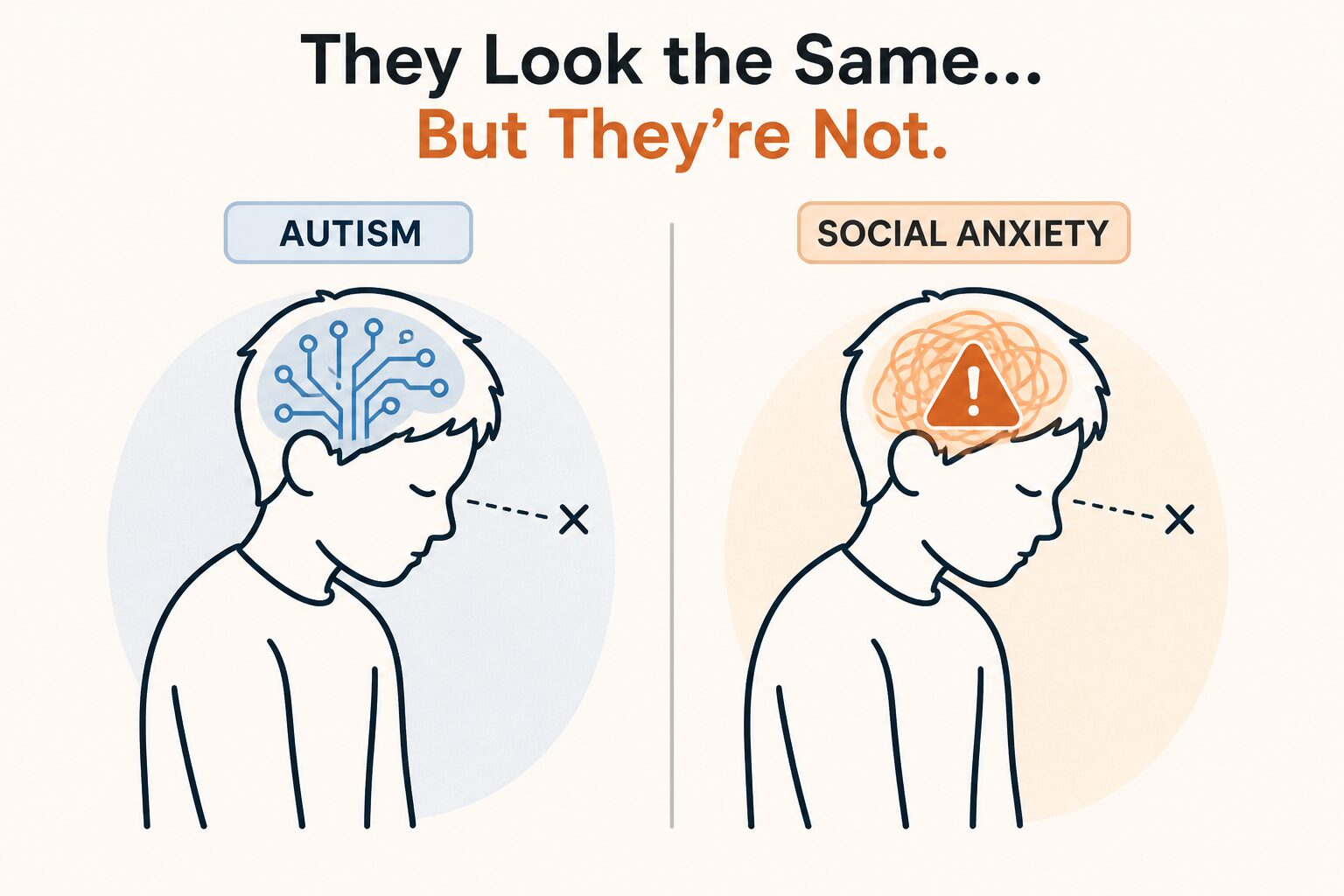
And I understood exactly why people asked that question. Because from the outside, social anxiety and autism can look almost identical.
But here’s what I’ve come to understand — and what I want to walk you through in this post. The fact that two conditions look the same on the surface doesn’t mean they are the same underneath. And knowing the difference isn’t just a matter of labeling. It changes everything about how you approach recovery.
Why They Look the Same From the Outside
Here’s the honest reason this confusion happens so often: the behaviors that show up in autism and social anxiety overlap almost completely.
Someone with autism might avoid eye contact because it feels overstimulating or socially confusing — their brain processes it differently. Someone with social anxiety, on the other hand, might avoid eye contact because they’re convinced that if they hold someone’s gaze too long, they’ll be seen as weird, judged, or rejected.
Same behavior. Completely different engine.
Someone with autism might leave a party early because unpredictable social environments are genuinely exhausting to navigate. Someone with social anxiety might leave a party early because the anxiety of being seen, evaluated, and potentially embarrassed became too overwhelming to endure.
Same behavior. Completely different engine.

This is what makes the confusion so understandable, and so important to untangle. Because if you’re trying to fix a car that won’t start, the solution depends entirely on whether the problem is the battery or the transmission. Treating one like it’s the other doesn’t just fail to help. It can actually make things worse.
If you want weekly posts on the deeper patterns behind social anxiety — what drives it, what keeps it alive, and what actually moves the needle in recovery — subscribe to my newsletter here. It’s what this blog is built around.
The Real Difference: Wiring vs. Fear
At its core, the distinction between autism and social anxiety comes down to this:
Autism is about how your brain is wired. Social anxiety is about what your brain has learned to fear.

In autism, the nervous system processes social information differently by nature. Reading facial expressions, interpreting tone of voice, adapting to unspoken social rules — these things don’t come automatically, because the brain isn’t organized in the way that makes them intuitive. This isn’t a trauma response. It isn’t something that developed because of painful experiences. It’s simply how the brain is built.
Social anxiety works from a completely different starting point. The brain is fully capable of reading social cues, but it has learned, through years of negative social experiences, to treat social situations as dangerous. A pattern of rejection, humiliation, misattunement, or criticism gets absorbed over time until the brain starts treating other people not as neutral presences, but as potential threats. The fear isn’t about processing difficulty. It’s about a deeply conditioned belief that something bad is going to happen — that you’re going to be judged, rejected, or exposed as inadequate.
I know that second experience from the inside. Walking onto my college campus felt like I was being struck by lightning. My brain wasn’t confused about what was happening socially. It was terrified of it. That distinction — confused versus terrified — is one of the clearest ways I’ve found to understand the difference between the two.
One way I’ve heard it described: imagine two people who both flinch when they hear a loud sound. The first flinches because their auditory system is hypersensitive — the sound genuinely registers as more intense for them neurologically. The second flinches because they grew up in an environment where loud sounds were always followed by something painful. Both flinch. But one is responding to how their nervous system works, and the other is responding to what they’ve been conditioned to expect.
That’s autism and social anxiety in a sentence.
What It Feels Like When You Have Both
It’s worth pausing here, because this isn’t just a theoretical exercise for a lot of people reading this.
Research shows that autistic individuals experience social anxiety at dramatically higher rates than the general population. According to the National Institute of Mental Health, social anxiety is one of the most common co-occurring conditions in autism. And it makes sense why. When your brain already finds social situations difficult to navigate, and you’ve spent years accumulating painful social experiences as a result, the conditions for developing a conditioned fear response are almost perfectly in place.
I’ve heard people with both conditions describe it as a double layer of difficulty. The first layer of difficulty is processing information — social situations that feel genuinely hard to read, predict, or navigate. The second is the fear that wraps around that challenge — the anxiety about being seen struggling, judged for the differences others notice, misunderstood or dismissed.
What makes this combination particularly exhausting isn’t the pain itself. It’s how out-of-control the pain feels. A conversation that seems minor to everyone else can leave you replaying every word for hours. An unexpected shift in someone’s tone can trigger a flood of anxiety that your brain can’t easily explain or soothe. Last-minute social plans. Unstructured group settings. Physical symptoms — shaking, blushing, a racing heart — that feel like they betray you at the worst possible moments.
Over time, that relentless loss of control can make even small social moments feel like emergencies.
But the research also points toward something hopeful: approaches that focus on self-regulation, gradual exposure to social situations, and building a clear understanding of your own specific patterns can meaningfully reduce distress over time.
What This Means for Your Recovery
Understanding which engine is driving your struggle isn’t about putting a label on yourself. It’s about knowing where to aim.
If the core issue is a processing difference — the way your brain naturally handles social information — then the most useful work involves building concrete social frameworks, reducing sensory or cognitive overload, and finding environments and relationships that accommodate how you’re wired rather than demanding you perform in ways that feel impossible.
If the core issue is learned fear — the way your brain has been conditioned to treat social situations as threatening — then the most useful work involves gradually updating that conditioned response. Building new experiences that contradict the old belief. Slowly convincing the subconscious that people are not, as a default, dangerous.
If it’s both, the work involves holding both truths at once — which is harder, but also more honest, and ultimately more useful than trying to fit yourself into one box or the other.
What I know from my own experience, and from the years I’ve spent studying and writing about this, is that the confusion between these two conditions tends to keep people stuck. They try strategies designed for one thing and wonder why they aren’t working for the other. They accept a narrative about themselves that doesn’t fully fit, and then blame themselves when the approaches built around that narrative fall short.
You deserve a more accurate map. And the first step toward building one is understanding that looking the same on the outside and being the same on the inside are two very different things.
If you’re working through your own social anxiety and want to go deeper on what’s really driving it, my post on social anxiety and shame gets into the internal engine underneath the fear — and why shame, specifically, is often what keeps the conditioned response locked in place.
If this post gave you something to think about, I’d love to hear your experience in the comments below. Whether you’re navigating social anxiety, autism, both, or still trying to figure out what you’re dealing with — your story matters here, and it might be exactly what someone else needs to read.
And if you want weekly writing on the deeper patterns of social anxiety and what recovery actually looks like from the inside, join my newsletter here. I’d love to walk this road with you.

Hi, I’m Blake Baretz, the creator of Social Anxiety Haven. I write about my personal journey with social anxiety and share research-backed strategies to help others navigate it. If you’d like more encouragement and resources, join my weekly newsletter.
Leave a Reply