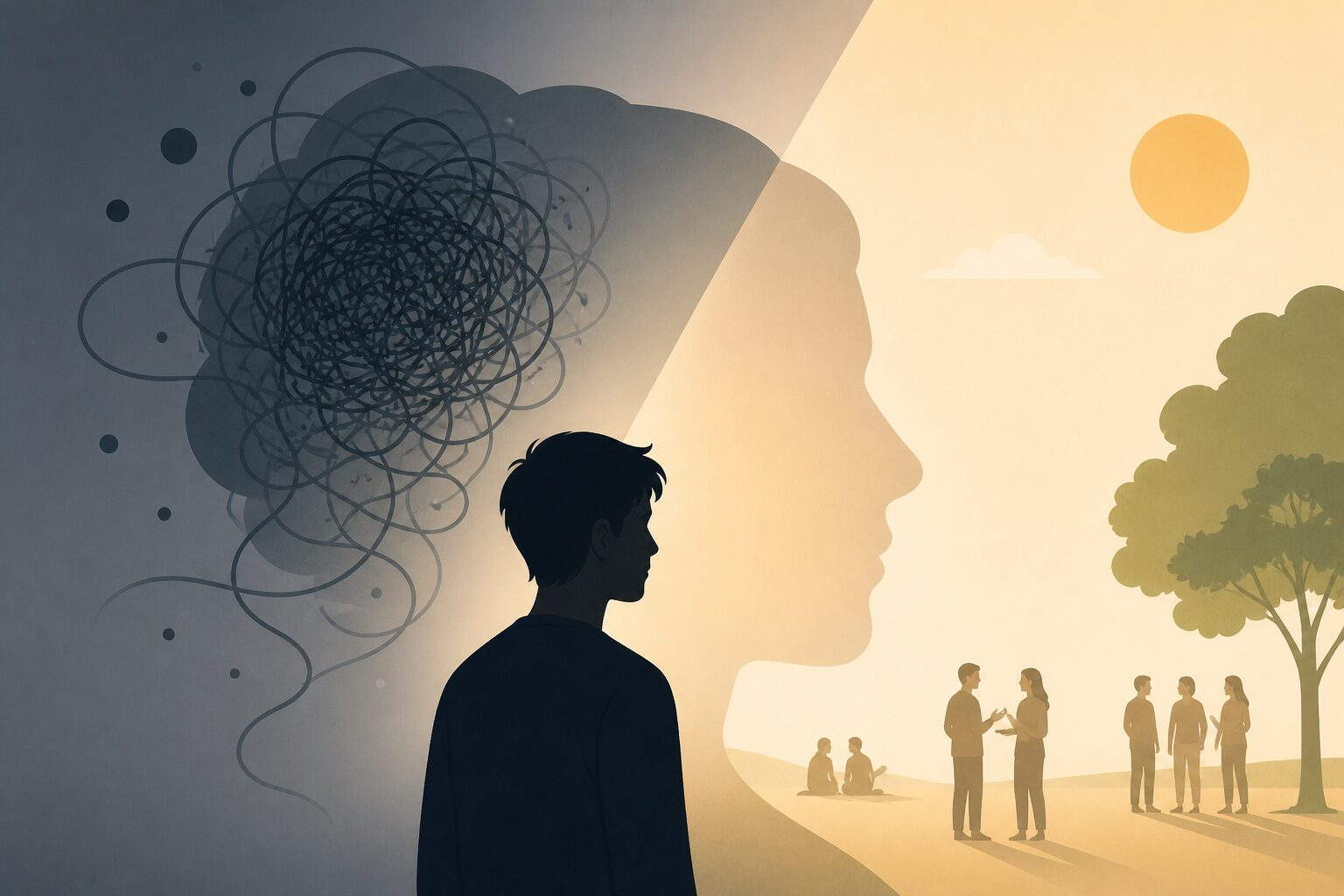
For years, I tried to recover from social anxiety without fully understanding what I was actually recovering from.
I read the articles. I looked up the definitions. I typed “what is social anxiety” into Google more times than I can count. And every time, I got the same answer: fear of embarrassment. Fear of humiliation. Fear of negative social evaluation.
And every time, something felt incomplete. Like a description of a building that only tells you what color the front door is.
I knew fear was part of it. I felt it every time I walked into a room full of people, every time someone asked me a question I wasn’t expecting, every time I had to speak up in a group. The fear was real. But there was something underneath the fear that none of those definitions ever touched.
It took me years of living with this condition — and years of working through it — to finally understand what that was.
This post is what I wish I could have read at the beginning of that journey.
What Everyone Gets Wrong About Social Anxiety
If you go on Google right now and search “what is social anxiety,” you’ll find some version of the same definition: a fear of embarrassment, a fear of humiliation, a fear of being negatively evaluated by others.
And look — I’m not saying that’s wrong. Fear is absolutely part of social anxiety. But here’s the problem with defining social anxiety purely as a fear: it treats the symptom as the cause.
Fear is what you feel. But feeling fear doesn’t mean that fear shouldn’t exist. Something has to trigger it. And in social anxiety, most definitions never tell you what that something actually is.
That gap — that missing piece — is what kept me stuck for so long. Because when you only treat the fear, you’re treating the surface level emotion of social anxiety. You’re not dealing with whatever set it off in the first place.
The Real Link Between Social Anxiety and Shame
The emotion that almost never gets talked about in the context of social anxiety is shame.
Not guilt — shame. They’re different. Guilt says I did something bad. Shame says I am something bad. Shame is the deep, quiet belief that some part of you — the way you talk, the way you think, the way you come across — is fundamentally flawed or unworthy.
I carried that belief for years without even knowing it had a name.
It showed up in the way I’d mentally edit myself before speaking, convinced that whatever I naturally wanted to say wasn’t good enough. It showed up in the way I’d observe other people in social situations and assume they had something I didn’t — some effortless quality of being acceptable that I just couldn’t access. It showed up in the exhaustion of constantly performing a version of myself I thought others could tolerate, while keeping the real version safely hidden.
That was shame. And it was doing something far more important than I realized.
It was causing the fear.

Think about it this way: if you genuinely believed that everything about you was whole — that no part of you needed to be hidden, edited, or defended — what would you actually have to fear in a social situation? You could walk up to anyone, say whatever came naturally to you, and have zero anxiety about how it landed. Because nothing about you would be at risk.
The fear exists because the shame tells you something is at risk. The shame tells you that if people see the real you — the unedited, unperformed, authentic you — they will confirm what you’ve always suspected: that you’re not enough.
That’s the engine underneath social anxiety. Not just fear. Shame driving fear.
If this idea resonates with you and you want to go deeper into where social anxiety comes from, and, more importantly about what you can do to recovery, subscribe to my newsletter here — each week you will receive content about how I learned to recover from social anxiety, and how you can too.
A Better Definition
So what does this mean for how we define social anxiety?
The standard definition — a fear of judgment — isn’t capturing the full picture. Because the thing we’re most afraid of isn’t really other people’s opinions. It’s the act of showing ourselves.
What social anxiety really is, at its core, is a fear of authentic self-exposure.

It’s a core belief system — built up over years — that convinces you that the real you is too flawed, too awkward, too much, or not enough to be safely shown to the world. Every avoidance behavior, every script you rehearse before a conversation, every moment of shrinking yourself in a group — all of it is the mind trying to protect you from that exposure.
This definition changed everything for me. Because it shifted the question from “how do I stop being afraid of people?” to “why do I believe I need to hide myself in the first place?”
Those are very different questions. And they lead to very different paths forward.
If this resonated with you and you want to share your opinions of social anxiety with me and other like-minded individuals like you, I’d love to hear your thoughts in the comments below.
What This Means for Your Recovery
Here’s where the social anxiety and shame connection becomes practically important.
Exposure therapy has been the gold standard for treating anxiety disorders for a long time — and for good reason. The idea is straightforward: the more you expose yourself to the thing you’re afraid of, the less power it has over you. And for certain phobias, this works remarkably well. If you’re afraid of spiders, consistent exposure to spiders will eventually reduce that fear.
But social anxiety isn’t a fear of an external object. It’s a fear of internal exposure. And that changes things.
If the root of your anxiety is shame — a belief that parts of you are unworthy of being seen — then simply putting yourself in more social situations isn’t automatically going to fix that belief. You can expose yourself to social situations indefinitely and still feel just as anxious, because the underlying shame hasn’t been addressed.
This was one of the most important realizations of my own recovery. I wasn’t just fighting a fear. I was fighting a story I’d been telling myself about who I was and whether that person was acceptable to the world.
So if you’re working with a therapist — or thinking about it — I’d encourage you to ask specifically about shame-focused work. Ask about approaches that go beyond exposure alone. Ask about what it would look like to not just tolerate social situations, but to actually show up in them as yourself.
I’m not a psychologist (although I will be in 4 years), and I won’t pretend to be. But I can tell you from my own experience that the shift from “how do I reduce my fear?” to “how do I reclaim my authentic self?” was a turning point in my recovery.
The Takeaway
Social anxiety is not just a phobia. It’s not simply a fear of judgment that you can logic or expose your way out of.
It is a core belief system that tells you your authentic self — the real, unfiltered version of you — is too flawed or too vulnerable to be safely shown to others. Shame builds that belief. Fear enforces it. And avoidance keeps it alive.
Once you start seeing social anxiety through that lens, recovery stops looking like forcing yourself to be confident and starts looking like something deeper: a genuine transformation of how you see yourself and what you believe you deserve to show the world.
That’s the work I’ve been doing. And it’s the work this blog is built around. If you want to follow that journey — and get the kind of honest, experience-based writing that goes beyond surface-level advice — join my newsletter here. I’d love to have you following along.

Hi, I’m Blake Baretz, the creator of Social Anxiety Haven. I write about my personal journey with social anxiety and share research-backed strategies to help others navigate it. If you’d like more encouragement and resources, join my weekly newsletter.
Leave a Reply