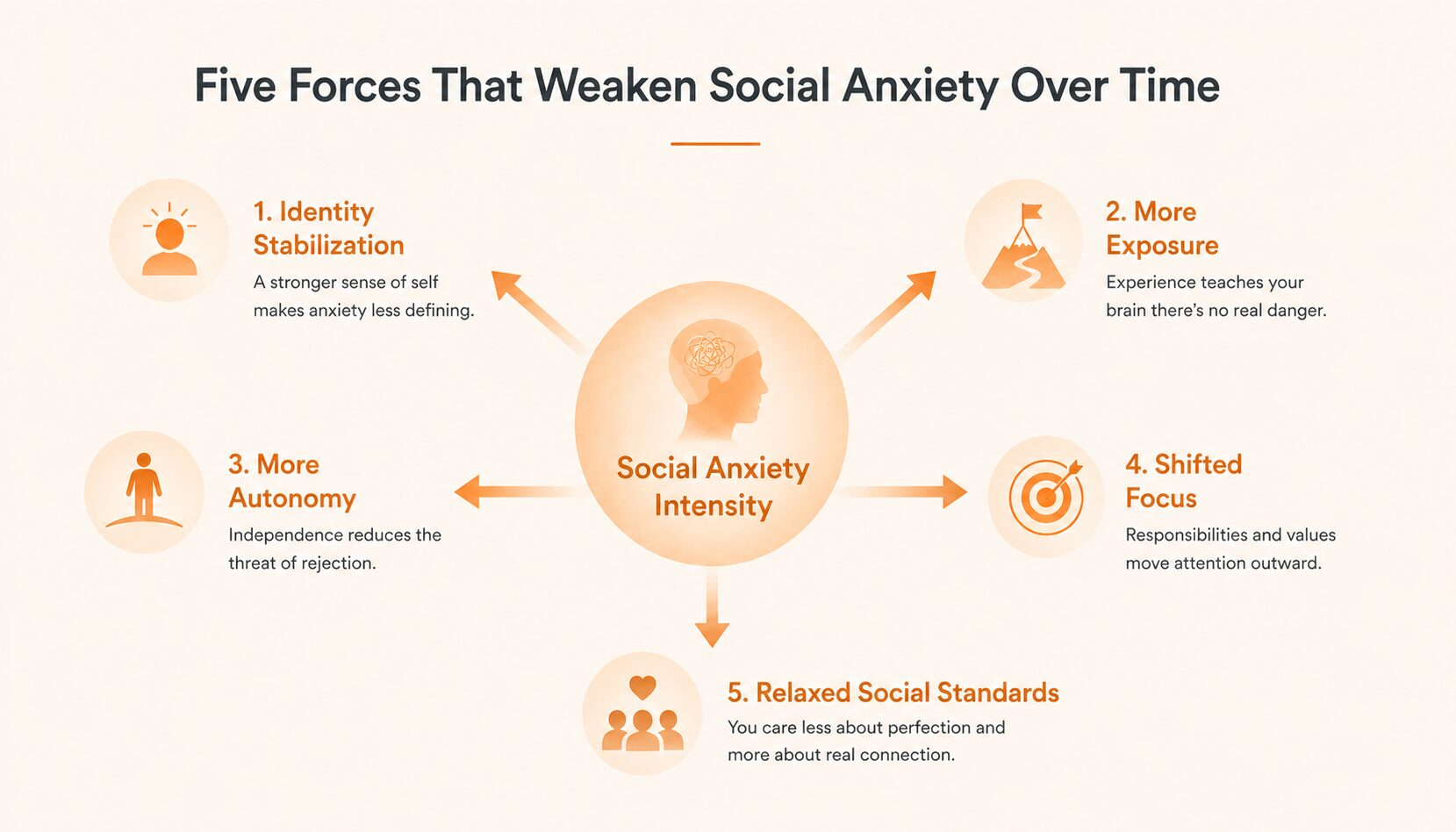
For a long time, one of the hardest parts of living with social anxiety wasn’t the anxiety itself.
It was not knowing if it would ever go away.
When I was first diagnosed, all I wanted was someone to tell me that I could be free and live a normal life again.
And here’s what I’ve learned after years of living with this: social anxiety does not define your life. In fact, it often decreases as we age. Not because people magically become confident, but because the conditions that keep social anxiety alive slowly begin to lose their power.
In this post, I want to walk you through the five reasons why this happens — and more importantly, what those reasons mean for where you are right now.
1. Your Identity Begins to Stabilize
One of the most profound ways social anxiety keeps itself alive is through our self-concept — the story we tell ourselves about who we are.
When that story gets distorted, anxiety stops being something we experience and starts becoming something we are. That’s when thoughts like “my anxiety is just who I am” or “I’m incapable of making real friends” stop feeling like symptoms and start feeling like facts.
This is why social anxiety can be so exhausting to work through. It doesn’t feel like solving a problem. It feels like fighting yourself. And when you’re fighting yourself, letting go of the anxiety can feel like losing a piece of your identity.
But something shifts as we get older. Our sense of self becomes more stable. We start to understand what makes us tick, what genuinely matters to us, what kind of people we want around us, and what kind of life we actually want to live. With that clarity comes a more accurate, more grounded self-concept.
And as that understanding deepens, anxiety begins to go away — not because we forced it out, but because it no longer fits the person we’ve become. We outgrow it through a more mature, self-defined identity rather than fighting it into submission.
2. You Gain More Exposure
One of social anxiety’s most powerful tools is catastrophization — the tendency to treat every social situation like a disaster waiting to happen.
Before a party, it might say: “Don’t say anything wrong or everyone will laugh at you.” Before a presentation, it might say: “You’re going to forget everything and completely humiliate yourself.” The brain, trying to protect you, generates worst-case scenarios at full volume.
But here’s what happens over time: you keep showing up. You keep surviving the conversations you were sure would destroy you. And slowly, your mind starts to notice a pattern–your original fear is inapplicable.
Think of it like a faulty fire alarm. The first night it goes off, you tear through every room looking for flames. The second night, same thing. But after the alarm keeps ringing with no fire to show for it — night after night — your mind starts to realize something. The alarm is the problem, not the fire. It’s faulty. And it needs to go.

Social anxiety works exactly the same way. When you’re younger and less experienced, every anxious signal feels like a genuine warning of real danger. But as you accumulate more social experiences — more evidence that the alarm went off and nothing catastrophic happened — your brain slowly stops confusing the alarm for the fire. And in that space, you gain the freedom to be more of yourself without fear.
According to the National Institute of Mental Health, social anxiety disorder is one of the most common anxiety disorders, and research consistently supports that exposure — both natural and therapeutic — plays a central role in reducing its intensity over time.
If you want to understand more about how these internal thought patterns fuel anxiety day to day, I wrote about it in depth in my post on internal social anxiety triggers — it goes deeper into exactly catastrophization works and why the socially anxious mind is so difficult to heal from.
And if you want posts like this delivered to your inbox every week, subscribe to my newsletter here. I write about the deeper patterns behind social anxiety — the kind of content that actually moves the needle in recovery.
3. You Gain More Autonomy
This one took me a long time to fully understand, but once it clicked, it changed how I saw everything.
When we’re young, we are genuinely dependent on other people for our survival. Food, shelter, emotional regulation, safety — none of that is something a child can provide for themselves. In that environment, rejection isn’t just painful. It’s dangerous. Being excluded or dismissed by the people around you carries a real survival threat, and the brain responds accordingly — with fear.
Now imagine yourself as an adult. You might know how to earn money, feed yourself, find shelter, and navigate the world independently. If someone ignores your basic needs, it might still hurt — but you still ultimately have autonomy over your life.

This is how the brain changes over time. As the prefrontal cortex develops and our independence grows, we become less reliant on others for our emotional and practical survival. Rejection stops feeling catastrophic. It becomes uncomfortable rather than dangerous.
Social anxiety eases not because people stop judging us — but because our brain stops believing that their approval is required for our survival.
Does this reframe the way you’ve been thinking about your own anxiety? If it does, I’d love to hear your thoughts in the comments below. Social anxiety is harder to have than most people realize, but sharing your experience with it is a great way for other people to resonate with the overall experience.
4. Your Responsibilities Shift Your Focus
As children, our mental bandwidth is relatively free. School, homework, sports, friendships — these are real concerns, but they leave a lot of room for self-monitoring and self-consciousness.
Adult life changes that equation completely.
When you’re managing a job, paying rent, maintaining relationships, handling health, and possibly raising a family, your mind simply has less space to dedicate to “how did I come across in that conversation?” Survival demands more of your attention. And as that happens, the relentless self-focus that feeds social anxiety starts to loosen — not because you solved it, but because life pulls your attention outward.
This doesn’t mean adult responsibilities cure social anxiety. But the shift in mental focus that comes with them is a real and underappreciated reason why anxiety tends to soften with age.
5. Social Standards Relax
Think about the social environment of high school. Rigid friend groups. Hierarchies enforced by cruelty. Popularity systems that sometimes rewarded the meanest people in the room.
That environment is a breeding ground for social anxiety — and for good reason. The social stakes genuinely feel higher, the judgment is more concentrated, and the consequences of not fitting in feel enormous.
But the real world doesn’t work that way. Social dominance and manipulation only take people so far. The most genuinely successful, fulfilled people tend to be the ones who are kind, open, and real. The people who were bullied or dismissed in high school often find that the world beyond it is more accepting of difference than they ever imagined.
As the people around us mature, the social environment itself becomes less threatening. People become more open to those who are quiet, quirky, or different. The cruelty of adolescence gives way — not perfectly, not universally, but meaningfully — to a world where authenticity is more welcome.
What This Means for Your Recovery Right Now
Here’s the most important thing I want you to take away from all of this:
These five patterns aren’t just things that happen passively with time. They’re things you can actively work toward right now.
You can intentionally build a clearer, more stable sense of who you are. You can seek out exposure rather than waiting for it to accumulate. You can work on developing emotional independence and self-sufficiency. You can redirect your attention toward meaningful goals. And you can choose environments that are genuinely more accepting of who you are.
Recovery isn’t about waiting to age out of social anxiety. It’s about deliberately creating the conditions that make it fade — now, rather than decades from now.
I started writing about social anxiety because when I was in the thick of it, I desperately wished I had known someone else going through the same thing. Someone who could say: it gets better, and here’s why, and here’s what you can do about it right now.
That’s what this blog is built to be. If you want to keep going deeper on identity, shame, and long-term recovery, subscribe to my newsletter here — I write about all of it every week, and I’d love to have you along for the ride.

Hi, I’m Blake Baretz, the creator of Social Anxiety Haven. I write about my personal journey with social anxiety and share research-backed strategies to help others navigate it. If you’d like more encouragement and resources, join my weekly newsletter.
Leave a Reply