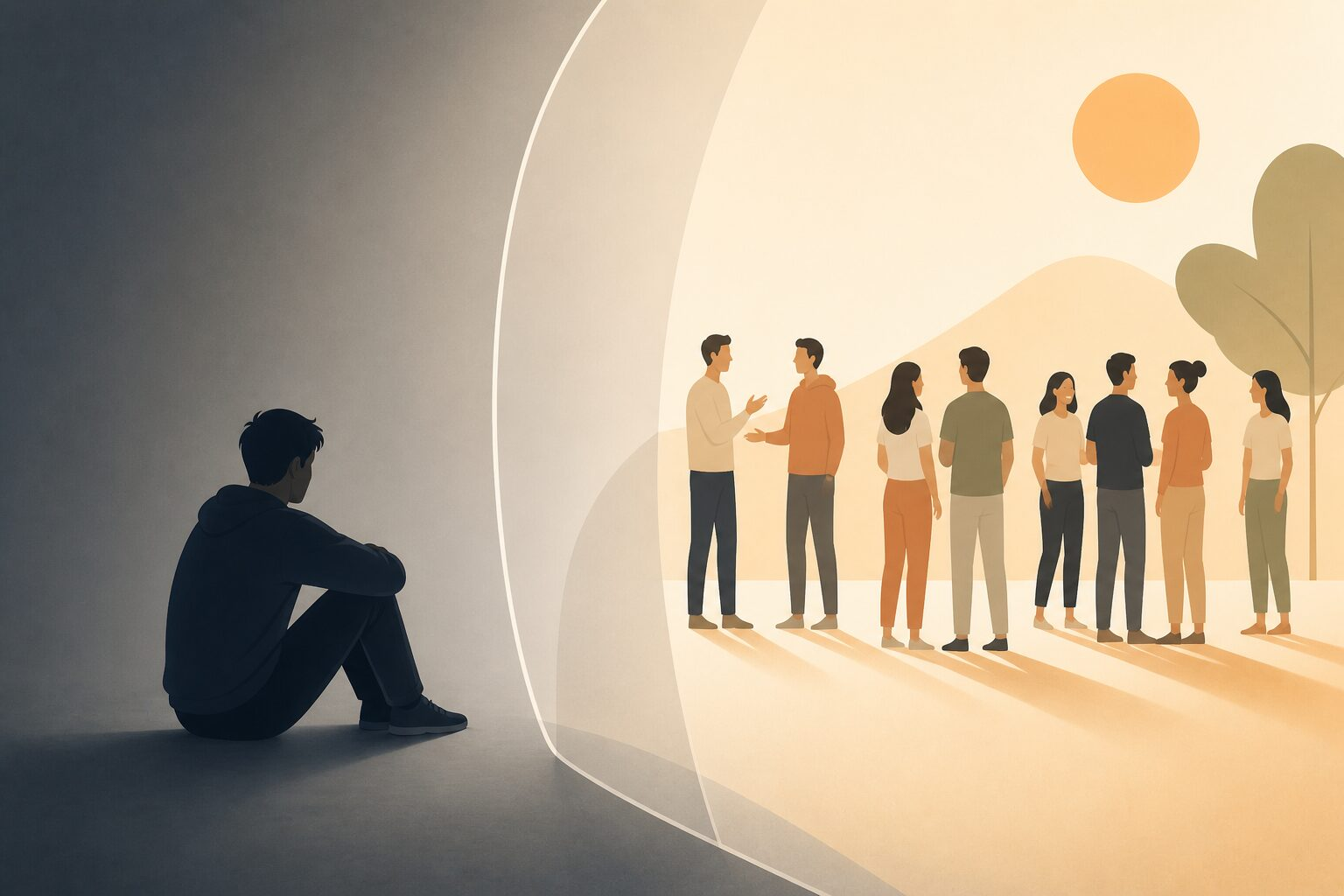
I want to tell you a story.
A story about what my life actually looked like when social anxiety was running the show.
This happened two years ago, during my sophomore year of college. I was roughly a year into the recovery process, and at that point in my life, my anxiety was still very much in charge of how I lived.
The Club Fair I Never Attended
I wasn’t involved in many extracurricular activities in college, and I genuinely wanted to change that. I wanted to feel connected to my campus and find people with shared interests.
The main way to do that was through the club fair — a large event on the front lawn where hundreds of students would gather, talk to club presidents, and figure out where they fit. It was exactly the kind of opportunity I was looking for.
But I couldn’t go.
Not because I didn’t want to. But because at that point in my life, I was struggling to do the most basic things. Getting out of bed in the morning to go to the cafeteria. Going to class. Spending a Friday night with friends.
These things seem like the simplest things for most people. Not for me. It took everything I had. Walking into a crowd of hundreds of people, navigating conversations with strangers, performing well enough to be accepted into a group — it was too much. It was too overwhelming
So I stayed in my room. And I felt the quiet, familiar ache of watching an opportunity pass me by.

The Email That Changed Things
Despite my feelings of disappointment and frustration, a couple of days later, I got an email from a Jewish organization on campus called Chabad. They were inviting me to participate in a student program called Sinai Scholars — a classroom-style discussion that meets once a week for two hours.
On paper, it was everything I needed. Low commitment. Small group setting. Structured format. A real reason to get involved without the chaos of a club fair. I read the email and felt something I hadn’t felt in a while: cautious hope.
I responded immediately…Yes, I’d love to be involved.
After I sent that message, a day passed. Then another. Slowly but surely, I was beginning to feel the familiar spiral — nothing’s going to come of this, I’m going to end up alone, there’s no way this works out — until finally, an email came back.
Great news: they said they’d love to have me. But first (and this is a big but), I’d need to complete a 15-minute coffee chat.
Fifteen minutes.
And just like that, everything shifted.
The Interview
If you’ve ever had social anxiety, you already know why a 15-minute one-on-one conversation can feel more terrifying than almost anything else. There’s nowhere to hide. No group to blend into. Just you and another person, expected to keep a conversation going for the entire duration — with something real at stake at the end of it.
I had about a week before the interview. And I used almost every hour of it to prepare.
On my phone, I literally spent hours rehearsing how I imagined the conversation would go. “Hey, how’s it going?” “It’s good, how are you?” “I’m good.” I mapped out possibilities, rehearsed responses, built out contingencies.
I was trying to construct a version of myself that was perfect — one that wouldn’t make a single social mistake, wouldn’t say the wrong thing, wouldn’t give them any reason to reject me.
For six days, this is what I did. Hours at a time, running scenarios in my head, scripting and rescripting.
The morning of the interview, nothing had changed. But despite everything, I still woke up flooded with anxiety. Getting out of bed felt hard. Going to the cafeteria to get breakfast felt even worse. Sitting in class felt unbearable. My mind was so consumed by the 15 minutes ahead of me that I couldn’t be present for anything else.
I remember sitting in my last class before the interview, watching the minutes tick by, barely hearing a word my professor said. Just counting down. Just waiting.
Counting Down the Minutes
When class ended, I didn’t move right away.
I sat in my chair as the other students filed out, and I genuinely considered not going. The negative thoughts were loud — you’re not going to be able to do this, you’re going to mess it up, you’re not ready — and part of me wanted to listen to them.
But eventually, I got up. I walked across campus. And with every step, the catastrophic thinking got louder. By the time I reached the dining hall, I was completely in my head.
I walked through the doors anyway.
At a table near the cafeteria, I saw a warm, friendly woman who smiled and said, “Hey, it’s nice to meet you. How are things going?”
And the interview began.
It didn’t go perfectly. I wasn’t following a script (I couldn’t) and that kept tripping me up internally even when things were going fine on the surface. But by the time it ended, something had happened that I hadn’t fully prepared for.
It had gone okay.
A few days later, I found out I had gotten into the program.
What This Story Is Really About
But here’s the thing I keep coming back to when I think about that week.
The interview was 15 minutes long. Fifteen minutes. And I spent the better part of a week — hours and hours of actual, irreplaceable time — preparing for it. Letting it take over mornings and classes and evenings and quiet moments that could have been about anything else.
That’s what social anxiety actually costs. Not just moments of fear — the stolen time. The mental real estate consumed by something that, when it finally arrived, lasted 15 minutes.
When you’re so focused on what other people think of you, it becomes almost impossible to sit down and notice all the things you’re actually doing right. The courage it took to respond to that email. The fact that you showed up at all. The resilience that exists underneath all the noise.
Social anxiety doesn’t just make life harder. It makes you miss the life you’re already living.

And I think that’s worth naming honestly.
You Are Worthy of Good Things
I started this blog because when I was in the middle of my recovery process, I desperately wished I had someone to tell me I wasn’t alone. Someone who had been through it and could say that it gets better.
That’s still what I believe. And that’s still why I’m still here.
If this story resonated with you and you want to keep going deeper — on recovery, identity, or what it actually looks like to rebuild your life around something other than fear — join my newsletter here. I write about social anxiety weekly and I’d love to have you along for it.
You are worthy of good things. Even on the hard days. Especially on the hard days.

Hi, I’m Blake Baretz, the creator of Social Anxiety Haven. I write about my personal journey with social anxiety and share research-backed strategies to help others navigate it. If you’d like more encouragement and resources, join my weekly newsletter.
Leave a Reply