There’s a book that sat on my shelf for two years.
For a long time, I didn’t tell anyone it helped me. Honestly, I was embarrassed. Who admits that a book changed their life? It felt like the kind of thing you keep to yourself — filed away next to the other things you did when you were desperate and didn’t want anyone to know how bad it had gotten.
But here’s the thing. Before I found that book, I was in the midst of a mental health crisis.
Not the ordinary kind of dread that comes from a hard week or a difficult season. The deep, settled kind — the kind that’s already there before you’ve fully opened your eyes.
Socializing frightened me.
And then I read something that made my social anxiety finally make sense. Not a trick. Not a hack. Just a completely different way of understanding what was actually happening inside my head.
This post is about the three things that came out of that book — the lessons that actually moved the needle in my recovery, and why I think they might help you too.
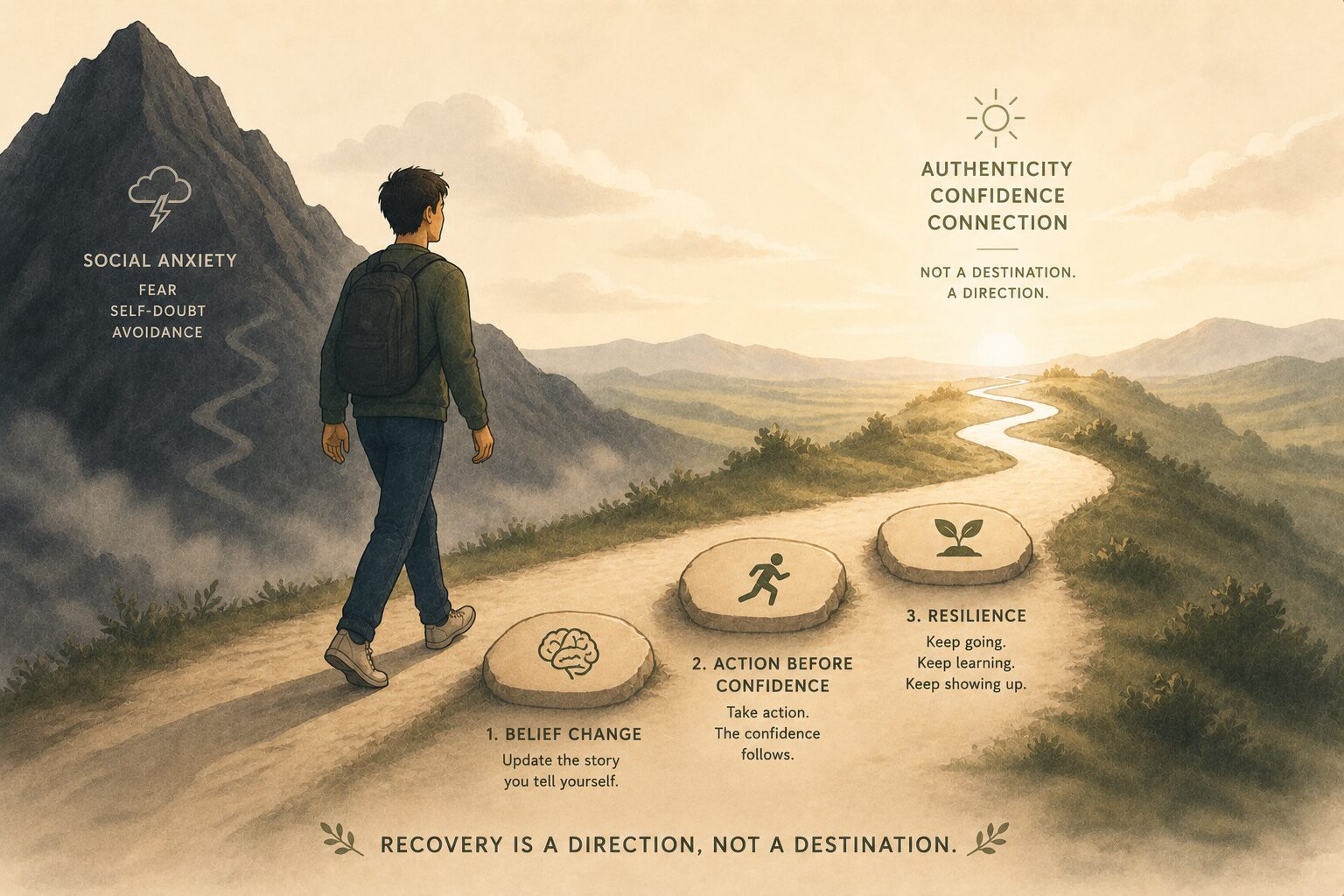
Lesson One: Exposure Therapy Alone Doesn’t Work
When I first started working on my recovery, I was operating under a belief that I think a lot of people share: that the more I exposed myself to social situations, the less anxious I would become. I leaned into this hard.
I forced myself to go to parties. I said yes to every social event I was invited to. I made myself start conversations with strangers. On the surface, I thought I was doing the right thing. More exposure, more evidence that nothing catastrophic was happening, less anxiety over time. That’s how it’s supposed to work, right?
Except it didn’t. After a while of pushing myself through situation after situation, something shifted in the wrong direction. My anxiety didn’t decrease — it grew. What I had stumbled into, without knowing it had a name, was anxiety sensitization: what happens when you repeatedly expose yourself to feared situations without changing the underlying thought patterns driving the fear. Instead of the fear getting less, it got worse.
Here’s the crucial point underneath all of this: exposure therapy alone does not work if your core beliefs don’t change. You can walk through hundreds of social situations and still come out the other side just as anxious — because the belief system that generates the anxiety is still intact. In rare cases of overexposure without belief change, the anxiety can actually get worse.

The goal, then, isn’t just to put yourself in social situations and hope for the best. It’s to gradually reconstruct the beliefs and perceptions you carry after those situations end.
One of the most effective tools I found for doing this was journaling.
I know — journaling gets mentioned so often in mental health spaces that it can start to feel like a platitude. But I want to share it with you because of what it actually did for me, and it wasn’t what I expected. When my anxiety was at its worst, there were days when I was so far inside my own head that I couldn’t open my phone to watch a video on YouTube. Some days, even texting a friend felt like too much. Whenever those days would come, I would just open my notes app on my phone and start writing — not with a plan or a format, just whatever was inside my head.
This worked wonders for me. But what made it work wasn’t the writing itself. It was the questions I started asking afterward. After a social encounter, I’d sit down and challenge my own predictions: What did I think was going to happen before this situation? What actually happened? What went better than I expected? If I had to do it again, what would I do differently?
Those questions did something that exposure alone never could. They gave my brain new evidence. They slowly, gradually, started to update the story I was telling myself about what social situations actually meant. If you want to learn more about how how this process of updating your brain with new evidence works, my post on internal social anxiety triggers goes into this in depth — it connects directly to the belief-change work we’re talking about here.
And overall, if this approach to recovery — working on the beliefs underneath the anxiety, not just the anxiety itself — resonates with you and what you’re going through, subscribe to my newsletter here. Changing beliefs is exactly the kind of thing I write about every week, and I’d love to have you along.
Lesson Two: Action Comes Before Confidence
The second lesson took me longer to accept, because it ran directly against how I thought recovery was supposed to work.
Every day, I was waiting to feel ready before I spoke up. Waiting to feel calm before I walked into the room. Waiting to feel confident before I started. I had this picture in my head of a future version of myself who had somehow arrived at readiness — who woke up one day feeling settled enough, grounded enough, unafraid enough to finally start living.
That version of me never showed up. And eventually I understood why.
There’s a principle that gets talked about in psychology called behavioral activation — the idea that action generates motivation and feeling, not the other way around. We have the sequence completely backwards. We think we need to feel ready first, and then we’ll act. But the research consistently shows that action comes first, and the feeling follows.
You didn’t learn to ride a bike by reading about balance. You fell, got back on, fell again. And at some point, without any dramatic moment of realization, your body knew how to balance — not because you studied it, but because you did it enough times that your brain had no choice but to adapt.
Social anxiety works the same way. You cannot read enough books, watch enough videos, or understand yourself deeply enough to think the anxiety away. I say that as someone who genuinely tried. I spent months studying cognitive behavioral therapy, reading about the nervous system, learning exactly why my brain was doing what it was doing. And it helped — but only to a point. Understanding your fear and actually moving through it are two completely different things.

Research even suggests this is true. According to the American Psychological Association, behavioral approaches to anxiety — those that prioritize action and gradual exposure combined with cognitive restructuring — consistently outperform insight-based approaches alone. The brain changes through doing, not through knowing.
One technique that helped me bridge the gap between knowing and doing was visualization — and I want to be specific about what I mean, because it’s not the passive daydreaming version that gets dismissed.
Visualization, done deliberately, is the practice of creating a clear mental image of where you want to go, and then asking yourself the most important question: what would I have to do today to get there? You’re not imagining a finished version of yourself. You’re using the image of who you want to become as a compass that points toward one small action you can take right now.
That question is what makes visualization active rather than passive. It keeps the goal present in your mind while directing your energy toward the next step rather than the entire journey.
So, if you’re sitting here reading this post thinking you’ll work on your social anxiety when you feel more ready or more confident — I want you to internalize this as soon as you can: that version of ready is never coming. The only way out is through your fear. And that starts with one small action today, before you feel ready to take it.
If that hit hard, it’s because it’s true — and it’s the kind of honest, uncomfortable truth I write about every week. Join the newsletter here. No fluff, no toxic positivity. Just an honest look at what social anxiety recovery actually requires, and the small steps that make it possible.
Lesson Three: Resilience Is Your Most Powerful Asset
The last lesson is the one I come back to most often. In some ways, it’s the simplest, but also the hardest to fully believe when you’re in the middle of the recovery process.
People who struggle with social anxiety dramatically underestimate their own capacity to change.
I did for a long time. I genuinely believed that social anxiety was just who I was, that my life could be nothing more. But this belief is a lie, and it is a lie that costed me years of possibilities and growth. Social anxiety is not who you are, and the potential that you have for your life is limitless, so don’t waste it believing that you deserve the pain that you are experiencing.
For me, the recovery process was brutal in ways I don’t have enough space to fully describe here. There were setbacks where I felt like starting over. There were days when giving up felt like the only rational option. There were moments of real despair.
But the only reason I’m on the other side of it is because I kept going anyway. I made the decision, over and over again, to face the pain rather than accept it as permanent.
Your mind is going to tell you things. It’s going to tell you to give up, that you’re worthless, that you’ll never be liked, that you’ll always be alone. It will say these things with complete conviction, in your own voice, at the moments when you’re least equipped to argue back.
But here’s what I know to be true: the only thing standing between who you are right now and who you want to become is the decision to keep moving toward it. You hold the cards. You decide where this goes.
To make this more applicable to you, what has helped you in your recovery process? I’d love to hear your thoughts and opinions in the comments below. Your experience might be exactly what someone else needs to read today.
Recovery Is a Direction, Not a Destination
Here’s how I want to leave you with all of this.
Recovery from social anxiety isn’t a moment you arrive at. It’s a direction you keep choosing. It’s the decision to challenge a belief after a hard social situation instead of just accepting it. It’s taking one small action before you feel ready. It’s getting back up after a setback and deciding, again, that you’re not done yet.

None of it is linear. None of it is clean. But all of it compounds.
You don’t have to live in fear of other people, and you certainly don’t have to spend your life performing a version of yourself that feels safe enough to show. There is a version of you on the other side of this that is fully, authentically, comfortably yourself.
That version of you is not a fantasy. It’s where this road leads.
If you want to keep walking through it together — with weekly writing on recovery, identity, and what it actually looks like to change from the inside out — join my newsletter here. I’d love to have you along for every step of it.

Hi, I’m Blake Baretz, the creator of Social Anxiety Haven. I write about my personal journey with social anxiety and share research-backed strategies to help others navigate it. If you’d like more encouragement and resources, join my weekly newsletter.
Leave a Reply