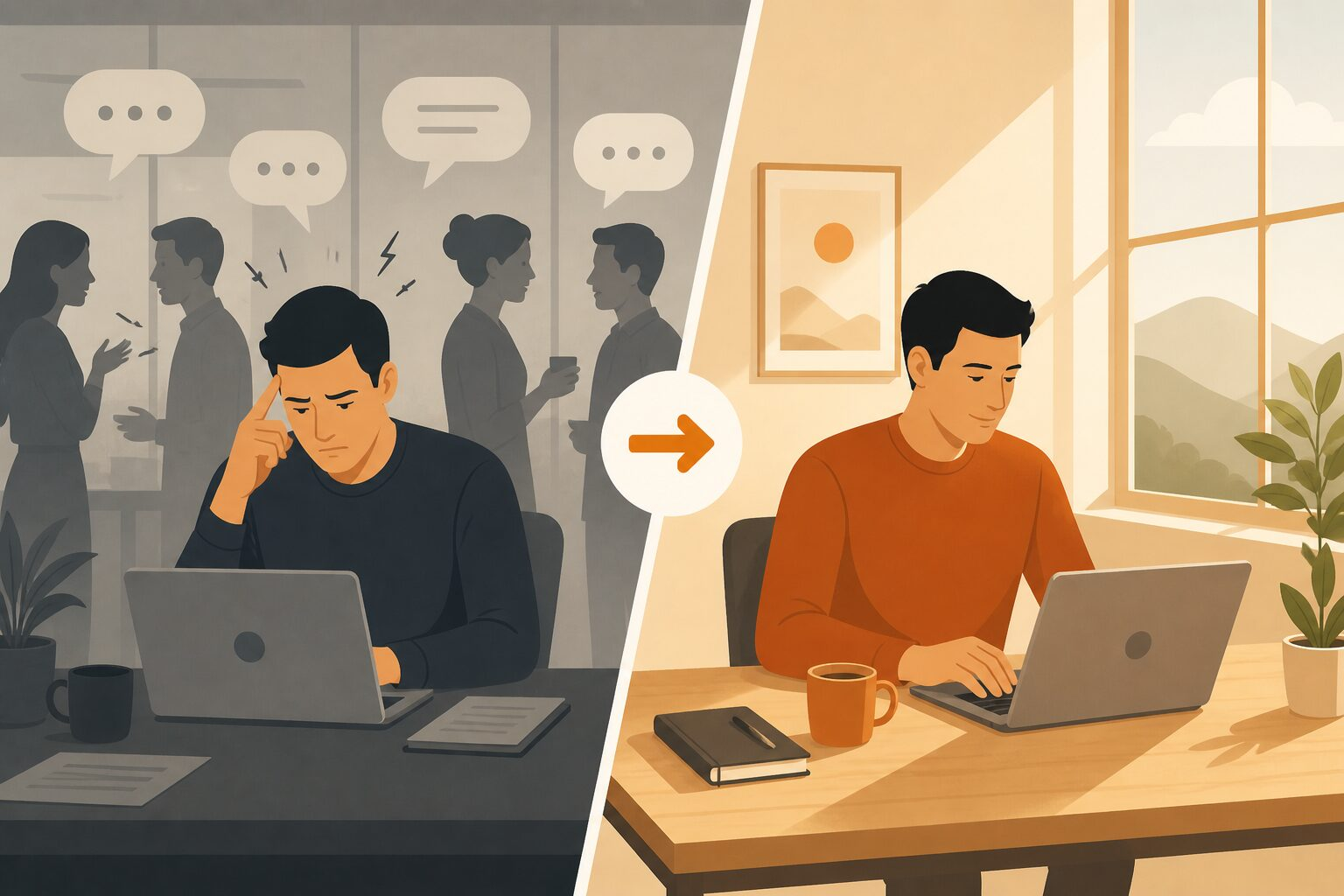
There’s a specific kind of exhaustion that comes with having social anxiety at work.
It’s not about managing the work itself . It’s the constant layer of social performance that sits on top of all of it. The pressure to come across the right way in every water cooler interaction. The energy spent managing how you’re perceived in meetings, hallway conversations, emails, and all the small moments in between that most people don’t think twice about.
For someone with social anxiety, the social performance of a job can be more draining than the actual job. And that’s a real problem.

To combat this problem, I started building side hustles on the side of my regular work. I did this to give me more space to live the life I wanted, and it reminded me that I could build something valuable without constantly performing for other people.
These are the five options I’d recommend — with honest assessments of what each one actually involves.
Why Low-Interaction Income Matters for People With Social Anxiety
Before we get into the specifics, I want to name something that I think often goes unsaid.
For most people, the advice around work and social anxiety focuses on how to cope better in high-social environments. And that advice has its place — exposure and skill-building matter.
But there’s another lever that doesn’t get talked about enough: environmental design. The idea that you can deliberately build your work life in a way that reduces unnecessary social drain — not by hiding from work, but by choosing income streams that are better matched to your social energy and lifestyle.

For this reason, side hustles aren’t just about money for people with social anxiety. They’re about autonomy. They give you a working life that belongs entirely to you — where the pressure to perform for others is low and where your energy goes into the work itself rather than the social layer around it.
If you want to go deeper on building a work life that actually works for someone with social anxiety — including mindset, not just the practicality — subscribe to the newsletter here. Work and jobs are things I write about regularly, and I’d love to have you reading along.
Side Hustle One: Freelance Writing
About a year ago, I decided to write a book on social anxiety. The task was enormous, the writing was intense, and the entire process required a level of introspection that I couldn’t sustain while also spending eight hours a day managing the social demands of a corporate environment. So I leaned into the writing more than the social politics.
What I didn’t realize at the time was that the writing I was already doing could generate real income. Through platforms like Upwork and Fiverr, I discovered that freelance writers can earn anywhere from $20 to $30 an hour writing blog posts, website copy, and content for other businesses. The skill I was already building had a market — and tapping into it didn’t require me to manage anyone, attend meetings, or perform for a room.
Freelance writing works particularly well for people with social anxiety because it’s almost entirely solo. You’re given a brief, you produce the work, you deliver it. The interaction required is minimal, asynchronous, and fully within your control. And for people who think and process deeply — which describes many people with social anxiety — writing is often a natural strength.
The honest downsides: holding yourself accountable without external structure is harder than it sounds, producing written content consistently takes real effort, and building a client base requires some self-promotion. None of these are insurmountable — but they’re worth knowing before you go into it.
If you’re also thinking about how your work situation as a whole could be restructured around lower-interaction environments, my post on the best remote jobs for people with social anxiety covers that territory in depth and pairs well with what we’re talking about here.
Side Hustle Two: Starting a YouTube Channel or Blog
This one is similar in spirit to freelance writing, with one key difference: instead of building someone else’s platform, you’re building your own.
A YouTube channel or blog gives you complete freedom of expression, the ability to build an audience around something you genuinely care about, and a platform for eventually selling products or services that align with your content. For people with social anxiety specifically, there’s something particularly meaningful about having a space that is entirely yours — where you set the terms, control the environment, and share what you actually think without filtering it through someone else’s requirements.
The upside is real. The downside is equally real, and I want to be honest about it: this path is slow. It can take years of consistent output before you see meaningful income. And if you’re looking for something that generates money in the next few months, this isn’t it.
But if you’re willing to play a longer game, it can compound over time. Every piece of content you create continues to work for you long after you’ve finished making it. And over time, that accumulation becomes something genuinely valuable.
Do this one because you care about it. Not because you want quick money.
Side Hustle Three: Print on Demand
Print on demand (POD) is one of the most socially minimal business models that exists — and for people with anxiety around customer interaction, that’s a significant selling point.
Here’s how it works. You design products — t-shirts, mugs, posters, tote bags, whatever fits your aesthetic — and partner with a third-party company like Printify, Printful, or Redbubble. When someone buys one of your designs through a sales channel like Etsy or Shopify, the partner company handles all the printing, packaging, and shipping. You never touch the product. You never interact with the customer directly. You just create the designs and set up the store.
For creatively inclined people who want to monetize their artistic work without the overhead of managing inventory or dealing with customers, this model is genuinely appealing. It requires no upfront investment beyond your time, it’s fully online, and once the store is set up, it can generate passive income over time.
The honest reality: design is a competitive space. There are a lot of print on demand stores, and standing out requires real creative effort and consistent output. If you treat this as a casual hobby, the results will reflect that. If you treat it like a part-time business — with intentional design choices, market research, and consistent promotion — it can generate meaningful income.
Side Hustle Four: Selling Your Own Products Online
This option shares some DNA with print on demand but operates at a different level and with a different ceiling.
When you create and sell your own products directly, there’s no platform taking a cut of your margins, no partner company setting constraints on what’s possible, and no employer deciding how far you can take it. You are the only gatekeeper to your own success. The upside is genuinely unlimited in a way that print on demand isn’t — one product, sold repeatedly, with distribution and marketing that compounds over time.
The asymmetric reward potential here is real. A single well-positioned product, marketed to the right audience, can generate income far beyond what any hourly side hustle can. And the entirely online nature of it means the social interaction required is minimal — most of it managed through automated systems, email, and platforms that put a layer between you and the customer.
The honest caveat: this option requires the most upfront work. You need to identify a genuine market need, create something that actually addresses it, and build the marketing systems to reach the people who would want it. According to the U.S. Small Business Administration, the businesses that succeed in online product sales are almost always the ones that started with deep research into their specific audience before launching anything.
This one is best suited for people who are genuinely business-driven — who have something specific they believe in and are willing to put in the foundational work to build it properly.
Side Hustle Five: Data Annotation
Of all the options on this list, data annotation is probably the least well-known — and for people who want something structured, reliable, and genuinely low-interaction, it might be the most immediately accessible.
Data annotation is the process of labeling data so that algorithms and AI models can learn from it. Computers don’t learn the way humans do — they need humans to identify, categorize, and contextualize information before they can process it meaningfully. Data annotators provide that human layer.
It comes in two levels. At the entry level, the work involves things like labeling images — identifying cars, people, or animals — tagging text by category, or transcribing audio. This kind of work typically pays in the $8 to $20 per hour range and requires no specialized background to get started.
At the advanced level, the work becomes more complex: drawing precise boundaries around objects, identifying relationships between data elements, working with multi-layered datasets where accuracy matters at a much higher level. Advanced annotators can earn $30 or more per hour, and some roles require domain expertise in areas like medicine, law, or linguistics.
What makes data annotation work so well as a side hustle for people with social anxiety is its structure. The tasks are clearly defined. The work is entirely online. Social interaction is minimal to nonexistent. And unlike creative side hustles, you don’t need to generate your own ideas or build an audience — you just do the work in front of you.
If you want something you can start quickly, earn from reliably, and do entirely on your own terms, data annotation is one of the strongest options on this list.
Which One Is Right for You?
Here’s a simple way to think about it.
If you want to start earning something real in a relatively short amount of time, freelance writing and data annotation are your best starting points. Both have accessible entry points, clear demand, and don’t require building an audience or a product from scratch.
If you’re willing to invest time now for something that builds over the long term, print on demand and selling your own products offer more upside — but require more patience, more creativity, and more business thinking upfront.
And if you’re someone who finds genuine meaning in creating — who wants to build something that is entirely yours, that reflects who you are and what you care about — the YouTube channel or blog route is the one worth considering. It’s the slowest to monetize. It’s also the one with the most potential to become something that genuinely changes your life.

Which of these feels most like the right fit for where you are right now? I’d love to hear in the comments below — and if you’re already working on one of these, tell me how it’s going. Your experience might be exactly what someone else needs to hear.
You Don’t Have to Keep Forcing Yourself Into Work That Drains You
Social anxiety at work is real, and the toll it takes at work is also real. But the answer isn’t just to push harder through environments that aren’t built for how you operate. Part of recovery is about building a life that works with who you are rather than constantly against it.
Side hustles don’t solve social anxiety. But they can give you a part of your working life where the pressure is lower, the autonomy is higher, and the energy you spend goes into building something that’s yours. Over time, this sense of agency does something for your confidence that no amount of forced exposure ever quite replicates.
You don’t have to choose between making a living and protecting your energy. These five options show you that both are possible at the same time.
If you want weekly writing on building a life that works with social anxiety — practical, honest, and grounded in real experience — join the newsletter here. I’d love to have you along.

Hi, I’m Blake Baretz, the creator of Social Anxiety Haven. I write about my personal journey with social anxiety and share research-backed strategies to help others navigate it. If you’d like more encouragement and resources, join my weekly newsletter.
Leave a Reply