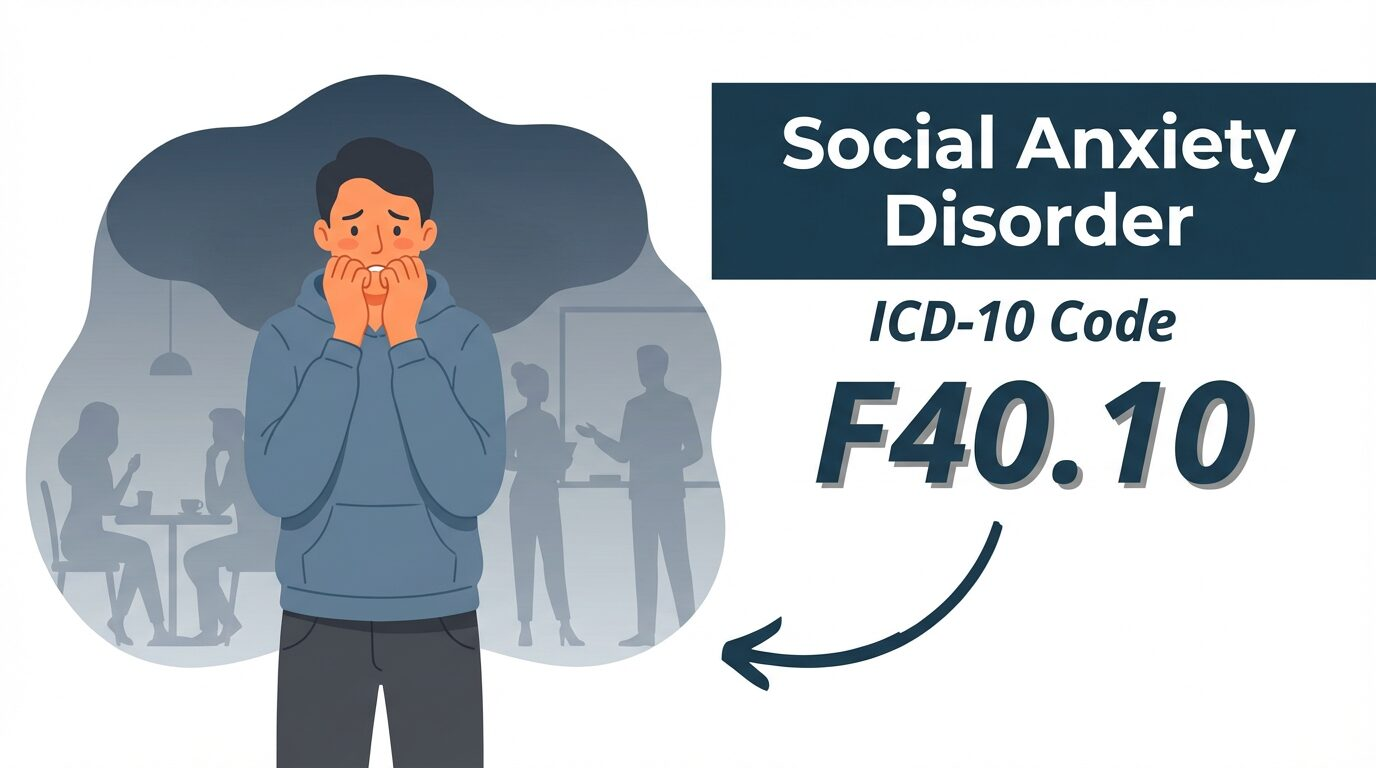
Most people don’t learn about social anxiety by reading clinical manuals. They learn about it the hard way—through years of confusion, self-blame, and constant fear in everyday interactions.
I was one of those people. I spent years ruminating in my social anxiety, blaming myself for what I had. I rationalized it to myself by saying that “I was inadequate,” that “I was unworthy of having friends,” that “I was incapable of even making friends at all.”
This is why learning how professionals classify social anxiety disorder in the ICD-10 is so important. It gives you a external framework that allows you to recognize your symptoms and validate your internal experience from an external perspective. This can bring relief and confidence in how to treat and overcome social anxiety.
In this post, we’ll break down exactly what the ICD-10 says about social anxiety disorder, explore the criteria doctors use to diagnose it, and explain why this classification matters for anyone navigating social anxiety.
We’ll also compare it to the DSM-5 system used in the United States, giving you a complete picture of how mental health professionals understand this common, treatable condition.
By the end, you’ll understand what social anxiety disorder ICD-10 really means—and why that knowledge can be the first step toward getting the support and treatment you deserve.
I. What is Social Anxiety Disorder?
To begin, let’s define what social anxiety disorder is.
Social anxiety disorder is far more than nervousness or fear in social situations — it is a deeply ingrained, persistent fear of being judged, humiliated, embarrassed, criticized, or scrutinized by others.
The fear behind social anxiety isn’t rational — it is created over years of emotional neglect and loneliness, negative social experiences, genetics, and low self-esteem.
The disorder itself is a reflection of your psychological state. It is a sign that numerous, multi-level mental processes are maladaptive and need to be redesigned.
In order to overcome social anxiety, you would need to manage the way your thoughts, feelings, and behaviors coordinate with one another by understanding the fundamental, core beliefs that you have about yourself (your social identity), other people, and the world.

This system of managing social anxiety, both through bottom-up and top-down processing, is one of the many things that I have discovered in my journey of overcoming social anxiety.
If you would like learn more about social anxiety, how I learned to overcome it and how you can too, subscribe to my newsletter where you will get weekly content on how you can begin to live a life of freedom–the kind of life you deserve to live.
II. Social Anxiety Disorder ICD-10 Classification
Now that we have defined what social anxiety disorder is, let’s understand how the ICD classifies it.
The ICD-10, or International Classification of Diseases, 10th Revision, is the system doctors around the world use to diagnose and code medical conditions, including mental health disorders.
For social anxiety, the ICD classifies it under the code: F40.1 – Social Phobias. This formal classification gives doctors a standardized way to recognize, document, and treat social anxiety.
Here is additional information the ICD gives us on social anxiety:
- F40.1 – Social Phobias: An anxiety disorder characterized by an intense, irrational fear of one or more social or performance situations in which the individual believes that he or she will be scrutinized by others.
- F40.10 – Social Phobia, Unspecified
- Fear is limited to specific situations (e.g., public speaking, eating in public)
- Avoidance is focused, and symptoms may be less pervasive but still impact daily life
- F40.11 – Social Phobia, Generalized
- Fear and avoidance occur across most social situations
- Associated with broader impairment in work, school, or social interactions
- F40.10 – Social Phobia, Unspecified
Important note: social anxiety disorder ICD-10 (or social phobia) is split into two subtypes: generalized and “unspecified,” or non-generalized.

III. Social Anxiety Disorder ICD-10 Criteria
Moreover, to receive a diagnosis of social anxiety disorder (F40.1) under the ICD-10, a person must meet several criteria.
Here is a list of the criteria the ICD-10 uses to assess whether someone has social anxiety or not:
- Marked fear or anxiety in social situations
- The person experiences intense fear or anxiety in one or more social or performance situations. Examples include:
- Speaking or giving a presentation in front of others
- Eating or drinking in front of people
- Writing, performing, or participating in class or meetings
- Meeting new people or interacting with strangers
- Being observed while doing everyday activities, such as using public restrooms or waiting in line
- The person experiences intense fear or anxiety in one or more social or performance situations. Examples include:
- Avoidance or endurance with distress
- The person either avoids these situations whenever possible or endures them with extreme discomfort.
- Avoidance may interfere with work, school, relationships, or social life.
- Enduring the situation often leads to severe anxiety, panic-like symptoms, or emotional distress.
- Physical symptoms
- Anxiety is accompanied by physical reactions, such as:
- Sweating or clammy hands
- Trembling or shaking
- Blushing or flushing
- Nausea or stomach discomfort
- Racing heart, shortness of breath, or muscle tension
- Difficulty speaking or making eye contact
- Anxiety is accompanied by physical reactions, such as:
- Duration and impact
- Symptoms are persistent, typically lasting six months or more.
- They significantly interfere with daily life, affecting education, work performance, relationships, and social functioning.
- Exclusion of other causes
- The anxiety cannot be better explained by another mental disorder, substance use, or medical condition.
While most people with social anxiety tend to meet all five of these categories, it is possible to have some, but not all, of them. Be sure to consult a professional clinician or psychological specialist to determine the extent and severity of your anxiety.
IV. Differences Between ICD-10 and DSM-5
In addition to the ICD-10, the DSM-5—the Diagnostic and Statistical Manual of Mental Disorders, Fifth Edition—is an official handbook used by psychologists, psychiatrists, and other mental-health professionals to assess and identify social anxiety disorder.
While both manuals classify mental health conditions, they approach social anxiety slightly differently in terms of categorization, naming, and diagnostic detail.

Categorization Differences
In terms of categorization…
- ICD-10: Social anxiety disorder ICD-10 is classified under F40.1 – Social Phobias. It emphasizes the phobic nature of the fear, meaning the anxiety is linked to specific social or performance situations that the person either avoids or endures with distress.
- DSM-5: The condition is called Social Anxiety Disorder and is considered an anxiety disorder rather than a phobia. DSM-5 focuses on functional impairment across social or performance situations, with greater attention to the severity, duration, and subtypes, including:
- Performance-only subtype: Anxiety occurs only in public performance situations (e.g., public speaking).
- Generalized subtype: Anxiety occurs in most social situations, similar to ICD-10’s generalized category.
Key distinction: the ICD-10 uses the term “social phobia” and frames the disorder in the context of fear and avoidance, while the DSM-5 uses the broader term “social anxiety disorder” and emphasizes the overall pervasive and impairing nature of the condition.
But if social phobia and social anxiety disorder refer to the same illness, why is there a name difference between the two classification systems?
Naming Differences
For decades, the DSM-5, like the ICD, used the term “social phobia” to classify what we know as social anxiety. Under the DSM-III (1980) and DSM-IV (1994), the condition was classified as a “phobic disorder,” reflecting the understanding at the time that the fear was primarily situational and specific.
Over time, however, research revealed that social anxiety was far more than an ordinary phobic condition—it was a pervasive, impairing illness that negatively affects people’s lives across multiple dimensions.
To fully capture the widespread impairment it can cause, the DSM-5, published in 2013, changed the name of social anxiety from “social phobia” to “social anxiety disorder.”
Their justification at the time was that this new name better reflected the chronic and debilitating nature of the condition, which could reduce stigma and misunderstanding.
Personally, I think the name change was a very good decision. Let me know in the comment section below which name you prefer.
V. Social Anxiety Disorder ICD-10 Resources & Tests
So, now that we’ve identified what social anxiety disorder is, how it’s defined in the ICD-10, and how it differs from the DSM-5, it’s important for you to assess whether or not you actually have it.
There are several self-assessment tools that can help you understand how your experiences align with social anxiety disorder ICD-10:
- Liebowitz Social Anxiety Scale (LSAS): A widely used questionnaire that evaluates fear and avoidance in social and performance situations.
- Free online social anxiety tests and quizzes: These can give you a snapshot of your symptoms and how they compare to clinical criteria.
It’s important to remember that online quizzes and self-assessments are not official diagnoses. They are tools for reflection and awareness, not substitutes for professional evaluation.
If your results indicate significant social anxiety, consider consulting a qualified mental health professional. A licensed clinician can provide a definitive diagnosis, interpret your experiences in context, and recommend evidence-based treatments tailored to your needs.
Using these resources alongside the contents of social anxiety disorder ICD-10 can help you better understand your symptoms, track patterns, and take the first steps toward managing social anxiety effectively.
VII. Conclusion / Next Steps
Social anxiety can feel overwhelming, but it’s important to remember that it is a treatable condition. Understanding how clinicians classify and assess it, such as through the ICD-10, is the first step in making sense of your experiences and accessing effective support.
For a deeper look at how social anxiety is defined in the United States, including slightly different criteria and subtypes, check out our upcoming article on the DSM-5 criteria for social anxiety disorder.
In the meantime, you can take a free social anxiety test to reflect on your own experiences, or explore related posts comparing social anxiety to shyness, avoidant personality disorder, or generalized anxiety. These resources can help you better understand your symptoms, take actionable steps, and move toward treatment and recover.

Hi, I’m Blake Baretz, the creator of Social Anxiety Haven. I write about my personal journey with social anxiety and share research-backed strategies to help others navigate it. If you’d like more encouragement and resources, join my weekly newsletter.