I used to believe that if I prepared enough, my presentations would stop going wrong.
So rehearsed my presentations, time and time again. I practiced in front of mirrors, timed myself, and went over the material until I could recite it in my sleep. All of this, I was convinced, would make my presentations better. Then, I would walk up to the front of the room, feel the weight of everyone’s attention land on me — and screw up the presentation anyway.
What I came to realize over years of trial and error is that my presentations didn’t fail because I didn’t know the material or that I hadn’t prepared. It was because the moment other people were watching me, something inside of me locked up. The words that had come so easily in my bedroom became difficult to access. And somewhere in the gap between what I knew and what I could say, the familiar spiral started: you’re messing this up, everyone can tell, you’re not good at this.
If you’ve been here before in your presentations, this post is for you. The problem isn’t your preparation. And understanding what the problem actually is changes everything.
The Real Reason Presentations Fall Apart
There’s a cognitive error that almost everyone who struggles with presentations makes. It sounds something like this: if only I had prepared more, I would have done better. If I had tried harder, I would have seemed more confident.
The logic feels sound. But it’s wrong. And it’s wrong in a way that keeps people stuck, because it directs all of their energy toward solving the wrong problem.
Your presentation skills have almost nothing to do with how you’ve prepared. What they have almost everything to do with is your perception of how other people are evaluating you while you’re up there.
This doesn’t mean something is wrong with you or your brain. In most cases, people feel some version of nerves when they’re being watched and evaluated. The difference for someone with social anxiety isn’t that the nerves exist — it’s that they are loud enough to overtake the actual ability to deliver and communicate.
Until you address that, more preparation will only take you so far.
If this idea landed for you — that your problem with presenting was never about your preparation — that’s exactly the kind of thing I write about every week on this blog. Join the newsletter and I’ll send you a new post each week on what’s actually driving your anxiety and what actually moves it.
What’s Happening in Your Brain
To understand why presentations feel so hard, you need to understand a small but important piece of neuroscience.
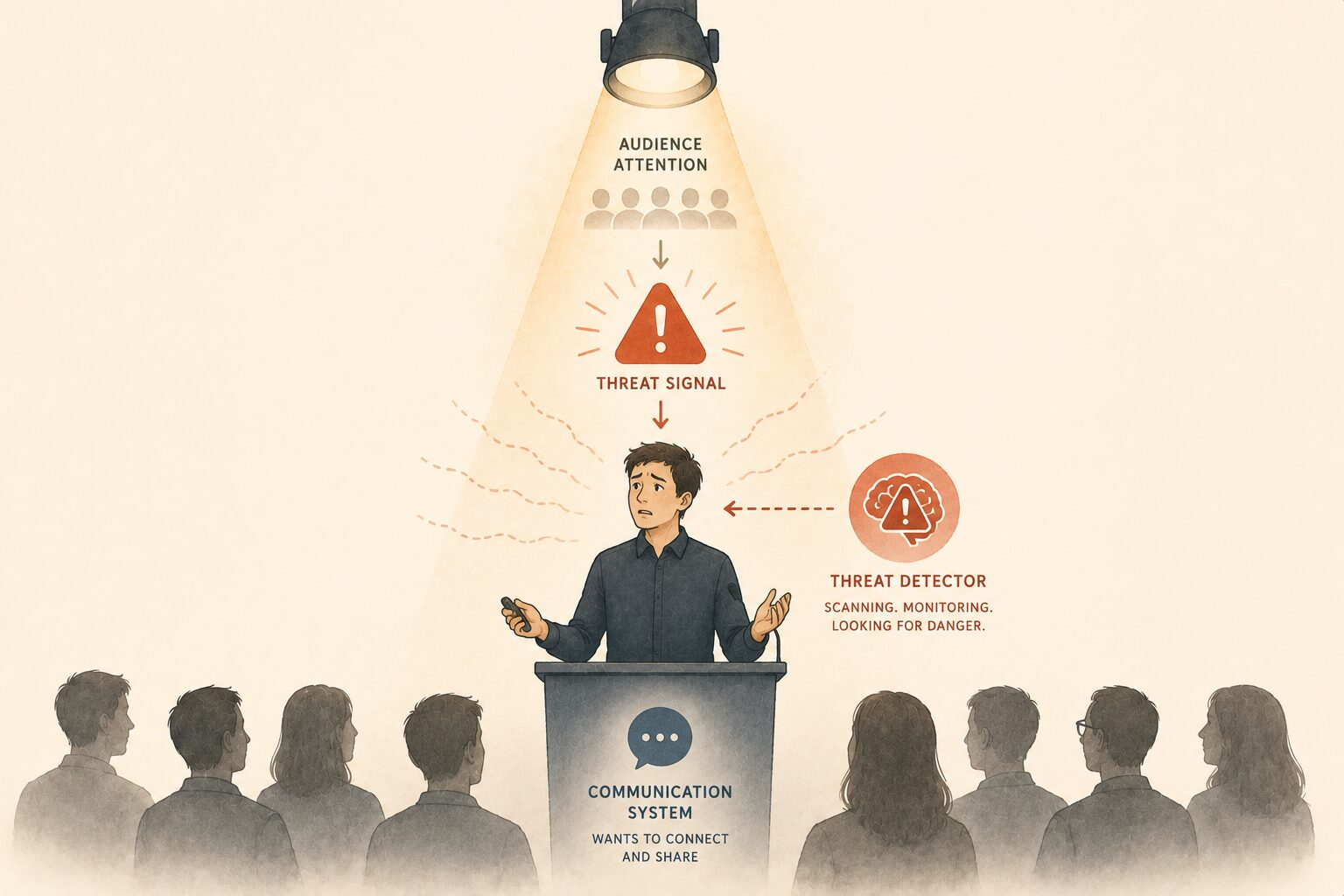
When you step in front of a room full of people and feel their attention on you, a part of your brain called the amygdala activates. The amygdala’s primary job is to detect threats and prepare your body to respond to them. It’s ancient, fast, and remarkably unsophisticated in one specific way: it doesn’t distinguish meaningfully between physical threats and social ones.
A predator in the wild and a room full of people watching you activate the same basic threat response. Your amygdala doesn’t know the difference between I might be attacked and I might be judged. Both register as danger, and both trigger the same cascade of protective responses associated with anxiety — heightened alertness, increased heart rate, narrowed attention.

I wrote about this mechanism in depth in my post on why social anxiety takes so long to overcome — specifically why, in social anxiety, the threat response gets buried in the subconscious and why it’s so resistant to rational argument. What’s relevant here is this: when your amygdala decides the room is a threat, your brain shifts into survival mode. And survival mode is not a good state for presenting.
You’re still trying to think and communicate. But you’re doing it while another part of your brain is simultaneously scanning for danger, monitoring how you’re coming across, and running a continuous threat assessment on the people in front of you. It’s like trying to drive a car while someone else in the passenger seat is repeatedly grabbing the wheel.
The Anxiety Cycle on Stage
What makes this particularly hard to escape is that presentation anxiety operates as a self-reinforcing cycle — each element feeding back into the next.
It starts with a trigger: you walk on stage and the attention lands on you. Your brain perceives that attention as a potential threat. That perception generates a physical response — racing heart, shallow breathing, tension in the body. Your attention turns inward toward those physical sensations, which generates negative thoughts: I’m going to mess this up, everyone can see I’m nervous, I’m not good at this. Those thoughts reinforce the belief that the situation is dangerous. And that belief makes the whole cycle stronger the next time.

To overcome this vicious cycle, the instinct isn’t to try to address all of it at once.
It’s in two specific places: your perception of the threat, and where your attention is directed. Those are the places that, when you shift them, begin to unravel everything else.
Three Ways to Break the Cycle
Step One: Recognize Thoughts as Passing Events, Not Truths
When your brain tells you that everyone in the room is judging you, it feels like an observation you’re making about reality. But it isn’t. It’s a prediction generated by a threat response trying to protect you, not accurately describe what’s happening around you.
The people in your audience are not, in most cases, cataloguing your mistakes and forming harsh judgments about your competence. They’re following along, half-distracted, thinking about their own things, hoping you say something interesting or useful.
Recognizing this doesn’t mean telling yourself to stop thinking negative thoughts. It means changing your relationship to them. Instead of treating them as facts that require a response, learn to notice them as passing events — things your brain is generating from within, not things in the room that are actually happening to you. Think to yourself: there’s the thought that everyone is judging me. My amygdala is doing its job. And then return to what you were saying.
That small shift — from this is what’s happening to this is what my brain is telling me is happening — begins to dismantle the perception that people are judging you.
Step Two: Shift Your Attention Outward
Here’s something that might seem counterintuitive: the more attention you put on yourself during a presentation, the worse the presentation goes. Not because self-awareness is bad, but because attention is a finite resource — and every unit of it that goes toward monitoring how you’re coming across is a unit that isn’t going toward what you’re actually trying to say.
When all your attention is on yourself, you’re no longer fully present in the communication. You’re attention is split between two things–yourself and your presentation. And that split is exactly what makes speech come out stilted, thoughts lose their thread, and the whole thing feel harder than it should.
The goal, then, isn’t to eliminate self-awareness entirely. That’s not realistic or even desirable. The goal is to reduce how much of your attention is being pulled inward — and the most effective way to do that is to deliberately redirect it outward toward your message, the ideas you’re trying to communicate, and the actual people in the room.
When you’re genuinely focused on the content and the audience rather than your own performance, the self-monitoring begins to quiet down. And in that space, what you actually know starts to come through more naturally.
Step Three: Reframe How You Interpret Past Presentations
The third piece is one that often gets missed — and it’s about what happens after the presentation is over, not during it.
When you go into a presentation feeling anxious and struggle to express yourself the way you normally can, it’s very easy to walk away with the conclusion that you’re not good at presentations or that you just a person with presentation anxiety. What this does, psychologically, is it embeds experience into your identity.
You’re taking a temporary state and treating it as a permanent, defining truth about who you are. And doing this isn’t just validating something that isn’t true. It’s costing you the opportunity to make future presentations better than the ones you had before.
You are not your anxiety, or the failed presentation attempts you’ve had in the past. And making this reframe is incredibly important.
In fact, the National Library of Medicine states that cognitive reframing — the practice of changing how you interpret and relate to past experiences — is one of the most evidence-supported approaches for reducing performance anxiety. Consistently, research points to the same insight: it’s not the experiences themselves that maintain anxiety, it’s the meaning you assign to them.
When you stop treating past presentations as evidence of who you are, they lose their grip on who you’re becoming. You go into the next one with less identity on the line. And when less of your identity is at stake, less of your bandwidth goes toward protecting it — which means more of it goes toward actually presenting.
Bringing It Together
Here’s the picture that emerges when you put all of this together.
Presentations feel hard not because you’re bad at them. They feel hard because your brain has learned to treat the spotlight as danger. And when that happens, the part of you that’s trying to communicate gets overridden by the part of you that’s trying to survive.
But now you know what’s actually happening. The amygdala doesn’t care that you’ve prepared. It just knows people are watching and it wants to keep you safe. The thoughts telling you that everyone is judging you aren’t facts. They’re your brain doing its job, not accurately describing your reality. And the story you’ve been telling yourself about being bad at presentations isn’t a truth. It’s a temporary state that got mistaken for a permanent one.
The path forward isn’t more preparation. It’s recognizing the thoughts for what they are, shifting your attention back to your message, and stopping the habit of turning anxious moments on stage into evidence about who you are.
Have you experienced this — knowing your material cold but still falling apart on stage? I’d love to hear your experience in the comments below. What’s been the hardest part of presenting for you? Your story might be exactly what someone else needs to read.
You’re Not the Anxiety — You’re the Person Moving Through It
Presentation anxiety is one of the most common and most misunderstood experiences that comes with social anxiety. And the belief that it’s somehow about preparation, confidence, or something you’re doing wrong keeps people stuck in a cycle that more effort can’t break.
What breaks it is understanding. Understanding what your brain is actually doing, the difference between a thought and a fact, and that the person who struggled through that last presentation isn’t a fixed version of you — it’s a version of you under pressure doing their best with what they had.
You showed up. You moved through it. You’re still here, still trying to figure it out.
If you want to keep going deeper on the psychology of social anxiety — identity, the threat response, and what real recovery looks like from the inside — join my newsletter here. I write about all of it, every week, and I’d love to have you along.

Hi, I’m Blake Baretz, the creator of Social Anxiety Haven. I write about my personal journey with social anxiety and share research-backed strategies to help others navigate it. If you’d like more encouragement and resources, join my weekly newsletter.
Leave a Reply