If you’ve struggled with social anxiety for any length of time, there’s a good chance you’ve asked yourself some version of the same question…
How long is this going to last?
Maybe you’ve been fighting it for years and you’re exhausted. Maybe it’s cost you friendships, opportunities, versions of your life you’ll never get back. Maybe you’ve tried things — therapy, exposure, self-help, sheer force of will — and you’re still here, wondering if there’s a ceiling on how much better things can actually get.
You deserve an honest answer. A real explanation of why social anxiety is built to last — and what that understanding actually means for your recovery.
That’s what this post is about.
Reason One: The Threat Response Is Buried in Your Subconscious
The first thing to understand — and this is probably the most important — is that social anxiety is not a rational fear.
Most people, including many who haven’t experienced it firsthand, assume social anxiety works like other fears. That it’s thought-based, or if you can just challenge your thoughts or reason your way to a different conclusion, the anxiety will lessen. This is one of the most persistent misconceptions about the condition — and it’s one of the main reasons people get stuck in recovery.
Social anxiety isn’t built on thoughts. It’s built on years — sometimes decades — of negative social experiences that have been absorbed into the subconscious mind. The thoughts are a symptom of something deeper, not the root.
The way I think about it is this. Imagine a clean river. If you throw one piece of trash in, it barely makes a difference. The water is still clear and healthy for life for sustain itself. But let’s say you decided to throw a piece of trash in every day. Over time, the trash in the river starts to accumulate, until one day the river becomes unsustainable for life. The damage caused to the river isn’t because any one piece of trash. It’s from the slow, invisible accumulation of all of it — festering, spreading, contaminating the whole system.

Your brain works in a similar way. When you experience a negative event — a humiliating moment, a rejection, being left out, being mocked — and your brain internalizes that experience as though you were the problem, you’re collecting a piece of trash. One negative event doesn’t cause social anxiety, but the accumulation of those experiences over time can “pollute” the river inside of your mind — creating a negative core belief.
At this point, social anxiety stops being a reaction to specific events and starts being the baseline. The river inside of your mind is polluted, and the brain is just operating from that polluted water system every time it encounters a social situation.
So the problem isn’t necessarily any singular social experience you might have had. It’s the accumulation of all of them, contributing to an underlying system of threat that is operating as a baseline assumption.
This is why social anxiety lasts so long on a neurological level. Just like you can’t clean up a polluted river overnight (even after you remove all of the trash), you can’t change the way your brain has learned to perceive things overnight either. The subconscious doesn’t respond to logical arguments. It responds to accumulated experience — which means rebuilding it requires accumulated new experience, applied consistently over time.
This is the slow, deliberate work of recovering from social anxiety. But it’s the kind that actually changes things at the root.
If you want to go deeper into social anxiety recovery — the subconscious patterns underneath it and what it actually looks like to rebuild them — subscribe to the newsletter here. It’s what this blog is built around, and I’d love to help you throughout your recovery.
Reason Two: The Threat Is Abstract and Diffuse
The second reason social anxiety lasts so long is that it’s extraordinarily hard to target — the fear itself doesn’t have a clear, specific source.
To understand why this matters, consider two people. The first has a fear of spiders. Every time he goes out into the world, he knows exactly what he’s afraid of. He sees a spider, his brain sends off a threat response, and he understands precisely why he feels the way he does. The threat is clear. It’s specific. And critically — it’s avoidable. He can go his entire life steering clear of spiders and function just fine.
Now consider the second person — someone with social anxiety. His brain is sending off the same kind of alarm. But here’s the difference: he can’t point to one specific thing and say that’s what I’m afraid of. Is it the people? The judgment? The possibility of embarrassing himself? The fear of being exposed as insufficient? It’s all of it and none of it at the same time. And worst of all, no matter where he goes, he can’t avoid it, because people are everywhere.

This is what makes social anxiety so uniquely difficult to treat. With a spider phobia, a therapist has a clear starting point. They can identify the trigger, build a gradual exposure hierarchy, and systematically help the brain learn that spiders aren’t actually dangerous. The path is relatively straightforward.
With social anxiety, there’s no single thread to pull on. There’s a web — a dense, interconnected tangle of fears, beliefs, memories, and experiences that have been building for years, often since childhood, and in ways the person can’t fully articulate. Unpacking that web takes serious time, patience, and a kind of self-understanding that doesn’t come quickly or easily.
I wrote about the deeper structure of this in my post on what social anxiety really is — specifically how shame becomes the engine underneath the fear, and why that makes the condition so much more complex than a simple phobia. If you haven’t read it, it gives important context to everything we’re talking about here.
Reason Three: Social Anxiety Never Fully Goes Away — And That’s Actually Good News
This might be the most counterintuitive thing in this post, so I want to say it carefully.
Social anxiety, in its most basic form, never fully disappears. And that’s not a tragedy. It’s actually by design — and once you understand why, it changes how you think about recovery entirely.
Think about what a life with zero social anxiety would actually look like. You’d say whatever came to mind without considering how it landed. You’d interrupt, talk over people, make everything about yourself — and feel nothing about any of it. You’d burn bridges without noticing, push people away without caring, and move through the world with a complete absence of self-awareness that makes real relationships possible.
Having no social anxiety isn’t freedom. It’s just a different kind of prison — one that damages everyone around you while you remain completely unaware.
In fact, the American Psychological Association states that anxiety in social contexts serves an adaptive function — it evolved as a mechanism for maintaining social bonds and navigating group dynamics. The problem, then, isn’t that the mechanism exists. The problem is when it gets stuck on overdrive.
Which brings me to a useful way I’ve found to think about recovery.
Social anxiety is like constantly managing an internal dial. On one end: zero social anxiety — the scenario we just described. On the other end: crippling social anxiety, the kind that makes ordinary moments feel like emergencies and keeps you from living the life you want.
Most people reading this are somewhere near that second end. And the goal of recovery isn’t to get to zero. It’s to find the middle — enough awareness to be considerate, thoughtful, and connected, but not so much that it’s running your life and holding you back from everything you want.

This is why, for many people recovery takes as long as it does. You’re not flipping an internal switch from “total anxiety” to “no anxiety”. You’re calibrating a fine dial your brain has never naturally found before.
And that kind of internal calibration doesn’t happen overnight. It takes time, patience, and a lot of trial and error. But it is absolutely reachable. I know that because I’ve been to the far end of that dial — and I’m not there anymore.
What This Means for Your Recovery
So to bring all of this together, the reason social anxiety has lasted as long as it has in your life isn’t because something is permanently wrong with you.
It’s because of what social anxiety actually is — a subconscious threat response built over years, a diffuse and abstract fear that resists simple targeting, and a dial that needs careful calibration rather than a simple switch that needs flipping.
Understanding that changes the recovery frame entirely.
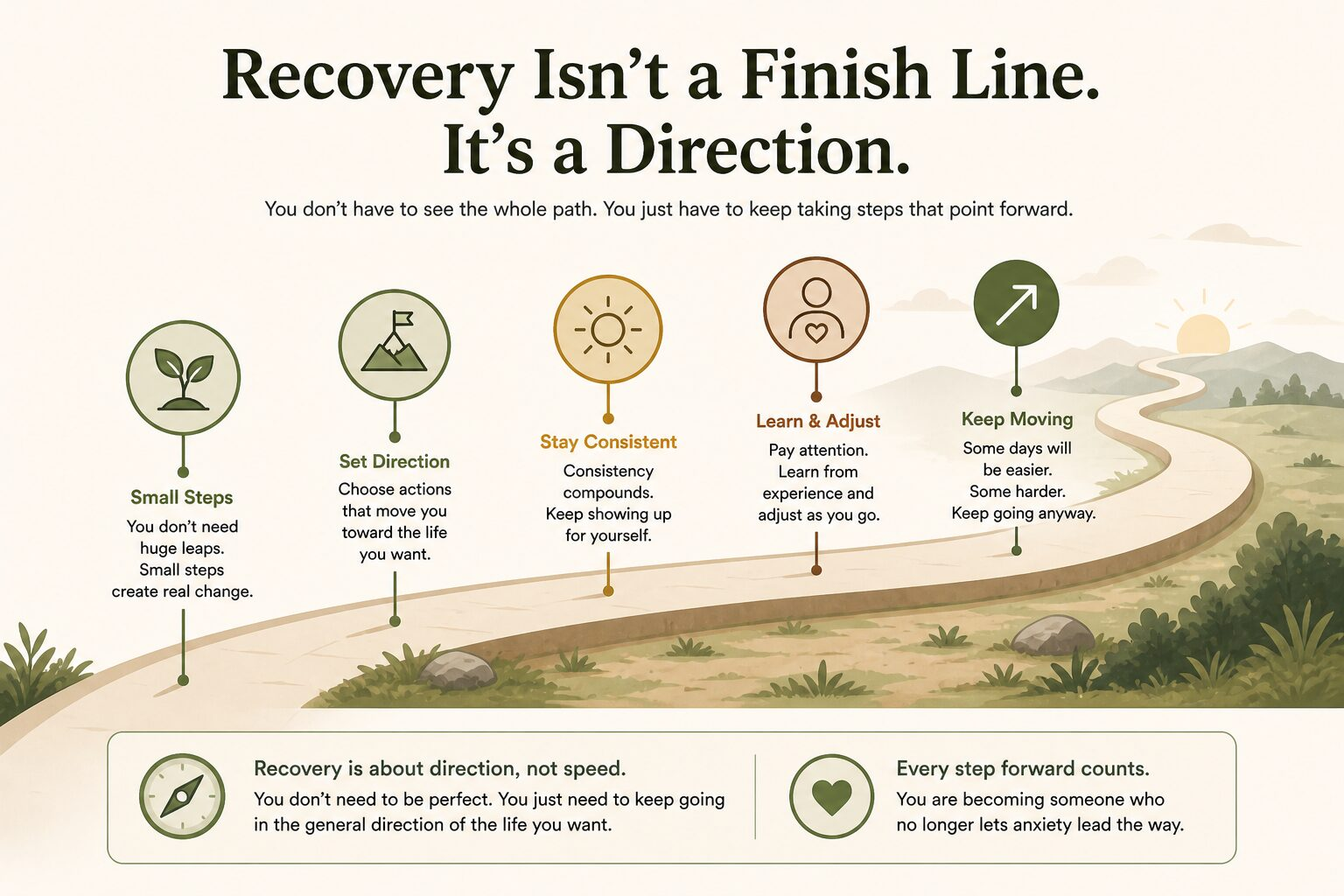
Recovery is not about speed or quickness. It’s about direction and intention. It’s about consistently moving toward that middle of the dial, one experience at a time, one updated belief at a time, one moment of showing up despite the fear at a time.
Where are you in your own recovery right now? I’d love to hear from you in the comments below — whether you’re just starting out, somewhere in the middle, or on the other side looking back. Your perspective might be exactly what someone else needs to read today.
You’re Not Behind — You’re Just Working on Something Hard
Social anxiety takes a long time to overcome because it’s genuinely hard to recover.
You are not behind. You are not running out of time. You are in the middle of something that takes as long as it takes — and there is no better reason to start moving than right now.
If you want weekly writing on the deeper patterns of social anxiety and what recovery actually looks like from the inside out, join the newsletter here. I’d love to walk this road with you.

Hi, I’m Blake Baretz, the creator of Social Anxiety Haven. I write about my personal journey with social anxiety and share research-backed strategies to help others navigate it. If you’d like more encouragement and resources, join my weekly newsletter.
Leave a Reply