If you’ve ever tried to reason your way through social anxiety and had none of it work, I want to offer you a precise explanation for why.
The technique you applied was applied to the wrong target. You were focusing on a fear in the present moment, when it was really a fear based in the past.
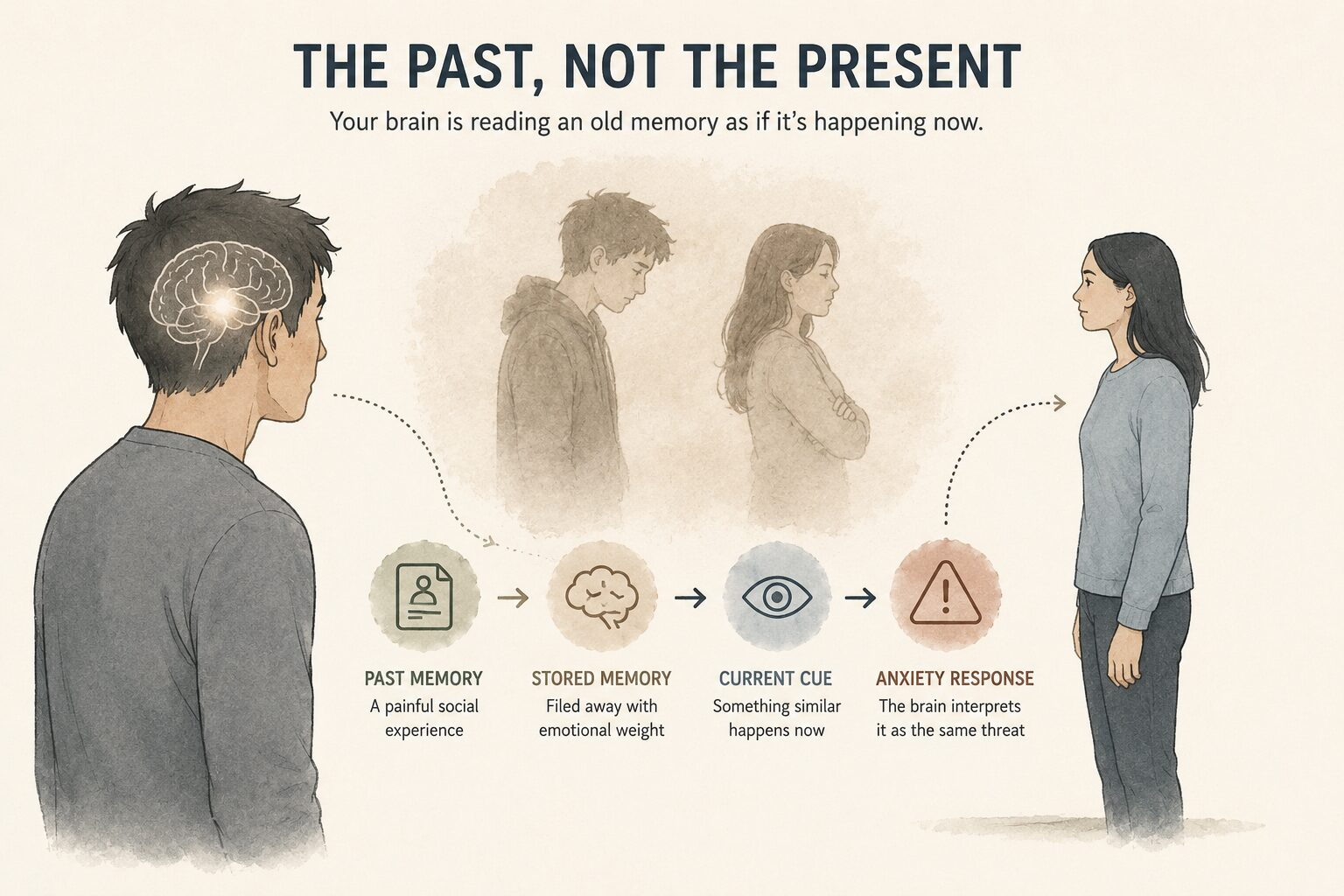
Social anxiety disorder is not a fear that is rooted in present social threats. It is constructed through a memory system that creates negative social memories and attributes them to the present moment rather than being recognized for what they are — memories.
This post is about the mechanism that makes that happen. How a past social experience becomes a present-tense alarm, why it arrives feeling like information about the person you’re currently facing, and why every technique built on the assumption that you’re afraid of now keeps missing.
The Misconception at the Center of Almost Every Treatment
The standard account of social anxiety describes it as a fear of social situations — fear of being evaluated, fear of embarrassment, fear of negative judgment from the people around you. And that description is accurate, as far as it goes.
What it misses is where the fear actually originates.
The fear doesn’t begin when something threatening happens in front of you. It begins in memory.
Here’s an example that makes this concrete.
You’re at a party and across the room there’s someone you’re drawn to. Nothing has happened yet. They haven’t looked at you, haven’t spoken to you, haven’t done anything at all. But before you’ve taken a single step toward them, the anxiety is already running — chest tight, thoughts accelerating, a quiet voice somewhere underneath everything telling you how this is going to go.
That voice isn’t making a prediction about this person. It’s reading a memory.
Somewhere in your history, there was a moment when you were yourself around someone — fully, unguardedly yourself — and what came back wasn’t connection. It was rejection, or indifference, or something that landed in the body as confirmation of a fear you were already carrying. The specific memory might not surface consciously. You might not be able to name it. But your nervous system logged it, and it has been storing it ever since, and the moment this situation resembled that one closely enough, the memory fired.
Not as a recollection. As a warning.
By the time you’re considering whether to walk across the room, your nervous system isn’t evaluating the person in front of you. It’s responding to an archived event from a different time, with a different person, in a different room — and delivering that response as though it were information about right now. The fear feels present-tense because it arrives present-tense. There’s no label on it that says this is old. It lands as a read of the current situation, and your body responds accordingly.
The person across the room didn’t produce that fear. They were just close enough to the stored pattern to trigger the retrieval.
The person in front of you didn’t produce that fear. They activated it — by being a close enough match to the stored pattern that the alarm started running.
Social anxiety, understood precisely, isn’t a fear of what’s happening now. It’s a fear that what happened before is about to happen again. And it’s that memory-driven fear response that fires in real time, in the body, in the room, as though the threat were present — because to the part of the brain generating the alarm, it is.
Which raises the question the standard account doesn’t answer: if memory is driving the fear, what’s causing the memory to behave this way?
If this is already reframing something for you — join my newsletter here. Every week I write about the mechanisms underneath social anxiety and what recovery actually looks like when you’re working at the right level. I’d love to have you there.
How Memory Actually Retrieves Itself
Most people think of remembering as a single process. Something prompts you, you search, you find it, it comes back. But memory retrieval isn’t one process — it’s at least two, and the difference between them is what this entire mechanism depends on.
The first mode is what researchers call generative retrieval. It’s slow and effortful. Your mind sets a cue, searches through what it has stored, verifies what it finds, and constructs a memory that fits the narrative you currently hold about yourself. This is the kind of remembering you do deliberately — when you sit down and try to recall something, when you consciously look back at a period of your life. The working self is involved throughout. It regulates what comes up. It contextualizes it. It can tag it as past.
The second mode is direct retrieval. And it works almost nothing like the first.
In direct retrieval, a stable pattern of activation forms within the memory system itself — not through a search, but spontaneously, because the memory has been so consistently paired with a particular goal or emotional state that it no longer requires a search process to surface. It arrives. Without effort. Without the working self initiating anything.

The researcher who mapped this most precisely, Martin Conway, is explicit about one critical detail: in direct retrieval, the part of the mind that would normally regulate and contextualize a memory — the part that would tell you this is something that happened before — operates only after the memory has already arrived. Not before. By the time your regulatory apparatus could flag it as a past event, the memory is already present in your awareness, already carrying its full emotional weight, already shaping how you’re reading the situation in front of you.
For someone with social anxiety, the memories that have been most consistently paired with the goal of avoiding rejection — memories of humiliation, of reaching for connection and being turned away, of being seen and found wanting — are precisely the memories that become candidates for direct retrieval. Not because they’re accessed frequently in the deliberate sense, but because their relevance to the goal the mind is organized around is so strong that the activation pattern forms on its own, and fires before regulation can reach it.
This is why telling yourself the threat isn’t real doesn’t work. By the time you’re telling yourself that, the memory has already arrived. The alarm has already run. You’re arguing with an output, not interrupting the process that generated it.
The Fear Is Reading the Memory, Not the Room
Here’s what happens once that direct retrieval fires.
The brain’s threat-detection system operates on similarity. When a current situation resembles a stored pattern closely enough — same social stakes, same possibility of exposure, same type of person or setting — the full emotional signature of the original event gets retrieved and delivered as present-tense data. Not as a memory of something that happened. As information about what’s happening right now.

The fear doesn’t arrive labeled as a memory. It arrives as a perception. A reading of the room. A sense of what the person across from you is thinking, what they’re about to do, what this situation is going to produce. And because it arrives that way — immediately, physically, without any announcement of its source — you have no mechanism for correctly locating it in time. So you locate it in the only place available: the present.
This is why I could do everything right in a social situation — stay in the conversation, not escape, even have an exchange that went reasonably well — and still walk away convinced it had been a disaster. Still certain the other person had seen something in me that confirmed what I already believed. The feelings weren’t irrational. They were the precise output of a retrieval process delivering archived information as though it were current, and a threat-detection system responding to that information with full seriousness. The alarm was doing exactly what it was built to do. It just wasn’t reading the room. It was reading the memory the room had triggered.
What I didn’t know then — and what changed things when I finally understood it — was that the people I was afraid of weren’t actually the source of the fear. They were cues. Triggers. The fear they activated had been stored long before I ever met them, in experiences that had nothing to do with them. My nervous system had just learned to read their presence as evidence that those experiences were about to repeat.
Why “Is This True?” Is the Wrong Question
Cognitive restructuring — the technique at the center of most cognitive approaches to social anxiety — is built on a specific assumption: that the fear you’re experiencing is generated by a current appraisal. That you’ve looked at the situation in front of you, drawn a negative conclusion, and that the fear follows from that conclusion. The intervention that follows from this assumption is to challenge the conclusion. Ask whether it’s accurate. Find the counter-evidence. Replace the distorted thought with a more balanced one.
That’s a reasonable intervention if the assumption holds.
But the assumption doesn’t hold here.
If the fear isn’t generated by a current appraisal — if it arrives through a direct retrieval process that bypasses the regulatory apparatus entirely, delivering a past emotional signature as present-tense data — then challenging whether the conclusion is accurate is working on the wrong layer. You’re not correcting a misappraisal of what’s in front of you. You’re arguing with an output of a memory system that has already fired, using a process that operates too slowly and too late to interrupt it.
The question cognitive restructuring asks is: is this true?
For someone with social anxiety, a more precise question would be: is this even about now?
And the answer, almost every time, is no. The fear is reading something archived. The person in front of you is a cue. What got activated was a stored pattern from a past that your nervous system has never finished processing — and that past is what the alarm is actually responding to.
That reframe doesn’t make the fear disappear. But it relocates it. And relocating it correctly — understanding that the source is memory rather than the present moment — is the first step toward working on the right problem.

Has this mapped onto your experience of anxiety in social situations — the sense that the fear is somehow already running before anything has actually happened? I’d genuinely like to hear it in the comments below.
What This Points Toward
What this video establishes — and what this post has tried to make precise — is the gap between where standard treatment looks for the fear and where the fear is actually coming from.
If the fear is memory-driven, then the level that matters isn’t the thought level. It isn’t the behavior level. It’s the level of the stored event itself — the archived experience the alarm is reading from — and what it would take for that stored material to stop functioning as a live threat signal.
That’s not something that happens through thought challenges. It’s not something that happens through exposure alone, for reasons I’ve covered in an earlier post. The mechanism is operating below both of those layers, in a part of the system that neither approach was designed to reach.
For the broader picture of how the fear-maintenance system works — including the suppression strategy that feeds the autobiographical memory base the retrieval system draws on — my post on the real reason social anxiety doesn’t go away covers the foundation. And for the structural ceiling this creates for exposure-based approaches specifically, why exposure therapy alone fails social anxiety goes into that directly.
The layer underneath all of it — what has to happen at the memory level itself for any of this to actually change — is what my newsletter is built around. Not the symptom layer. Not the behavioral layer. The architecture of the stored material and what genuine change at that level actually requires.
If this post is the first explanation of your social anxiety that has located the fear in the right place — that’s where to go next.
Join the newsletter here. I write every week, and I’d love to have you there.

Hi, I’m Blake Baretz, the creator of Social Anxiety Haven. I write about my personal journey with social anxiety and share research-backed strategies to help others navigate it. If you’d like more encouragement and resources, join my weekly newsletter.
Leave a Reply