I spent a long time convinced that I wasn’t trying hard enough to recover.
I had done the work. I’d gone to therapy, challenged my thoughts, pushed myself into situations that terrified me. I understood, intellectually, exactly what social anxiety was and how it was supposed to be treated. And still — underneath all of it — something kept regenerating the pain. The cycle would reset. The anxiety would come back. And every time it did, the conclusion felt more inevitable: the problem isn’t the approach. The problem is me.
Given what I could see, that conclusion felt rational.
What I couldn’t see was the thing producing all the evidence I was using to reach it.
This post is about that thing — the mechanism that sits underneath the anxiety, avoidance, and everything the standard model describes.
The Standard Explanation — and Why It’s Incomplete
The standard explanation for why social anxiety persists goes something like this: you have negative automatic thoughts about social situations. Those thoughts generate anxiety. The anxiety drives avoidance. And avoidance prevents you from accumulating the kind of evidence that would disconfirm the thoughts — so the cycle continues.
That model isn’t wrong. It describes something real, and if it had worked for you, you wouldn’t be reading this.
The problem isn’t that it’s false. The problem is that it’s describing the surface layer of the condition. What it doesn’t describe is the mechanism that’s generating the thoughts in the first place. The thoughts, anxiety, avoidance — those are outputs. Something is producing them. And that something stays completely off the map in most standard approaches to treatment.
Until you name the input source, working on the outputs is almost impossible to sustain. You can interrupt the cycle temporarily. But the thing driving it stays active, and the cycle reconstitutes. Over and over. And every time it does, you take it as evidence about who you are rather than evidence that you’re working on the wrong layer.
That input source has a name.
If this is already reframing something for you — join my newsletter here. Every week I write about the mechanisms underneath social anxiety and what recovery actually looks like when you’re working on the right layer. I’d love to have you there.
The Mechanism: Self-Suppression
The thing that maintains social anxiety — at the level most approaches don’t reach — is a self-suppression strategy.
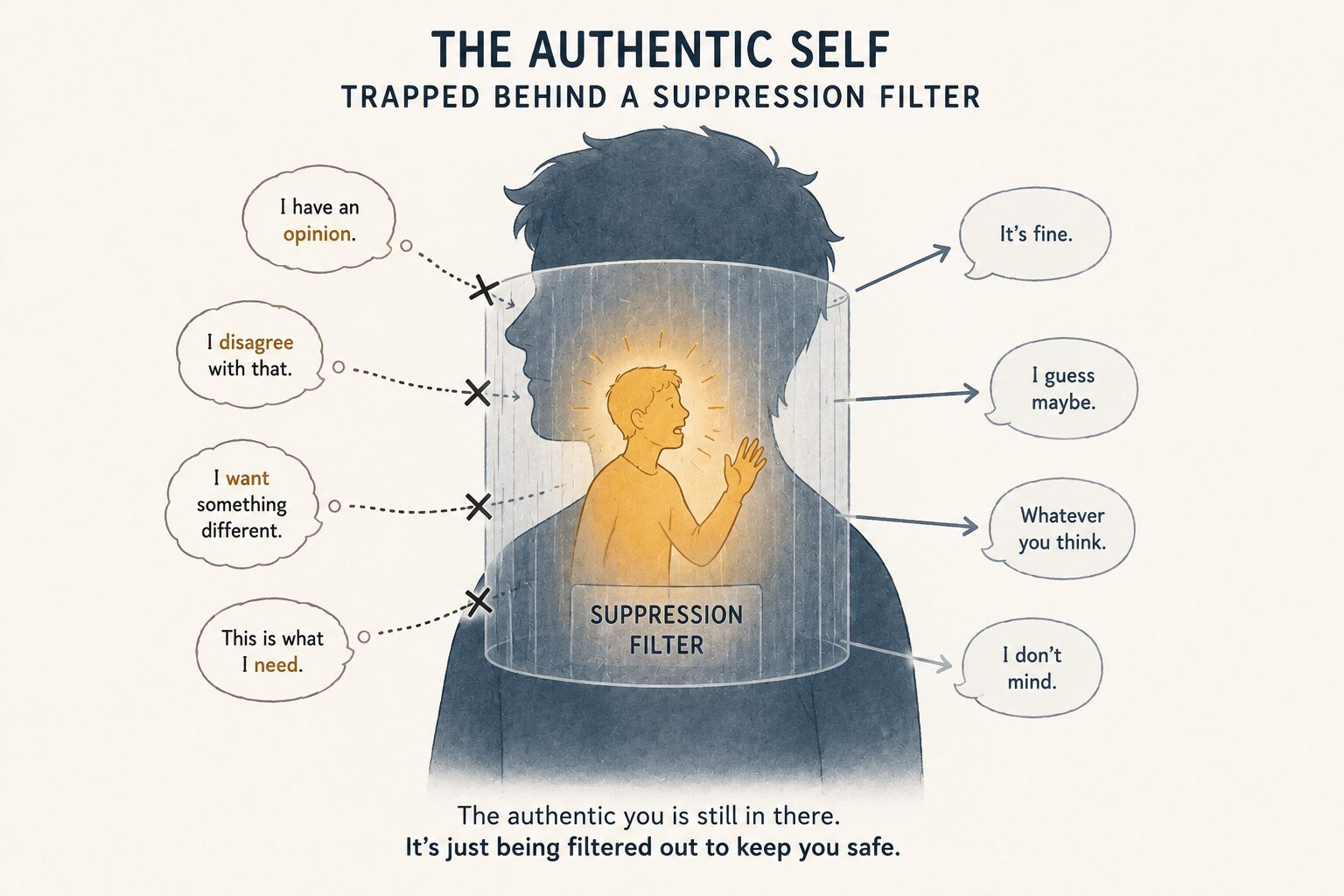
Self-suppression is the deliberate or subconscious filtering of your authentic self in social situations — pulling back what you actually want to say, minimizing your presence, deferring, giving the version of yourself that takes up less space — out of fear of how you’ll be received.
And here’s what makes it so hard to identify: it isn’t found in the big, dramatic moments. It’s found in the small ones. The ones that feel almost completely automatic.
Someone asks you what you want from the grocery store. And something in you pulls back. You don’t fully answer. You hedge. You minimize. You give a version of an answer that keeps you small and safe and unlikely to be judged for wanting the wrong thing.

That’s the suppression strategy. And by the time social anxiety has been running at any significant level, it isn’t a decision anymore. It runs before you have the chance to notice it running.
Here’s where it comes from. Early experiences — direct negative social feedback, or just the persistent, grinding feeling of not quite connecting, of being somehow invisible despite trying — condition a very rational response: if authentic expression generates bad outcomes, minimize it. The strategy is built on negative reinforcement. Anxiety drops when you suppress. So the suppression gets reinforced. Over and over and over, until it becomes automatic. Until it disappears from your awareness entirely.
Which is exactly when it becomes the most dangerous thing in the condition.
Why It’s So Hard to See: The Three Costs
Here’s what makes the suppression strategy so difficult to identify — and so difficult to treat.
Every time it runs, it produces three consequences simultaneously. And all three of those consequences get attributed to who you are rather than to the strategy.
The first cost is degraded self-concept clarity. When you continuously filter your authentic responses — when the edited version is what you present to the world — you progressively lose access to reliable information about your actual preferences, your actual reactions, your actual social self. The signal channel goes quiet. And when you try to ask yourself what do I actually want here or what do I actually feel about this person — the answer is genuinely harder to access. Not because there’s nothing there. Because the suppression strategy has been running the channel that would carry that information into the ground.
The second cost is what researchers call sociometer deprivation. The sociometer is the internal system that tracks your genuine sense of social belonging — and it needs real inclusion signal to function. Not performed connection. Not the version of you that shows up when you’re managing your presentation. It needs authentic exchange. When suppression prevents that — when every interaction is a managed performance rather than a genuine encounter — the sociometer receives no real signal. It stays in a state of chronic deprivation. The loneliness doesn’t lift even when you’re surrounded by people, because you were never really there.
The third cost is degraded real social performance. When you’re running a constant self-monitoring strategy — editing yourself in real time, regulating your expression, managing how you’re being perceived — you are consuming cognitive resources that should be going to the actual conversation. The natural, at-ease version of you isn’t accessible when the suppression strategy is running. And other people read that, not consciously, but they experience someone who seems slightly unreachable. Slightly hollow. Their response — pulling back a little, not pursuing the connection — becomes more evidence. More data that gets attributed to who you fundamentally are.

The strategy generates the evidence. And then it hides.
I know this from the inside because when I was deepest in it, I didn’t experience it as hiding something. I experienced it as discovering something. I was looking for a natural, at-ease social self — some version of me that connected with people without effort — and I couldn’t find it. And I didn’t think I’ve been suppressing it. I thought: it was never there. I’m just not someone who is naturally good at this. Something is missing.
That experience — a part of you that seems gone, that you didn’t even know you’d lost — is not a character defect. It is the precise psychological fingerprint of a long-running suppression strategy. The part didn’t disappear. It was conditioned out of expression until it stopped feeling present.
This is why the condition generates its own confirming evidence while the cause stays hidden. You’re not wrong to conclude something is wrong with you — given what you can see, that inference is rational. What you can’t see is the causal agent that has been producing every piece of evidence you’ve used to reach that conclusion.
If you want to understand more about how this internal loop sustains itself — the thoughts, emotions, and physical sensations that keep the cycle running from the inside — my post on internal social anxiety triggers maps this in detail.
The Double Bind
Here’s what makes all of this even harder to escape: the goal architecture splits.
You still want connection. That hasn’t gone anywhere. The desire for genuine friendship, for being known, for belonging — it’s fully intact. It was there before the condition formed and it persists throughout the entire duration of it. That persistent desire is part of what makes the suffering so chronic.
But underneath that explicit goal, there’s an implicit system — the one running the suppression strategy — that has reorganized around a completely different objective: don’t let them see how defective you actually are. Limit exposure. Control the presentation. Minimize the risk of full visibility.
Two systems. Running simultaneously. Pointing in opposite directions.

The connection-seeking goal pushes you into social situations. The concealment goal activates the suppression strategy the moment you arrive. You go to the party. You manage every interaction. You leave feeling more alone than when you came in — and the implicit system reads that as confirmation. See? Genuine connection isn’t available to someone like you. The strategy was right.
This is why effort doesn’t break the pattern. You can try harder at socializing — attend more events, push through more interactions, force more conversations. But if the suppression strategy is running underneath all of it, the effort is being applied to the output while the mechanism generating the problem stays active. You’re working harder inside a system that is designed to reconstitute itself.
The bind is this: the thing you need to do to genuinely connect is precisely what the suppression strategy exists to prevent. Not because you’re weak. Because the strategy has been conditioning this response since before you were aware of it. And it is very good at its job.
This is also why CBT tends to have a ceiling for this profile of person — you can read more about that structural gap in my post on why CBT didn’t work for my social anxiety.
What This Actually Means
So here’s what’s actually happening.
Social anxiety doesn’t persist because of the anxiety. It persists because of the self-suppression strategy running underneath it — conditioning its costs onto your sense of self, generating its own confirming evidence, and hiding its causal role the entire time.
That is why nothing you’ve tried at the level of the thoughts has held. You were working on outputs generated by a mechanism you didn’t have a name for.
Now you have a name for it.
But naming it is only the first layer. Because what the suppression strategy does — over time, across enough cycles — goes deeper than anxiety. It rewrites who you believe you are. It doesn’t just make you anxious in social situations. At a certain point in its development, it stops being something that happens to you and starts being something you become.
That is the next layer. And it’s the layer that explains why understanding this — even at the depth we just went — doesn’t automatically produce recovery. Intellectual understanding isn’t enough when the identity itself has been rewritten. That’s what I’ll be covering next.
For now: you were never the problem. The mechanism was. And the fact that you can see it clearly for the first time is not a small thing.
I’d genuinely like to hear where this lands for you. If the suppression pattern I described is something you recognize in your own experience, leave a comment below. Putting language to something you’ve been living with for years is part of how this starts to shift.
The Layer Underneath This One
What I’ve covered today is the mechanism — the self-suppression strategy, how it forms, what it costs, and why it keeps the cycle intact even when you’re working hard to break it.
What comes next is the question that follows naturally from all of it: if suppression rewrites who you believe you are, what does it actually take to change that? Not manage it. Change it.
That’s what my newsletter is built around — the identity layer that sits underneath everything we covered today, and what a real path toward recovery looks like when you’re finally working on the right thing. If this post is the first explanation of your experience that has actually made sense, that’s where to go next.
Join the newsletter here. I write every week, and I’d love to have you there.

Hi, I’m Blake Baretz, the creator of Social Anxiety Haven. I write about my personal journey with social anxiety and share research-backed strategies to help others navigate it. If you’d like more encouragement and resources, join my weekly newsletter.
Leave a Reply