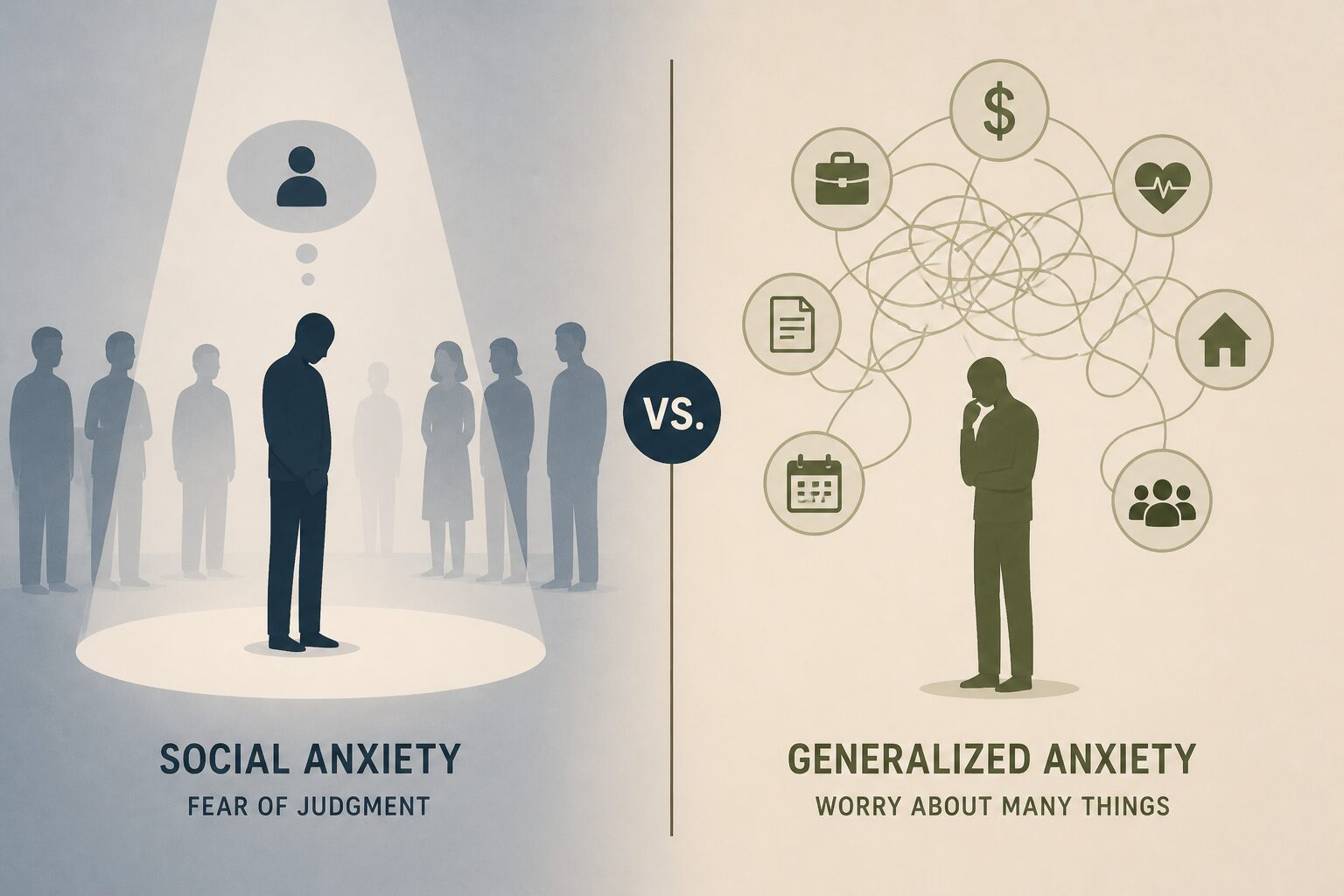
Social anxiety has a way of showing up where you least expect it.
It’s there when you’re standing in front of a room full of people, but it’s also there when you’re sitting across from someone on a first date, when your phone lights up with a notification, or in the anticipation of a conversation you haven’t had yet.
When anxiety touches that many parts of your life, it’s natural to start wondering whether what you’re dealing with really is just social anxiety — or whether more general is at work.
That question is worth taking seriously. Because social anxiety and generalized anxiety disorder are two distinct conditions with different roots, different patterns, and different implications for recovery. They can look similar from the outside — and they can coexist — but understanding which one is driving your experience, or how they’re interacting when both are present, is something that can give you something more concrete to work with.
That’s what this post is about.
The Fear Behind Each Condition
If you’ve been following this series, you already have a good idea of what social anxiety disorder is. But the piece most relevant to this post is this: at its core, social anxiety is a fear of being yourself in the presence of others. Not just a fear of judgment — though that’s part of it — but a fear of social exposure.
The fear is social in nature. It needs an audience — real or imagined — to activate. Which is why, even when social anxiety spreads into unexpected corners of your life, like a buzzing phone or an unopened email, the fear underneath is always the same: what will someone think of me because of this?
Generalized anxiety disorder operates on a completely different engine.
GAD isn’t about people. It isn’t about being seen or evaluated or judged. It’s about uncertainty — specifically, the inability to tolerate not knowing how things will turn out. Someone with GAD worries across the full spectrum of life: their health, their finances, their relationships, their performance at work, the future in general. The anxiety doesn’t need a social trigger. It just needs something to be unresolved.

Where social anxiety asks “what will people think of me?”, generalized anxiety asks “what if something goes wrong?”
That distinction is the clearest way to start separating the two. And it’s the lens worth carrying through the rest of this post as you start to make sense of which pattern fits your own experience.
If you want weekly writing on how anxiety operates beneath the surface and what recovery actually looks like, join the newsletter here — it’s where I go deeper on everything this blog covers.
Social Anxiety Disorder vs. Generalized Anxiety Disorder: What’s the Difference?
Now that we have a clear picture of what each condition is afraid of, let’s look at how those differences play out across symptoms, triggers, internal experience, and coping patterns.
The table below gives you a quick reference: out to you:
| Feature | Social Anxiety Disorder (SAD) | Generalized Anxiety Disorder (GAD) |
| Primary Trigger | Social situations, being seen, evaluated, or judged | Uncertainty, negative personal outcomes, losing control |
| Core Fear | “What if people judge me for who I am?” | “What if something goes wrong in the future?” |
| Focus of Attention | Internally-based. Focus on the self, how others perceive you | Externally-based. Focus on future outcomes and hypothetical problems |
| Internal Dialogue | Self-critical, concerned about judgment or embarrassment | Worrying, imagining worst-case scenarios, overthinking |
| Typical Coping Behaviors | Avoidance, scripting conversations, self-monitoring, ruminating about social interactions | Overplanning, reassurance seeking, checking if things are in order |
| When Anxiety Peaks | During or anticipating social situations | Constantly, often independent of social context |
A few things in this table worth unpacking.
The focus of attention is a big difference. Social anxiety turns your attention inward — toward yourself, your performance, how you’re coming across. Generalized anxiety turns your attention outward and forward — toward future events, hypothetical problems, outcomes you can’t yet control.
The “when anxiety peaks” row is also worth sitting with. Social anxiety has a rhythm — it spikes before and during social situations and tends to ease when you’re alone or in a safe environment. Generalized anxiety doesn’t follow that rhythm. It runs in the background constantly, attaching itself to whatever is unresolved at any given moment. If social anxiety is a spotlight that switches on in certain situations, generalized anxiety is a fluorescent light that never fully turns off.
And the coping behaviors, while different in form, share the same fatal flaw: they both make the underlying fear worse over time. Avoidance reinforces the belief that social situations are dangerous. Overplanning reinforces the belief that uncertainty is intolerable. The relief each strategy provides is real but temporary — and the cost is a slowly shrinking life.
Social Anxiety Disorder vs. Generalized Anxiety Disorder: Can You Have Both?
If you read through that table and found yourself recognizing patterns in both columns, you’re not imagining it.
Social anxiety disorder and generalized anxiety disorder have a significant comorbidity rate, and the reason why makes sense once you understand how each condition develops.
Social anxiety, as we covered earlier, can spread beyond obviously social situations. When it touches enough areas of your life — your phone, work, relationships, your sense of what the future holds — it starts to look a lot like generalized anxiety from the outside. Living inside of that level of chronic fear tends to produce a kind of persistent, free-floating worry that defines GAD.

But here’s the nuance worth holding onto: even when both are present, one typically leads.
There’s usually a primary fear underneath both that the other fear has attached itself to. Someone whose anxiety is fundamentally social might develop generalized worry as a downstream effect of years of avoidance and isolation. Someone whose anxiety is fundamentally about uncertainty might find that social situations become a particularly concentrated source of that uncertainty over time. The conditions interact, but they don’t usually arrive as equals.
When both SAD and GAD are present at the same time, the experience tends to feel like this:
- Anxiety that spikes before, during, and after social interactions — and then keeps going, attaching itself to unrelated concerns about work, health, or the future.
- Fear of being judged or misunderstood by others alongside a persistent sense of dread that has nothing specific to point to.
- Replaying conversations and fixating on perceived social mistakes, while simultaneously overthinking future outcomes and trying to mentally prepare for everything that could go wrong.
- A widespread difficulty relaxing — not just in social contexts, but anywhere, at any time.
If that description fits, the most useful question to ask isn’t “which one do I have?” It’s “which fear tends to start the cycle?”
One clarification worth making here: having both SAD and GAD is different from having generalized social anxiety disorder, which is a subtype of social anxiety defined by fear and avoidance across most social situations rather than just specific ones. I cover this distinction in depth in my posts on the DSM-5 and ICD-10 — worth reading alongside this one if you want a complete picture.
But this does not necessarily mean you have both of them entirely. Even for people who are officially diagnosed with both, there is often one primary source behind their fears.
So while it might be possible to have GAD and SAD, one of them likely is contributing more to your anxiety than the other.
Where Do We Go From Here?
Understanding the difference between social anxiety disorder and generalized anxiety disorder isn’t about finding the right label for yourself. It’s about getting precise enough about what’s actually driving your fear so that you can stop fighting it blindly and start responding to it intentionally.
Anxiety feels overwhelming when it’s vague. When it seems to come from everywhere at once, it’s easy to feel like there’s no way to get traction on it. But that vagueness usually isn’t the whole picture. Underneath it, there’s almost always a primary fear doing the driving. And once you can see it clearly, you have something concrete to work with.
And if you want honest, experience-driven writing on what that process actually looks like from the inside, join the newsletter here — it’s what this blog is built around, and I’d love to have you along for it.
If this post helped you get clearer on what you’re dealing with — or if you’re still somewhere in the middle of figuring it out — leave a comment below. I read every single one. Sometimes just naming the fear out loud is the first thing that starts to loosen it.

Hi, I’m Blake Baretz, the creator of Social Anxiety Haven. I write about my personal journey with social anxiety and share research-backed strategies to help others navigate it. If you’d like more encouragement and resources, join my weekly newsletter.
Leave a Reply