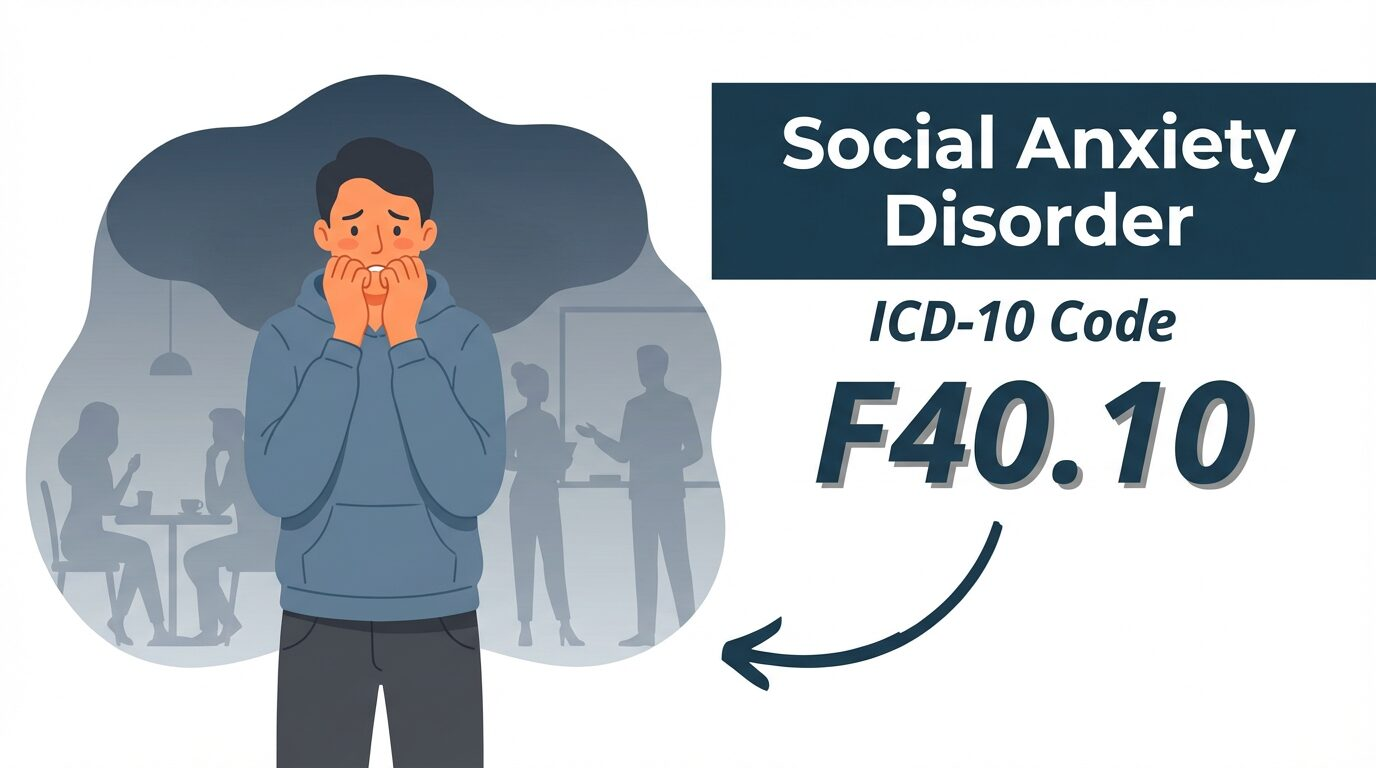
Most people don’t find out they have social anxiety by reading a clinical manual.
They find out the same way I did — by spending years assuming the problem is them.
For years, I just assumed I was incapable of making friends. That I was boring or uninteresting. It never fully occurred to me that what I was experiencing had a clinical definition — that somewhere in a medical handbook, there was a code that described exactly what I’d been living with.
But if you’re reading this, something has likely shifted for you. Maybe you’ve realized that what you’re experiencing is more than nervousness or shyness. Maybe you’ve gotten tired — of the pain, the self-blame, the constant feeling that something is wrong with you — and you’ve decided that this time, you’re going to understand it rather than just endure it.
Regardless of why you’re here, you are in the right place.
The moment you stop treating social anxiety as something wrong with you and start treating it as a condition with a name, a definition, and a path forward, everything about recovery changes in a significant way.
In this post, we’ll walk through what social anxiety disorder actually is, how the ICD-10 classifies it, what the diagnostic criteria look like in plain language, and how it compares to the DSM-5. By the end, you’ll have an external framework you can hold your own experience up against — and for a lot of people, that’s where clarity begins.
I. What is Social Anxiety Disorder?
Before we get into how the ICD-10 classifies it, it’s worth being clear on what social anxiety disorder actually is — because most people who have it have spent years misunderstanding it.
Social anxiety disorder is not ordinary shyness or nervousness before a big presentation. Those experiences are uncomfortable and can go away over time. Social anxiety disorder is something different in kind, not just degree.
At its core, social anxiety disorder is a persistent, deeply ingrained fear of being judged, humiliated, criticized, or scrutinized by other people. The fear isn’t rational — it doesn’t respond to logic or reassurance the way ordinary nervousness does. It responds to deeply ingrained associations and patterns the brain has internalized over decades of negative experiences. It isn’t built on thoughts. It’s built on belief systems that have been absorbed so deeply into the nervous system that they operate almost automatically.
To someone with social anxiety, it feels like the fear they have is completely out of their control — like it’s a part of who they are. Telling them to just “snap out of it” isn’t realistic. It is embedded into their self-perception.
Moreover, the fear people with social anxiety experience isn’t just “in their head.” It is a tantalizing, almost traumatic (in some cases) mental and bodily response to danger. On the outside, it looks like nervousness. On the inside, it feels like they are being attacked by something real and visceral.
This is what makes social anxiety disorder different from ordinary social fear — and why the ICD-10 classification is so valuable. When you can see your experience described in clinical terms, it stops feeling like something is wrong with you and more like what it actually is: a recognized, diagnosable, and treatable condition.
If you want to go deeper on what social anxiety actually is and how it operates beneath the surface, I write about it every week in my newsletter — join here if you want that sent straight to your inbox.
II. Social Anxiety Disorder ICD-10 Classification
The ICD-10 — the International Classification of Diseases, 10th Revision — is the system doctors and mental health professionals around the world use to diagnose and code medical conditions. Think of it as a universal reference manual that allows clinicians across different countries, languages, and healthcare systems to speak the same language when it comes to diagnosis and treatment.
For social anxiety, the ICD-10 classifies it under F40.1 – Social Phobias. That code is how a doctor in Germany, a psychiatrist in Japan, and a therapist in the United States can all refer to the condition when they write it down.
Within this classification code, the ICD-10 breaks social anxiety into two subtypes:
F40.10 – Social Phobia, Unspecified. Fear is limited to specific situations — public speaking, eating in front of others, using public restrooms. The avoidance is focused, and while symptoms may be less pervasive, they still meaningfully impact daily life.
F40.11 – Social Phobia, Generalized. Fear and avoidance occur across most social situations, not just specific ones. This subtype tends to be associated with broader impairment — in work, school, relationships, and everyday functioning.
This distinction deeply matters because it shapes how severe the condition is and what treatment looks like. Someone with the unspecified subtype (or non-generalized) might be able to navigate most of daily life with manageable anxiety, with one or two situations that consistently derail them. Someone with the generalized subtype is often contending with social anxiety as a near-constant presence.

If you’ve ever felt like your anxiety follows you everywhere rather than appearing in specific situations — that’s what the generalized subtype looks like. And recognizing which one fits your experience is one of the first useful things this classification system gives you.
III. Social Anxiety Disorder ICD-10 Criteria
To receive a diagnosis of social anxiety disorder under the ICD-10, a person needs to meet several specific criteria.
Here’s what the ICD-10 looks for:
1. Marked fear or anxiety in social situations
The person experiences intense fear or anxiety in one or more social or performance situations. Examples include:
- Speaking or giving a presentation in front of others
- Eating or drinking in front of people
- Meeting new people or interacting with strangers
- Being observed while doing everyday activities
- Writing, performing, or participating in class or meetings
2. Avoidance or endurance with distress
The person either avoids these situations whenever possible, or endures them with significant discomfort. This avoidance often interferes with work, school, relationships, or everyday life. When enduring rather than avoiding, severe anxiety, panic-like symptoms, or emotional distress are common.
3. Physical symptoms
Anxiety shows up in the body, not just the mind. Common physical symptoms include:
- Sweating or trembling
- Blushing or flushing
- Racing heart or shortness of breath
- Nausea or stomach discomfort
- Difficulty speaking or making eye contact
4. Duration and impact
Symptoms are persistent — typically lasting six months or more — and significantly interfere with daily functioning across education, work, relationships, and social life.
5. Exclusion of other causes
The anxiety cannot be better explained by another mental disorder, substance use, or medical condition.
One important note: while most people with social anxiety meet all five of these criteria, it’s possible to meet some but not all of them. The criteria are a clinical guide, not a checklist where every box needs to be ticked. If you recognize yourself in several of these, that recognition alone is worth bringing to a qualified mental health professional.
IV. Differences Between ICD-10 and DSM-5
If you’ve been looking up social anxiety online for any length of time, you’ve probably come across both the ICD-10 and the DSM-5. They’re both official classification systems used by mental health professionals to diagnose social anxiety disorder — but they approach it slightly differently, and understanding why is actually more interesting than it might sound.
The Categorization Difference
The ICD-10 classifies social anxiety under F40.1 – Social Phobias, framing it primarily as a phobic condition, or a fear response tied to specific social or performance situations.
The DSM-5, used predominantly in the United States, calls it Social Anxiety Disorder and places it squarely in the anxiety disorder category rather than the phobia category. The DSM-5 puts greater emphasis on functional impairment — how much the condition interferes with your actual life — and gives more attention to severity, duration, and subtypes, including a performance-only subtype for people whose anxiety is limited specifically to public performance situations.

The key distinction: the ICD-10 emphasizes the fear and avoidance. The DSM-5 emphasizes the pervasive, impairing nature of the condition across multiple areas of life.
The Naming Difference
This one is worth understanding because it reflects how our understanding of social anxiety has evolved.
For decades, both classification systems used the term “social phobia.” Under the DSM-III in 1980, the condition was classified as a phobic disorder — the assumption being that the fear was primarily situational and specific, like a fear of heights or spiders.
But over time, research made it clear that social anxiety was something far more pervasive than an ordinary phobia. It wasn’t just a fear of specific situations — it was a condition that could reshape a person’s entire life, affecting their relationships and sense of identity.
To reflect this reality, the DSM-IV dropped the term “social phobia” for “social anxiety disorder” in 1994. The reasoning was that the new name better captured the chronic, wide-ranging nature of the condition — and that doing so might reduce the stigma and misunderstanding that came with calling it a phobia.
Personally, I think it was the right call. A phobia sounds like something specific and manageable. Social anxiety disorder is something that your entire life revolves around. The name change reflects that difference.
Which term resonates more with your own experience? Feel free to let me know in the comments below — I read all of them.
V. Social Anxiety Disorder ICD-10 Resources & Tests
Now that you have a clear picture of how the ICD-10 defines and classifies social anxiety disorder, the natural next step is figuring out where you actually fall within that picture.
There are a few tools worth knowing about here. The most widely used is the Liebowitz Social Anxiety Scale (LSAS) — a structured questionnaire that evaluates fear and avoidance across a range of social and performance situations. It’s the same tool clinicians use in formal assessments, and going through it can give you a surprisingly clear sense of the severity and pattern of your anxiety.
Beyond the LSAS, there are free online social anxiety tests and quizzes that can give you a useful snapshot of your symptoms and how they compare to clinical criteria. I cover several of these in depth in my post on do I have social anxiety, which walks through how to use self-assessment tools effectively and what to do with the results once you have them.
One important caveat: none of these tools are a substitute for professional evaluation. They’re starting points. If your results indicate significant social anxiety, the most valuable thing you can do is bring that information to a licensed mental health professional who can interpret it in context and recommend a treatment path tailored to your situation.
That said, don’t underestimate what self-assessment can do on its own. For a lot of people, going through the LSAS for the first time and seeing their experience reflected back to them is incredibly liberating.
That confirmation is worth something. It was for me.
If you want to keep going deeper on understanding and overcoming social anxiety, join the newsletter here — every week I share honest, experience-driven writing on what recovery actually looks like from the inside.
Moving Forward
Social anxiety disorder makes you feel like you are problem — that the fear, avoidance, and self-consciousness are just facts of your life rather than symptoms that are actually treatable.
But the ICD-10 shows us something different. It shows us that what you’ve been experiencing has a set of diagnostic criteria and a body of evidence-based treatment behind it. This isn’t a small thing. For a lot of people (myself included), it was the first real crack in my belief that nothing would change.
Social anxiety isn’t permanent. And the fact that you’re here, reading this, trying to understand what’s actually happening rather than just enduring it, tells me you’re closer to recovery than you might think.
If you want support along your recovery journey — honest, experience-driven writing on what recovery actually looks like — join the newsletter here. I write about this every week because it’s what I wish I’d had when I was in the middle of it.
And if this post resonated with you, leave a comment below. Tell me where you are in your own journey. I read every single one — and sometimes, knowing someone else who has been through is the thing that helps most.

Hi, I’m Blake Baretz, the creator of Social Anxiety Haven. I write about my personal journey with social anxiety and share research-backed strategies to help others navigate it. If you’d like more encouragement and resources, join my weekly newsletter.
Leave a Reply