I’ve talked to a lot of people with social anxiety over the years — through this blog, comments, messages that come in from people who’ve found their way after years of struggle.
And one of the patterns I keep hearing, more than almost any other, goes something like this: “I knew something was getting in the way socially. But I could never tell if I was afraid of people — or if my brain just worked differently around them.”
Or the reverse: “I was told it was anxiety. But coping strategies never really worked, and nobody ever considered that my brain might actually be wired differently.”
Both of those stories point to the same problem. ADHD and social anxiety can look so similar from the outside that it becomes genuinely difficult to understand what’s driving the struggle. And when you don’t understand what’s driving it, everything you try feels like guesswork.
That’s what this post is about. Not a clinical breakdown, but a real explanation of what these two conditions are, how they can quietly build on each other, and what understanding the difference actually means for your recovery.
What ADHD and Social Anxiety Actually Are
Before we talk about how these two conditions interact, it helps to be clear on what each one actually is — because they’re genuinely different things, even when they produce similar-looking behavior.
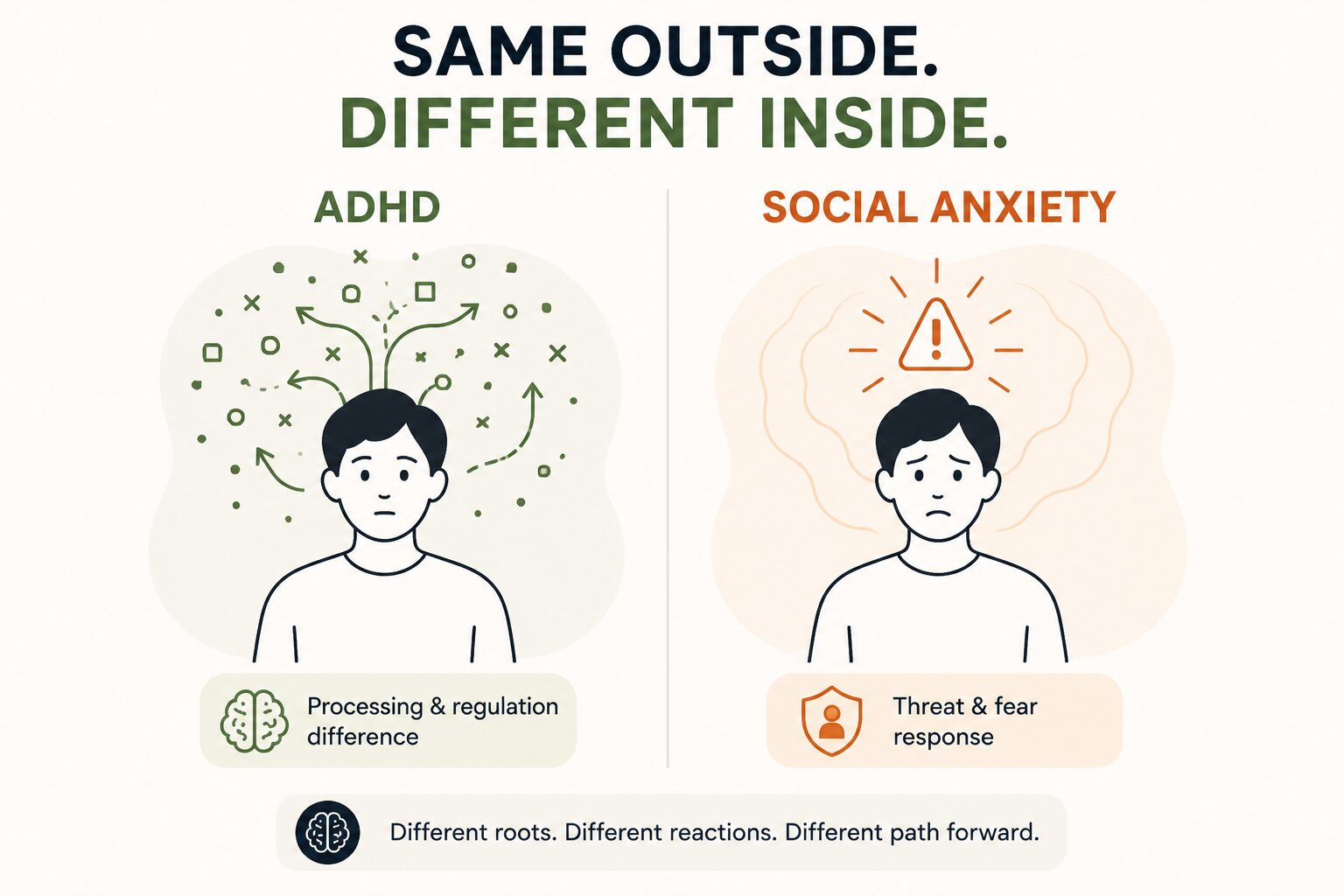
ADHD is a difference in how the brain regulates attention, emotion, and stimulation. It’s not a lack of effort or intelligence. It’s a nervous system that takes in more information at once and has a harder time filtering what’s most relevant in the moment. In social situations, this shows up as racing thoughts, missed cues, impulsive responses, or sudden mental blanks that are impossible to explain to someone who hasn’t experienced them. The struggle is real — but it isn’t driven by fear. It’s driven by how the brain is wired.
Social anxiety is something different at the root. It isn’t primarily about how the brain processes information — it’s about what the brain has learned to expect. Through years of negative social experiences, the brain develops a conditioned response: people are potential threats, and social situations are where you get exposed, judged, and criticized. That fear becomes automatic. It fires before you’ve had a chance to think. And it shapes every interaction that follows.

Think of it this way. Imagine two people who both go quiet in a group conversation. The first goes quiet because the pace of the conversation moved too fast. The second goes quiet because somewhere in the last few minutes they said something that landed strangely, and now they’re convinced everyone in the room noticed and is silently judging them for it.
Both people are quiet. The room sees the same thing. But what’s happening inside couldn’t be more different, and the path forward for each of them looks completely different too.
I write about this kind of thing every week — the deeper patterns underneath social anxiety and what it actually looks like to work through them. If you want that in your inbox, subscribe to my newsletter here.
How ADHD Can Build the Conditions for Social Anxiety
Here’s where things get complicated… and important.
ADHD and social anxiety don’t just coexist. For many people, one quietly creates the conditions for the other to take root.
Picture what it’s like to move through your social world with ADHD. You’re in a conversation and your attention goes astray — not because you don’t care, but because that’s just how your brain works. You might miss a shift in tone, a moment where the other person wanted you to respond, a joke that went over your head. And you see a flicker of confusion, or mild irritation.
Your brain registers that signal. And compartmentalizes it.
The next conversation, you’re a little more alert to that possibility. You monitor the social situation a little more closely. And maybe you miss something again — a comment, an expression — and again, you see frustration in the person you were talking to.
Over time, what started as a neurological processing difference starts to accumulate into something else entirely. A growing belief that social situations are where you mess things up.
That belief is the architecture of social anxiety. And ADHD, through no fault of the person carrying it, can build that architecture piece by piece — one misunderstood interaction at a time.

This is the feedback loop that makes the combination of both conditions so difficult to live with. ADHD creates social missteps. The missteps erode the confidence. The eroded confidence generates fear. The fear produces hypervigilance. And the hypervigilance makes the ADHD symptoms worse, because a brain that is simultaneously trying to manage attention differences and monitor itself for social failure has almost no bandwidth left for actual connection.
What starts as occasional awkward moments can — slowly, invisibly — become a pattern of dread.
What Actually Helps
If any of this resonates, the most important thing I want you to take from this post is the following: recovery doesn’t mean eliminating ADHD or eradicating social anxiety. It means interrupting the feedback loop between them.

The loop runs in one direction — misfire, self-blame, fear, hypervigilance, more misfires. The work of recovery is learning to interrupt it at each of those nodes, consistently, until the loop starts to lose its momentum.
Building awareness of your specific triggers is where that work begins. Genuinely noticing which situations consistently leave you more depleted, more self-critical, more afraid. That awareness is the difference between being swept along by the loop and being able to see it from the outside.
Breaking the cycle of overthinking after social interactions matters enormously. Rumination — or replaying every moment of a conversation looking for what went wrong — is one of the primary ways the loop feeds itself. Journaling, talking it through with someone you trust, or even just setting a conscious limit on how long you allow yourself to replay an interaction can start to weaken that habit over time.
Gradual exposure is the long game. The only way to genuinely update the brain’s conditioned fear response is to accumulate new evidence — to show up in social situations and survive them, repeatedly, until the brain starts to revise its prediction of what those situations mean.
And for those navigating both conditions, ADHD-specific strategies — writing down key points before a meeting, using visual reminders, keeping conversation anchors handy — can reduce the cognitive load that makes social situations so overwhelming, which frees up bandwidth for actual connection rather than constant self-monitoring.
Professional support, whether through CBT, ADHD coaching, or both, can be genuinely useful here — not because it offers a shortcut, but because having someone help you map your specific patterns is far more efficient than trying to figure it out alone.
You’re Not Just One Thing
What I want to leave you with is simpler than any strategy.
If you’ve been struggling socially for years and the explanations you’ve been given have never quite fit, it’s worth sitting with the possibility that both things are true.
You don’t have to choose one explanation. And you don’t have to fit yourself into a box that doesn’t fully describe your experience just because it’s the one someone handed to you.
Understanding what’s actually driving your struggle is the most clarifying thing you can do for your recovery. Because once you understand it clearly, you stop fighting the wrong thing. And you start working with what’s actually there.
If this resonated with you, I’d love to hear your experience in the comments below. Whether you have ADHD, social anxiety, both, or you’re still figuring it out — your story matters here, and sharing it helps more people than you’d expect.
If you want to go deeper on how social anxiety develops and what keeps it alive, my post on autism and social anxiety covers similar ground from a different angle — specifically how a brain that processes social information differently can end up developing a conditioned fear response on top of that processing difference.
And for more on the conditions that overlap most often with social anxiety, my post on avoidant personality disorder vs. social anxiety is worth reading — it gets into why AvPD and social anxiety are so frequently confused, and what distinguishes them at the root.
If you want weekly writing on the deeper patterns of social anxiety and what recovery looks like from the inside, join my newsletter here. I’d love to walk this road with you.

Hi, I’m Blake Baretz, the creator of Social Anxiety Haven. I write about my personal journey with social anxiety and share research-backed strategies to help others navigate it. If you’d like more encouragement and resources, join my weekly newsletter.
Leave a Reply