Social anxiety has a way of taking things from your life gradually — so gradually that you almost don’t notice it until it’s already happened.
First it takes your voice. Then it takes your relationships. Next, your esteem.
And at its worst, it takes away something you never expected it to touch: your ability to leave the house.
That last part surprises a lot of people, because social anxiety is supposed to be all about people — “why are you so afraid of people?” the world might ask. But after a while, if the anxiety has really gotten to you, it begins to feel like the world has become unsafe…
…Why does the grocery store feel threatening? Why does public transportation feel impossible? Why does the distance between my front door and anywhere else feel like something I can’t cross?…
This fear of leaving the house is where social anxiety and agoraphobia begin to blur. Agoraphobia is a persistent, deep fear of being trapped or losing control in situations where escape feels difficult. It isn’t just about fearing open spaces. It’s about fearing places you can’t get out of if something goes wrong — and for someone whose nervous system is already primed for threat, that fear can quietly attach itself to almost anywhere.
That distinction is what this post is built around. By the end, you’ll have a clearer sense of which fear has been driving your experience — and what that means for finding your way back out.
The Core Fear Behind Each Condition
Before we compare the two conditions directly, it’s worth being precise about what each one is actually afraid of — because the surface symptoms can look nearly identical while the underlying fear is completely different.
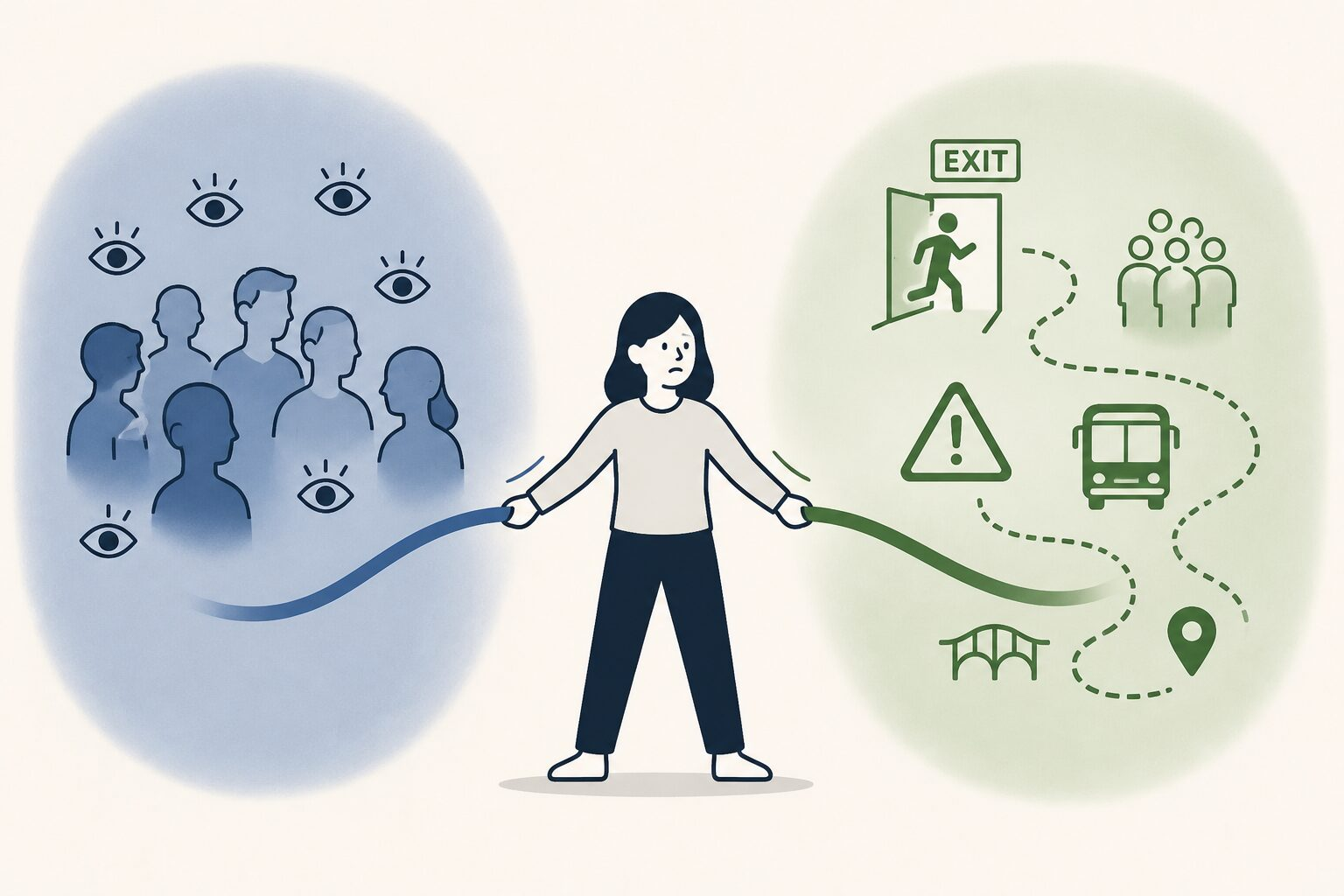
If you’ve read my other posts in this series, you already have a clear picture of what social anxiety is like. But the piece most relevant to this comparison is this: social anxiety is fundamentally a fear of people — specifically, of being judged, evaluated, embarrassed, or rejected. The threat is always about social exposure.
Agoraphobia works differently. The fear isn’t about people — it’s about entrapment, being somewhere you can’t escape from if something goes wrong. About losing control, experiencing panic, and having no way out.
Common triggers for agoraphobia include crowded areas, public transportation, busy streets, open spaces, and anywhere that feels far from safety or difficult to leave quickly. But notice what those situations share — it isn’t the presence of other people that makes them threatening. It’s the absence of an exit, the idea of being stuck with nowhere to go and no one who can help you fast enough.
This distinction — between judgment versus entrapment, shame versus loss of control — is the thread that runs through everything in this post. Keep it in mind as we go deeper, because it’s the clearest way to start making sense of which fear has been driving your own experience.
If you want weekly writing on how social anxiety operates beneath the surface and what recovery actually looks like, join the newsletter here — it’s where I go deeper on everything this blog covers.
Agoraphobia vs. Social Anxiety: The Core Differences
Now that we have a clear picture of what each condition is afraid of, let’s look at how those differences play out in practice — in triggers, avoidance patterns, physical symptoms, and the role panic plays in each.
The table below gives you a quick reference:
| Social Anxiety | Agoraphobia | |
| Core Fear | Being judged, embarrassed, or humiliated in social situations | Experiencing panic, losing control, or being unable to escape a situation |
| Focus of Conscious Attention | Internal: monitoring the self, overanalyzing what is being said | External: scanning environment for danger or exit routes |
| Common Triggers | Speaking, eating, or performing in front of others; social gatherings involving other people | Crowds, public transportation, open spaces, being far from home |
| Avoidance Patterns | Cancelling social events, rehearsing conversations, withdrawing from interactions | Avoiding feared places, relying on safe zones, limiting outings |
| Role of Panic | Panic attacks may occur, but it is usually tied to social evaluation | Panic is central; even a single panic episode can reinforce avoidance |
A few things worth expanding on.
The focus of attention in both disorders is different. Someone with social anxiety moves through the world with their attention turned inward — monitoring how they come across and replaying what they just said.
Someone with agoraphobia moves through the world with their attention turned outward — scanning the environment for exits, measuring the distance from safety, calculating what would happen if something went wrong right now.

Same avoidance behavior on the surface. Completely different internal experience underneath it.
The role of panic is also worth understanding carefully. Panic attacks can occur in both conditions — but in social anxiety, panic is a response to social threat. It’s triggered by the presence of people and the fear of evaluation. In agoraphobia, panic is often the thing being feared rather than the response to the fear. A single intense panic episode in a particular environment can be enough to make that environment feel permanently unsafe — which is why agoraphobia can expand so quickly once it takes hold.
Agoraphobia vs. Social Anxiety: Which Fits Your Experience?
By now you have a clear picture of both conditions. The natural next step is turning that understanding toward your own experience.
Start with these three questions:
- When anxiety hits, does it feel like shame — like you’ve been exposed or evaluated — or does it feel like danger, like you’re trapped somewhere you can’t escape from?
- Do your anxious thoughts focus mostly on how other people are perceiving you, or on what might happen in the environment around you?
- When you avoid something, is it because you’re afraid of a social mistake — or because you’re afraid of panicking, losing control, or not being able to get out?
If your experience aligns more closely with social anxiety, the fear tends to be people-shaped. You want connection but dread the exposure that comes with it. The anxiety shows up most reliably when you’re being observed, evaluated, or required to perform in some way. The world hasn’t necessarily become unsafe — but the people in it feel like a constant, low-grade threat.
If your experience aligns more closely with agoraphobia, the fear tends to be place-shaped. Certain environments have stopped feeling safe because of what might happen there and whether you’d be able to handle it. The anxiety is less about being seen and more about being stuck. You’ve developed rituals around safety — knowing where the exits are, never going too far from home, needing someone with you before certain outings feel possible.

And if both descriptions feel true, that’s worth paying attention to too, because it points toward something we’ll cover in the next section.
Agoraphobia vs. Social Anxiety: Do You Have Both?
Many people who land on this post aren’t dealing with one clean condition. They’re likely dealing with something that has expanded in both directions — social situations feel threatening and certain places feel unsafe. So much so to the point that no single explanation seems to fully capture what they’re going through.
That experience is more common than most people realize, and if you’re one of them, you’re not alone. Social anxiety and agoraphobia have one of the higher comorbidity rates among anxiety disorders, and the reason why makes sense once you understand how each condition develops.
Think about what this looks like in practice. Social anxiety starts narrowing your world socially — you avoid gatherings, cancel plans, withdraw from situations where you might be evaluated. But the more you stay home, the more the outside world starts to feel unsafe. The nervous system, already primed for threat, begins extending that threat response beyond people and onto places. What started as a fear of judgment quietly becomes a fear of the outside world.
The reverse can happen too. Someone with agoraphobia who avoids public spaces starts avoiding the social experiences that build connection and confidence. Over time, this makes the people themselves start to feel threatening, because the prolonged isolation has made ordinary social interaction feel high-stakes.
In both cases, the conditions feed each other. And when that’s happening, the experience of anxiety stops feeling like one specific fear and starts feeling like a general sense that the world has become too much, too unpredictable, too difficult to navigate.

Some signs that both patterns may be present:
- You avoid social situations and certain environments, but for different reasons depending on the context.
- Panic or intense anxiety can arise both around people and in places that feel difficult to escape.
- You’ve developed coping strategies for both — rehearsing conversations before social events and mapping exits before entering unfamiliar spaces.
- The world has shrunk in multiple directions at once, and it’s hard to remember exactly when or how it started.
If this is what you’re going through, it’s important to understand that both conditions are treatable — and treatment that addresses one will often create movement in the other. Approaches like cognitive behavioral therapy and graduated exposure work well for both, and a good clinician will be able to help you untangle which fear to address first and in what order.
If this is resonating and you want honest writing on what recovery from anxiety actually looks like from the inside, join the newsletter here — I write about it every week because it was the hardest and most important part of my own journey.
Moving Forward
Social anxiety takes things from your life. Your authentic voice, relationships, and — at its worst — your ability to move freely through the world. By the time most people start looking for answers, the loss has been accumulating for years.
But understanding the difference between social anxiety and agoraphobia can give you clarity about what has actually been driving your fear. A fear of judgment and a fear of entrapment require different approaches, and knowing which one you’re dealing with is the first step toward addressing it effectively.
The process of recovery takes time, but with the right support, and a clearer understanding of what you’re actually working with, the closer you come to the finish line of recovery.
If you want to keep going deeper on anxiety, recovery, and what the research actually says about getting better, join the newsletter here — every week I share honest, experience-driven writing on what this process looks like from the inside.
And if you recognized yourself in the shrinking, or in the blur between these two conditions — leave a comment below. I read every single one. Sometimes naming what’s been happening is the thing that starts to change it.

Hi, I’m Blake Baretz, the creator of Social Anxiety Haven. I write about my personal journey with social anxiety and share research-backed strategies to help others navigate it. If you’d like more encouragement and resources, join my weekly newsletter.
Leave a Reply