One of the hardest parts of living with social anxiety is not knowing where you end and the anxiety begins.
Is the quietness in a group conversation just who you are? Or is it fear dressed up in your personality as a disguise?
These questions matter more than they might seem. Because if you spend years trying to fix something that’s simply part of who you are, you end up fighting yourself. And if you spend years accepting something that’s actually treatable as a permanent feature of your personality, you end up surrendering to something you never had to carry.
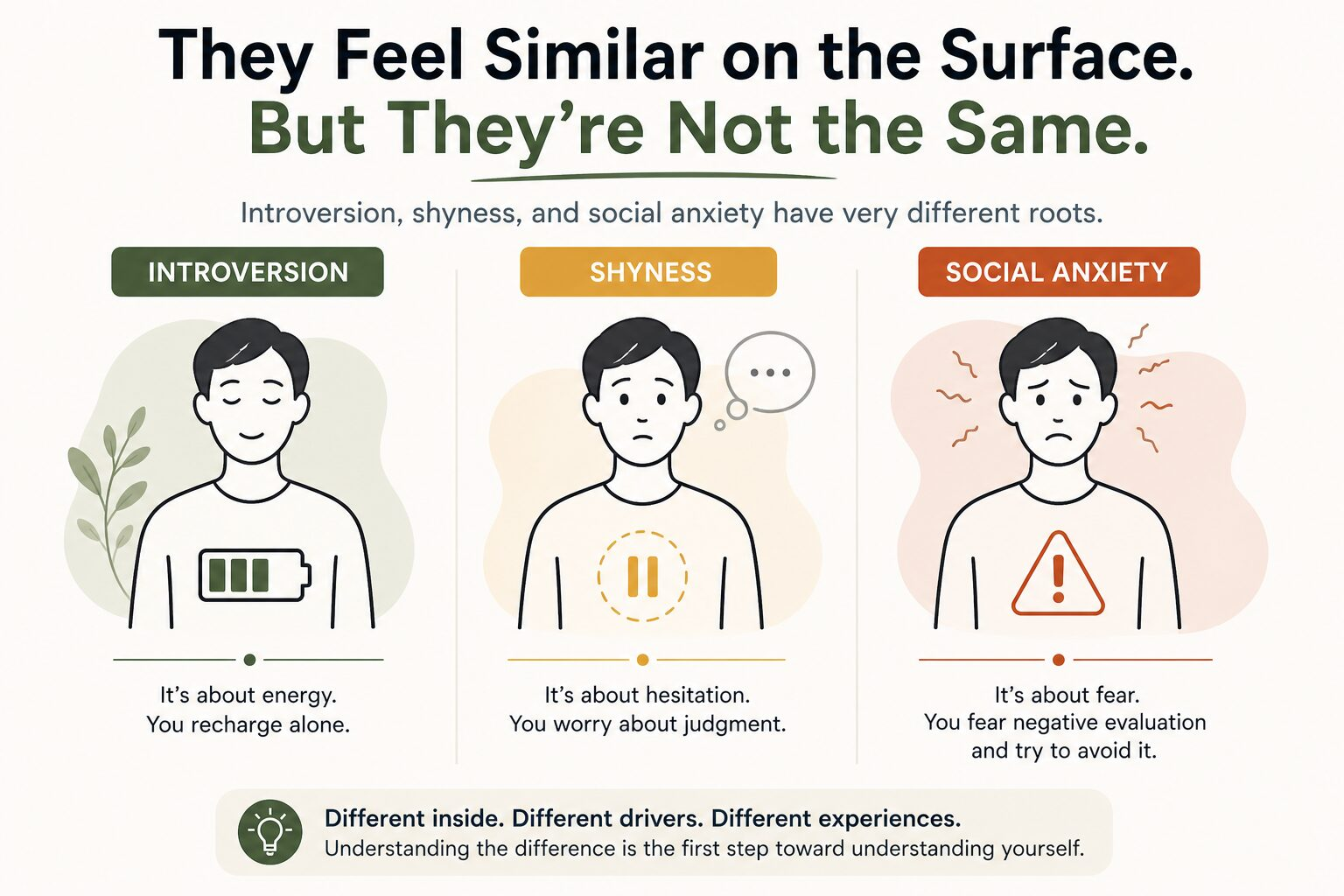
Introversion, shyness, and social anxiety sit on a spectrum that runs from personality to condition — from who you are, to how you tend to feel, to something that has taken root in you and is actively shaping your life in ways that go beyond preference or temperament.
Understanding where your experience actually lives on that spectrum is one of the most clarifying things you can do — not just for recovery, but for understanding yourself.
That’s what this post is about.
Introversion: A Personality, Not a Problem
Introversion is the starting point of this spectrum — and the most important thing to establish about it is this: it is not a disorder, a limitation, or something that needs to be fixed. It’s a personality trait that describes how your nervous system naturally responds to stimulation and social interaction.
While extroverts tend to gain energy from being around people, introverts spend that energy in social situations and need time alone to recover it. It’s not avoidance or fear. It’s just how their nervous system is calibrated — and it’s a calibration that has its own distinct advantages.
Evolutionary psychologists have made an interesting case for why introversion exists in the first place. When our species first evolved, survival required different kinds of people filling different kinds of roles. Extroverts — more outgoing, novelty-driven, energized by social contact — were well suited for exploration, alliance building, and the high-stakes social dynamics of expanding the group’s reach. Introverts — more inward-focused, cautious, attuned to detail and pattern — thrived in roles that required vigilance, deep thought, and quiet persistence. Both temperaments served the group. Neither was a mistake.
That same logic holds today. In a world that rewards visibility, speed, and constant social performance, introverts bring something the culture often undervalues but genuinely needs: the capacity to slow down, think carefully, and contribute with depth rather than volume.
What introversion is not is shyness or social anxiety. An introvert can love people, enjoy social events, and move through conversations with genuine confidence — they just need time alone afterward to recover. There’s no underlying fear driving the behavior. No avoidance rooted in dread. Just a nervous system that processes stimulation differently and needs space to reset.

That distinction is important, because conflating introversion with social anxiety is one of the most common ways people end up either pathologizing something healthy or dismissing something that deserves real attention.
Shyness: The Space Between
If introversion is about energy, shyness is about hesitation. And it sits in an interesting middle ground — more than a personality preference, but less than a clinical condition.
Shyness is a tendency toward self-consciousness and discomfort in social situations, particularly unfamiliar ones. A shy person isn’t necessarily drained by social interaction the way an introvert is — they might actually want to connect, join the conversation, or be in the room. What holds them back is an internal barrier: a worry about saying the wrong thing, appearing awkward, or being evaluated negatively by the people around them.
That worry is real. But it’s also typically situational and manageable. Shyness tends to ease as familiarity increases. The first day of a new job might feel excruciating for someone who is shy. Six months in, the same environment feels navigable, and the hesitation softens with exposure and time.
The key distinction between shyness and social anxiety is this: shyness responds to familiarity. Social anxiety often doesn’t. Someone with social anxiety can know a person for years and still feel the same dread before seeing them. The fear doesn’t soften with exposure the way shyness does — at least not without deliberate, structured work to change it.

Shyness is also worth taking seriously in its own right, because it’s often a signal that fear is starting to play a role in your social life. Understanding whether your hesitation is situational shyness or something more persistent is one of the more useful things you can do for your own self-awareness — and it’s a question worth sitting with honestly before moving on to the next section.
If you want weekly writing on the fear side of social experience and what it actually looks like to work through it, join the newsletter here — it’s where I go deeper on everything this blog covers.
Social Anxiety: Something You Have, Not Something You Are
Social anxiety disorder is where the spectrum moves from personality and temperament into clinical territory. The most important thing to understand about it — the thing that separates it from both introversion and shyness — is captured in the distinction I made in the intro: social anxiety isn’t who you are. It’s something that has taken root in you and is something that, with the right support, can change.
At its core, social anxiety is an intense, persistent fear of being judged, embarrassed, or negatively evaluated in social situations. Unlike introversion, which is driven by how the nervous system responds to stimulation, social anxiety is driven by what the brain has learned to expect. Through years of negative social experiences — criticism, rejection, humiliation, or simply growing up in an environment where being seen felt unsafe — the brain develops a conditioned response: people are potential threats, and social situations are where you get exposed.
The difference between this and shyness is one of intensity, persistence, and impact. A shy person might hesitate before speaking up in a meeting. A person with social anxiety, however, might spend the entire night before the meeting unable to sleep, convinced that when the day comes, they will say something wrong. A shy person feels awkward at a party, but might warm up after an hour. A person with social anxiety, on the other hand, will probably either leave early or endure the party with significant distress, and avoid the next invitation because the cost of attending feels too high.
Social anxiety also has a physical dimension that shyness typically doesn’t. Racing heart, sweating, trembling, nausea, the sudden inability to find words — these aren’t just discomfort. They’re a full nervous system response to a perceived threat, which is why telling someone with social anxiety to “just push through it” misses the point entirely.
Misconceptions and Overlaps
Now that we’ve defined introversion, shyness, and social anxiety, the honest thing to acknowledge is that they don’t always show up cleanly separated in real life.
You can be an introvert who is also shy. You can be shy without being introverted. You can have social anxiety and introverted tendencies that make it harder to know which one is asking for space on any given day. And you can move through years of your life carrying all three at once, never quite sure which one is doing the most damage or deserving the most attention.
The overlaps are real. But so are the distinctions — and learning to notice them in your own experience is one of the more useful things you can do.

The clearest way to start is with a single question for each one.
For introversion, ask: does this drain me, or does it frighten me? An introvert at a crowded party feels tired. Someone with social anxiety at the same party feels afraid. Both might leave early. Both might prefer to have stayed home. But the internal experience driving that preference is completely different — and so is what it needs.
For shyness, ask: does this ease with familiarity? Shyness softens over time in the same environment with the same people. Social anxiety often doesn’t — at least not on its own. If the hesitation you feel around someone you’ve known for years is the same as the hesitation you felt when you first met them, that’s information worth paying attention to.
For social anxiety, ask: is this fear shaping my life in ways I didn’t choose? Not just discomfort. Not just a preference for quiet. But a pattern of avoidance, rumination, and shrinking that has accumulated over time into a life that looks different from the one you actually want.
A few common misconceptions are also worth naming directly, because they tend to keep people stuck in the wrong explanation for longer than necessary.
The idea that introverts don’t like people is one of them. Introverts often love connection — they just need it in smaller doses and require time alone afterward to recover. The preference for depth over volume isn’t antisocial. It’s just a different way of being social.
The idea that shyness is a permanent character flaw is another. Shyness is about internal hesitation, not competence. Shy people can communicate thoughtfully and connect genuinely — the hesitation is a surface feature, not a structural one, and it tends to respond well to gradual confidence building.
And the idea that social anxiety is just an extreme version of shyness or introversion is perhaps the most damaging of all. Social anxiety is a clinical condition. Treating it like a personality quirk you need to push through — or a sensitivity you simply have to accept — keeps people from getting the support that actually moves the needle.
How to Assess Yourself: Understanding Your Social Personality
Understanding the distinctions intellectually is one thing. Knowing where your own experience actually lands is another — and it’s worth being honest with yourself about which one you’re doing.
The three questions from the last section are a good starting point. But if you want something more structured, there are specific tools that can help you get a clearer picture.
For introversion, the 16 Personality Types assessment is worth exploring. It maps where you fall on the introversion-extroversion spectrum by looking at how you naturally process the world, where you direct your energy, and how you tend to respond to social stimulation. It isn’t a diagnostic tool — introversion isn’t a condition to be diagnosed — but it can give you useful language for understanding your own temperament and stop you from pathologizing something that’s simply part of how you’re wired.
For shyness, the McCroskey Shyness Scale is a widely used psychological measure that assesses your tendency toward hesitation and self-consciousness in social situations. It can help you understand whether what you’re experiencing is temporary discomfort that responds to familiarity — the hallmark of shyness — or something more persistent that might warrant a closer look.
For social anxiety, the Liebowitz Social Anxiety Scale (LSAS) is the gold standard. It’s the same tool clinicians use in formal assessments, measuring both fear and avoidance across a range of social and performance situations. Going through it yourself can give you a surprisingly clear picture of where your anxiety is most concentrated, how severe it tends to be, and whether it’s operating at a level that deserves professional attention. I cover the LSAS in more depth in my post on what is the LSAS, which walks through how it works and how to interpret your results.
One important note across all three: self-assessment tools are starting points, not professional verdicts. They can sharpen your self-awareness and point you in a useful direction. But if your results indicate significant social anxiety — or if you recognize yourself clearly in the description from Section III — bringing that recognition to a qualified mental health professional is the most valuable next step you can take.
If you want to go deeper on self-assessment and what to do with what you find, my post on do I have social anxiety covers the full process in detail.
Final Thoughts
We started this post with a question that a lot of people with social anxiety carry for years without ever fully resolving:
Where does my personality begin and my anxiety end?
That question is hard to answer when everything gets labeled the same way — when introversion, shyness, and social anxiety all look identical from the outside and feel frustratingly similar from the inside.
What this post gives you is a way to start separating those threads. Introversion feels like exhaustion after a party, where your nervous system is just asking for space. Shyness is the hesitation you might feel in a new environment that softens with familiarity. And social anxiety is a persistent, pattern-shaping fear that has been quietly narrowing your world in ways you don’t consciously chose.
Knowing the difference is where recovery begins.
If you want to keep going deeper on separating who you are from what anxiety has built around you, join the newsletter here — it’s what I write about most, because it was the most important part of my own recovery.
And if this post helped you get a little clearer on where you actually land — leave a comment below. I read every single one. Sometimes just having the language for it is the thing that starts to move it.

Hi, I’m Blake Baretz, the creator of Social Anxiety Haven. I write about my personal journey with social anxiety and share research-backed strategies to help others navigate it. If you’d like more encouragement and resources, join my weekly newsletter.

Leave a Reply