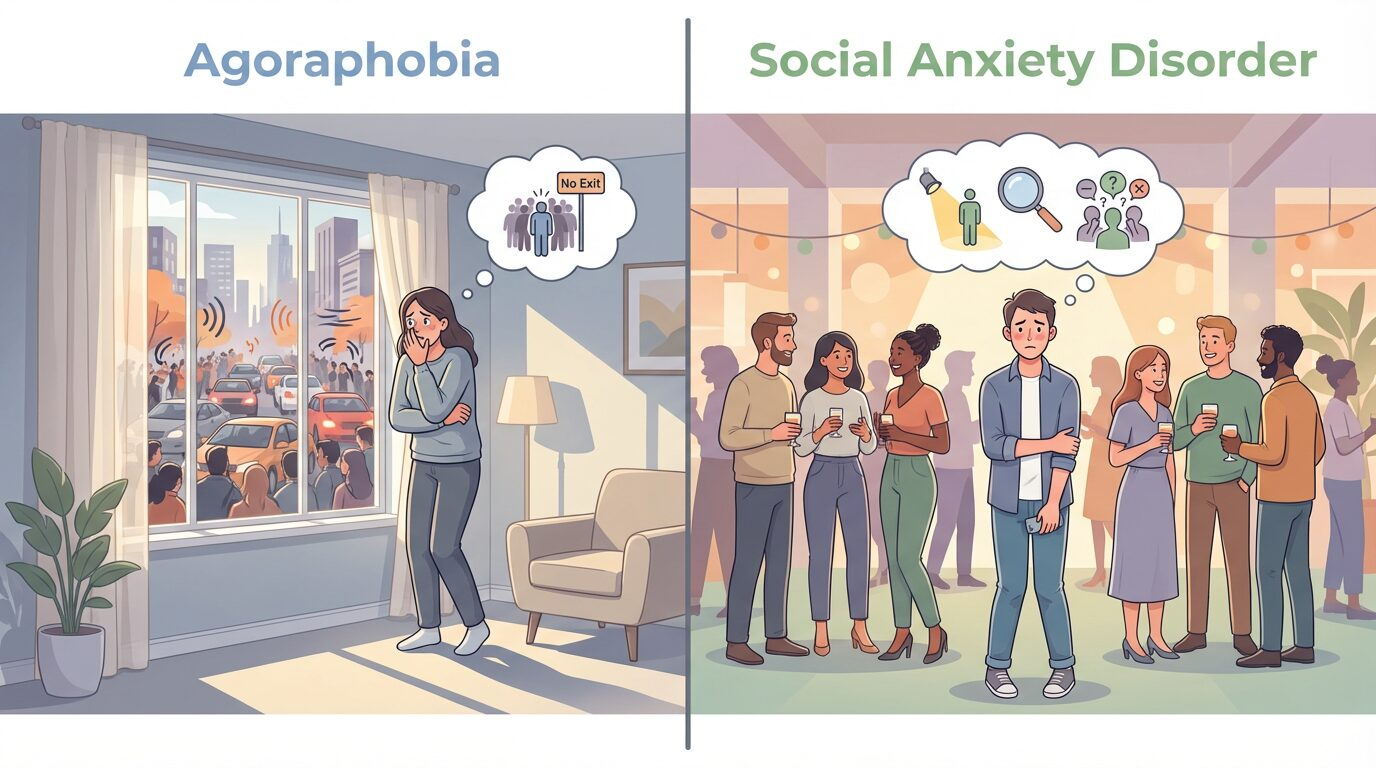
If you’ve ever wondered whether you have agoraphobia vs. social anxiety, or feel like neither label quite fits what you’re going through, you’re not alone.
These two disorders are some of the most misunderstood and frequently confused anxiety conditions, not just by people searching for answers online, but often by friends, family, and even clinicians.
One day it feels like people are the problem. The next it feels like the world itself has shrunk. You might avoid social situations because you’re terrified of being judged, misunderstood, or exposed, yet you also avoid certain places because you’re afraid of panicking, getting stuck, or not being able to leave.
When both of these patterns are present, it can start to feel like no explanation fully captures what you’re going through.
This post will help you make sense of that confusion.
We’ll break down agoraphobia vs. social anxiety, compare the core symptoms of each disorder, and help you understand which experience—or both—best reflects what you are going through.
By the end, you should have a clearer sense of what’s driving your anxiety and why your anxiety behaves the way it does.
Let’s break it down.
What is Social Anxiety Disorder?
Before we compare agoraphobia vs. social anxiety, let’s briefly go over what social anxiety is.
Social anxiety disorder is more than feeling nervous or anxious in social situations. It is a persistent, irrational, and overwhelming fear of judgment, embarrassment, or rejection.
Living with social anxiety is incredibly paralyzing. When I was diagnosed with it at 19, my whole life changed. All of the easy things that people take for granted in life (going on a walk through the park, enjoying dinner with a friend, or being in a close relationship) was too difficult for me to get through.
Luckily, however, social anxiety did not determine my life’s direction and neither will it direct yours. One of my goals for this blog is connect with a community of people with social anxiety and give them insight into how their condition works and how they can overcome it. If you struggle with social anxiety and want to connect with a community of people working through it, consider joining our newsletter.
Each week, you’ll receive content on how I navigated and worked though my recovery with social anxiety, along with practical tips and encouragement for your own journey.
The Deeper Fear Behind Social Anxiety
It’s important to note that people with social anxiety aren’t afraid of people themselves—they’re afraid of the judgment that comes with being seen. Every piece of social information during a conversation can feel like a spotlight, highlighting every imagined flaw they believe they have.

Because of their irrationally held fears, people with social anxiety often avoid social interactions entirely. They might…
- Skip events
- Cancel plans at the last minute
- Rehearse conversations endlessly
- Distance themselves from the people who care about them
Over time, these avoidance patterns only feed their fear. The more social situations are avoided, the fewer opportunities there are to prove that interacting with others is safe.
This creates a self-reinforcing cycle that fuels deep levels of anxiety: avoidance strengthens the negative beliefs people with social anxiety have about themselves and other people, which in turn makes social situations feel even more threatening the next time around.
What is Agoraphobia?
Agoraphobia is a deep, persistent fear of being trapped or being unable to escape a situation if something goes wrong.
Similar to social anxiety, agoraphobia is difficult to pinpoint and understand. People with it often feel safe only in specific places, like home, or with specific people, but as soon as they venture beyond these mentally constructed boundaries, they feel an intense amount of anxiety.
Common situations that trigger anxiety inside of people with agoraphobia include:
- Crowded areas
- Public transportation
- Busy streets
- Being far from home
As you can tell, it isn’t the environment itself that feels threatening—it’s the sense of losing control, experiencing panic, or being unable to get help if something happens that triggers anxiety inside people with this illness.

Because many of the situations above don’t have a “safety net” for them to leave quickly, get support, or feel in control, patients struggling with it begin to get anxious in these situations.
In short, agoraphobia is a fear of being trapped and losing a sense of control, a fear that can shrink your world and make even ordinary tasks feel impossible.
Agoraphobia vs. Social Anxiety: The Core Differences
Now that we have covered what agoraphobia and social anxiety are, let’s analyze the core differences between their underlying fears.
Below is a table briefly comparing agoraphobia vs. social anxiety:
| Social Anxiety | Agoraphobia | |
| Core Fear | Being judged, embarrassed, or humiliated in social situations | Experiencing panic, losing control, or being unable to escape a situation |
| Focus of Conscious Attention | Internal: monitoring the self, overanalyzing what is being said | External: scanning environment for danger or exit routes |
| Common Triggers | Speaking, eating, or performing in front of others; social gatherings involving other people | Crowds, public transportation, open spaces, being far from home |
| Avoidance Patterns | Cancelling social events, rehearsing conversations, withdrawing from interactions | Avoiding feared places, relying on safe zones, limiting outings |
| Role of Panic | Panic attacks may occur, but it is usually tied to social evaluation | Panic is central; even a single panic episode can reinforce avoidance |
While agoraphobia vs. social anxiety overlap in some ways, it’s important to note:
- Social anxiety is a fear that is focused on social evaluation, tied to shame and self-consciousness; agoraphobia is a fear of entrapment, embedded in a feeling of loss of control and being unable to escape
- Triggers and avoidance patterns for social anxiety often are caused by the presence of other people, while for agoraphobia, they are caused by the supposed safety of their environment
Agoraphobia vs. Social Anxiety: Which Do You Have?
Knowing what we have gone over so far, to get a better idea of which condition (it’s also possible to have both, as we talk about in the next section) between agoraphobia vs. social anxiety you might have, try and analyze the root behind your fear:
- When anxiety hits, do you feel self-conscious and ashamed or trapped and unsafe?
- Do your anxious thoughts focus mostly on how others see you or what might happen in the environment?
- Do you avoid situations because you’re worried about social mistakes or because you’re worried about panic or being trapped?
If these questions already resonate, you may have a clearer sense of which fear drives your anxiety.
But if things still feel blurry, below is a broader comparison of common traits associated with agoraphobia vs. social anxiety. As you read through them, try and notice which list aligns more with your daily habits and thought patterns:
If You Relate Mostly to Social Anxiety, You Might Notice:
- You want to connect with others but feel held back by nerves, self-consciousness, or worry about judgment.
- Your anxiety feels distressing and unwanted, prompting a desire to overcome it.
- Avoidance tends to be specific to social situations, not affecting all areas of life.
- You replay conversations or social interactions in your head afterward, ruminating on what went wrong or how you were perceived.
- Physical symptoms like blushing, sweating, shaking, or heart racing often occur during social interactions.
- Self-doubt is mostly tied to social performance, not your overall self-worth.
- Exposure or practice in social situations can sometimes reduce anxiety over time.
- You may avoid speaking up, performing, or attending events, but still have social goals you hope to pursue.
- Fear of negative evaluation is situational rather than constant—a fear that flares in social contexts but isn’t pervasive across all areas of life.
If You Relate Mostly to Agoraphobia, You Might Notice:
- Avoidance is widespread across environments, affecting many aspects of life including travel, errands, work, or unfamiliar places.
- You often feel unsafe or trapped in certain environments, with anxiety tied to panic or loss of control rather than social evaluation.
- Leaving “safe zones” like home can feel overwhelming or unbearable.
- You may rely on a trusted companion to go out or avoid certain places altogether.
- Situations like crowded areas, public transportation, or busy streets trigger intense fear.
- Physical panic symptoms (heart racing, sweating, trembling, dizziness) may occur even without social interaction.
- Anxiety tends to center on environmental or situational threats, not how others see you.
Like I said before, though, it’s possible for you to be diagnosed with agoraphobia and social anxiety!
In the next section, we’ll dive into how these fears can interact and overlap with one another, exploring what it looks like when someone struggles with both.
Agoraphobia vs. Social Anxiety: Do You Have Both?
Many people wonder if it’s possible to experience social anxiety and agoraphobia at the same time—and the answer is yes. While both disorders have distinct core fears, they can definitely overlap, creating patterns that feel complex and sometimes overwhelming.
For example, someone might primarily fear judgment in social situations but also develop a fear of panic or being trapped in certain environments. This can cause avoidance patterns between agoraphobia vs. social anxiety to blend: you might skip social events, avoid public transportation, or stay home more than you’d like, all while experiencing intense self-consciousness in interactions.

Recognizing this overlap can be empowering because it helps you understand why anxiety sometimes feels bigger than any single disorder.
Some signs that both patterns may be present include:
- You avoid social situations and certain places due to fear.
- Panic or intense anxiety can arise both around people and in environments.
- You feel trapped by fear in multiple areas of life, not just one.
- Coping strategies for social anxiety (like rehearsing or masking) and agoraphobia (like relying on safe zones) are both part of your daily routine.
If you see yourself in the above signs, the good news is that treatment can address both simultaneously.
Approaches like cognitive-behavioral therapy, exposure therapy, and gradual desensitization can help you face both fears safely, rebuild confidence, and regain freedom in your social life and daily routines.
In future posts, I will be exploring different treatment approaches for social anxiety and talk about some of the ones that helped me improve my confidence and mental health the most. Consider subscribing to my blog to get weekly content updates on social anxiety recovery.
Conclusion
Agoraphobia vs. social anxiety can feel confusing and overwhelming, especially when avoidance and fear blend across different dimensions.
Understanding the differences and similarities between both disorders—and the patterns that resonate with your daily habits—is a crucial first step towards understanding your internal experience.
Remember, knowing what you’re dealing with isn’t just about labels. It’s about giving yourself the language, understanding, and perspective to navigate your anxiety with greater awareness.
And if you want to explore related topics, check out our post on Avoidant Personality Disorder vs. Social Anxiety for a deeper dive into overlapping patterns, or learn more about diagnostic criteria in our DSM-5 guide to Social Anxiety.

Hi, I’m Blake Baretz, the creator of Social Anxiety Haven. I write about my personal journey with social anxiety and share research-backed strategies to help others navigate it. If you’d like more encouragement and resources, join my weekly newsletter.