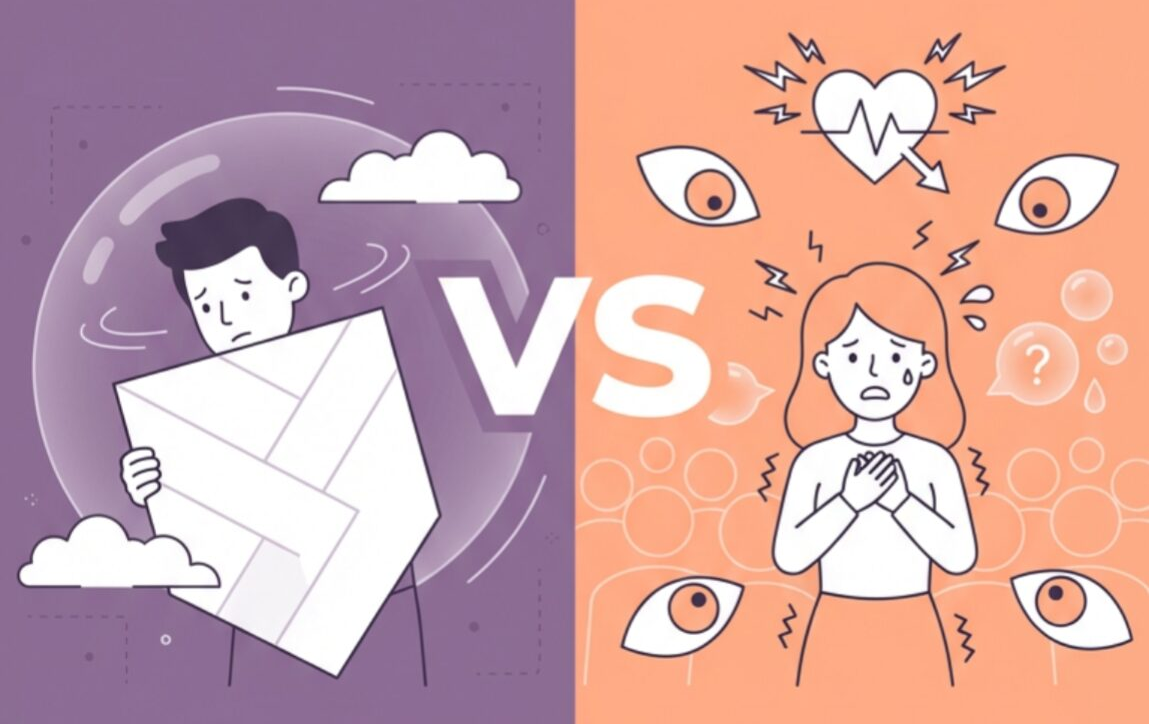
Social anxiety disorder (SAD) and Avoidant Personality Disorder (AvPD) look very similar from the outside.
In both, there tends to be a level of avoidance, fear of judgment, and a sensitivity to how others see you. Because of these similarities, many are left wondering which one actually explains what they’re going through.
As someone who lived with social anxiety, I struggled with identifying my anxiety and how to overcome it. In this guide, I’ll write about the things that I learned from personal experience and researched knowledge.
I’ll explain avoidant personality disorder vs. social anxiety, how identity plays a role in both, and help you understand which pattern—or whether aspects of both—may be driving the pain you’re struggling with.
By the end, you should have clarity on how these conditions overlap, how they differ, and why past explanations may not have fully captured your experience.
Let’s take a closer look.
What Social Anxiety Disorder Is
To open our discussion on avoidant personality disorder vs. social anxiety, let’s understand what social anxiety disorder is.
Social anxiety disorder (SAD) is an anxiety disorder defined by an intense, persistent fear of being judged, embarrassed, or negatively evaluated in social situations. At its core, SAD is driven by fear — fear of saying the wrong thing, fear of looking awkward, fear of being seen as weird or stupid.

Common signs of social anxiety disorder include:
- Overthinking conversations before and after they happen
- Avoiding social events or speaking situations
- Feeling physically panicked (blushing, shaking, sweating) when interacting
- Constant self-monitoring and worrying about how you appear
- Fearing that others are noticing your anxiety
One of the biggest misconceptions about social anxiety is that it is permanent. This is absolutely not true, and I am an example of why. I struggled with social anxiety for 3 years, and I have learned through extremely painful experience what it feels like to have it and overcome it.
If you would like to receive more information on how you can learn to overcome social anxiety, feel free to subscribe to our newsletter.
Each week, you will receive personalized content on what it feels like to have social anxiety, from someone who has struggled with it for years. Sometimes, just hearing someone who has been through it can mean the world, and our newsletter is a great way to stay updated for our content.
What Avoidant Personality Disorder (AvPD) Is
Avoidant personality disorder is a personality disorder, not an anxiety disorder. What this means is that AvPD is a pervasive pattern of thinking, feeling, and behaving that exists across many or all areas of life. This means it can feel like a more deeply ingrained condition than SAD.
While social anxiety disorder is mainly characterized by fear, avoidant personality disorder is defined by an ingrained belief that someone is defective, inferior, or unworthy of connection. SAD says, “I’m afraid people might judge me.” AvPD says, “People will reject me because of who I am.”
People with AvPD often experience everything someone with SAD does — fear of judgment, avoidance, worry — but they also struggle with core identity themes that shape how they see themselves in every area of life. This makes symptoms more pervasive and more persistent than the typical pattern in social anxiety.

Key features of AvPD include:
- A long-standing belief of being inadequate, socially inept, or fundamentally flawed
- Extreme sensitivity to rejection and criticism
- A strong desire for close relationships but an even stronger fear of being hurt
- Avoiding most social contact (including with close friends or coworkers)
- Viewing oneself as inferior or unlovable
- Patterns beginning in early adulthood and consistently affecting many areas of life
Unlike SAD, avoidant personality disorder is not limited to social-performance situations — it affects identity, relationships, self-worth, and general functioning. Treatment often requires longer-term psychotherapy focused on self-esteem, relational patterns, and core beliefs.
Avoidant Personality Disorder vs. Social Anxiety: Comorbidity
It’s also important to recognize that you might struggle with AvPD and SAD (especially if you have generalized social anxiety).
In fact, research consistently shows that AvPD has one of the highest comorbidity rates with social anxiety disorder, compared to any other mental health condition.
What a Comorbid Patient Often Looks Like
So, to help you see whether you have both conditions, this section is dedicated to helping you understand what a comorbid (person who has two mental illnesses) patient looks like.
Here are five things that could signal you struggle with SAD and AvPD:
1. Chronic, pervasive toxic shame
A person with SAD and AvPD oftentimes carries a core belief that something is fundamentally wrong with them. What this means is they separate the “good” parts of themselves from the “bad” parts of themselves.
There is a chasm inside of their identity that limits them from fully experiencing reality. Take, for example, making friends. People with avoidant personality disorder might rationalize to themselves that other people couldn’t possibly like them because “it is only a matter of time before they see who they really are.” Because of this, people with AvPD naturally separate themselves from other people–because they have already justified within themselves that they couldn’t possibly be liked.
For people with social anxiety, however, these thoughts might cause intense levels of anxiety. They want to make friends with other people, but because of their deeply embedded beliefs that they are flawed, only the “good” side of them can fully experience the love and companionship of relationships.
2. Identity-level wounds
Instead of seeing anxiety as a problem they have, people with SAD and AvPD might start seeing anxiety as a reflection of who they are.
People with comorbid conditions might claim:
- “I am a socially anxious person”
- “My personality is the problem.”
- “I need to be a more likable”
- “I’m incapable of change.”
Because they associate their anxiety with who they are, people with SAD and AvPD can struggle with social anxiety for years. To them, recovery isn’t just about overcoming a simple fear like arachnophobia: it is about reshaping and transforming the perception of their very identity, which takes years.
3. Extreme avoidance that has shaped your entire life
In addition to the variables above, having SAD and AvPD likely means avoidance has plagued you from a very early age and exists as a way for you to distance yourself from social situations. It is likely the go-to defense mechanism your mind uses to protect you from feeling hurt.
Here are classic examples of avoidance taking form in a person’s life:
- Avoiding friendships (not going out with friends because its too overwhelming)
- Avoiding romantic relationships (refusing to see a movie with your loved one because you have “too much work”)
- Avoiding opportunities at school or work
- Avoiding visibility, leadership, or anything that risks criticism
But it isn’t necessarily the avoidance that is so important–it is the reason why it exists internally. While many people with social anxiety associate avoidance with social withdrawal, avoidance (particularly inside of people with AvPD) can show up emotionally in the form of self-suppression, or the deliberate suppression of who you are out of fear of rejection.

Self-suppression can show up in many ways, including:
- Avoiding intimate situations and uncomfortable conversations to avoid feelings of rejection
- Avoiding the expression of your true opinions out of fear of embarrassment
- Hiding your emotions, even positive ones, to prevent drawing attention or criticism
- Pretending to share interests or opinions you don’t actually hold in order to fit in
- Silencing yourself in conversations, meetings, or social gatherings, even when you have something meaningful to contribute
- Suppressing humor, sarcasm, or playful expressions for fear of being judged
For me, self-suppression was everything in sustaining my anxiety. Instead of simply withdrawing from social situations entirely, my brain was very sneaky.
It would tell me not to offer my opinions to other people because it could expose the parts of myself that needed to stay hidden. It would tell me that I shouldn’t be who I truly was because internally, there must have been something wrong.
It is internal dialogues like these that are a sign of something more than social anxiety, that you might be struggling with something more related to your own identity than your perception of other people, that it’s more a sign of shame masked as fear than just fear itself.
4. An extreme, chronic difficulty forming or maintaining relationships
Most people who have SAD and AvPD either have never had close friends in their life or have a significant difficulty in making them. This isn’t because of some deficit they are born with: they simply don’t have the experience.
Making friends is like any skill in life: it takes practice and vulnerability. And because people with AvPD tend to be so withdrawn, this can feel like a huge uphill battle. For them, it feels like “why should I open myself up around other people when all my life no one has done the same for me?”
The result is a self-fulfilling prophecy: because they avoid being vulnerable, they never give others the chance to reciprocate closeness or build trust, which makes them distance themselves from people even more.
Understanding these patterns is crucial because the emotional experience of someone with both SAD and AvPD can be significantly more intense, identity-based, and chronic than either condition alone.
Avoidant Personality Disorder vs. Social Anxiety: a DSM-5 Perspective
But, its important to note that while both conditions can occur together, there are notable diagnostic differences between avoidant personality disorder vs. social anxiety.
The DSM-5 (Diagnostic and Statistical Manual of Mental Disorders, Fifth Edition) is the standard reference used by mental health professionals in the United States to diagnose and classify mental health conditions. It provides clear criteria for each disorder, helping clinicians understand overlapping symptoms.

In this section, we will go over the differences between avoidant personality disorder vs. social anxiety disorder using the DSM-5.
DSM-5 Criteria for Social Anxiety Disorder (SAD)
In my last post on the DSM-5 and Social Anxiety Disorder, I explored how the DSM defines social anxiety, how its understanding has evolved across editions, and what clinicians look for in a diagnosis.
In short, the DSM-5 focuses on:
- Marked fear or anxiety about social situations involving possible scrutiny
- Fear of negative evaluation by others
- Avoidance or endurance with distress of social situations
- Interference with daily life or distress
- Duration of 6 months or more
- The anxiety is not better explained by another mental disorder or the effects of a substance
But feel free to check out the post above for more information; it’s pretty interesting.
DSM-5 Criteria for Avoidant Personality Disorder (AvPD)
Unlike SAD, AvPD is classified as a personality disorder, meaning it is pervasive, persistent, and begins in early adulthood. According to the DSM-5, an individual must meet four or more of the following criteria:
- Avoids occupational activities involving significant interpersonal contact due to fears of criticism, disapproval, or rejection.
- Unwilling to get involved with people unless certain of being liked.
- Shows restraint in intimate relationships because of fear of shame or ridicule.
- Preoccupied with being criticized or rejected in social situations.
- Inhibited in new interpersonal situations due to feelings of inadequacy.
- Views self as socially inept, personally unappealing, or inferior to others.
- Reluctant to take personal risks or engage in new activities due to potential embarrassment.
Differences Between Avoidant Personality Disorder vs. Social Anxiety
So, to conclude, in terms of diagnosis and symptoms, there are a couple of key differences between avoidant personality disorder vs. social anxiety disorder:
- Scope of Avoidance: In SAD, avoidance is usually situational, triggered by specific social or performance contexts. In AvPD, avoidance is pervasive, affecting nearly all social, occupational, and intimate interactions.
- Relation to Self-Image: AvPD is ego-syntonic; the avoidance fits the individual’s self-perception. They often think, “I’m just not good enough, so I must avoid this,” making the behavior feel like a natural part of who they are. In contrast, SAD is ego-dystonic, meaning the anxiety feels alien and unwanted, prompting distress and a desire to overcome it.
- Chronicity and Onset: AvPD symptoms are chronic, often traceable to early adulthood, and deeply linked to personality traits or temperament. SAD can fluctuate over time, sometimes easing with experience, therapy, or changes in circumstances.
- Core Psychological Patterns: AvPD involves deep-seated feelings of inadequacy, hypersensitivity to rejection, and pervasive self-criticism, whereas SAD primarily centers on fear of negative evaluation in specific situations without the same global sense of personal inadequacy.
In short, SAD is about anxiety in certain social scenarios, while AvPD represents a broader, enduring personality pattern that shapes how a person experiences nearly every relationship and social opportunity.
Which One Are You? Avoidant Personality Disorder vs. Social Anxiety Disorder
So, now that we’ve covered the similarities and differences between avoidant personality disorder vs. social anxiety, it’s important for you to assess which of the two (or both) you might have:
If You Relate Mostly to SAD, You Might Notice:
- You want to connect with others but feel held back by nerves, worry, or self-consciousness.
- Your anxiety feels distressing and unwanted, prompting a desire to overcome it.
- Avoidance tends to be specific, not affecting all areas of life.
- You ruminate on social interactions, replaying them in your head afterward.
- Physical symptoms like blushing, sweating, or shaking often occur in social situations.
- Self-doubt is mostly linked to social performance, not your overall self-worth.
- Exposure or practice in social situations can sometimes reduce anxiety over time.
- You may avoid speaking up, performing, or attending events, but still have social goals you hope to pursue.
- Fear of negative evaluation is situational, not a constant, pervasive belief about yourself.
If You Relate Mostly to AvPD, You Might Notice:
- Avoidance is pervasive, affecting almost all social, work, and intimate situations.
- You often feel fundamentally inadequate, socially inept, or personally unappealing.
- The avoidance feels ego-syntonic, aligned with your self-image—“this is just who I am.”
- You preemptively withdraw from interactions out of fear of criticism, rejection, or embarrassment.
- You have a deep, chronic fear of disapproval that is consistent across relationships and contexts.
- Intimate relationships are often avoided or superficial because of fear of rejection or ridicule.
- Self-criticism and feelings of inferiority are global, not limited to specific situations.
- You may experience chronic loneliness due to the combination of avoidance and low self-esteem.
Note: This guide is for educational purposes and is not a substitute for a professional diagnosis. If you’re unsure or concerned about whether you have avoidant personality disorder vs. social anxiety, make sure to check in with a licensed psychologist or clinician.
Self-Assessment Tools
In addition, there are several self-assessment tools you can use to determine whether or not you have avoidant personality disorder vs. social anxiety.
1. Liebowitz Social Anxiety Scale (LSAS)
The LSAS is a widely used clinical questionnaire that measures fear and avoidance in social and performance situations. It provides a score indicating the severity of social anxiety and can help you see patterns over time. Many therapists use it to track progress during treatment.
2. Online Social Anxiety Quizzes
There are several reputable quizzes designed to give a quick snapshot of social anxiety symptoms. While not diagnostic, they can help you identify triggers, situational fears, and the intensity of your anxiety. Look for quizzes that reference clinical research or established scales.
3. Personality Assessments
Because Avoidant Personality Disorder (AvPD) is a personality-based condition, personality assessments can help you understand long-term patterns in self-perception, relational tendencies, and avoidance behaviors. Tools like the MMPI or other personality inventories may be used by clinicians to distinguish AvPD from situational social anxiety.
4. When to Seek Professional Evaluation
Self-assessments are only a starting point. You should consider professional evaluation if:
- Your social anxiety or avoidance interferes with daily life, work, or relationships.
- You notice persistent feelings of inadequacy or fear of rejection across nearly all social situations.
- Self-assessment results indicate moderate to severe symptoms.
- You want personalized guidance, therapy, or treatment options.
Remember: Only a licensed psychologist, psychiatrist, or qualified mental health professional can provide an official diagnosis. Self-assessments are tools for awareness, not a substitute for professional care.
Conclusion
Living with social anxiety or patterns of avoidance can feel confusing and isolating, but understanding the differences between Avoidant Personality Disorder vs. Social Anxiety Disorder is an important step toward clarity and support.
Remember: whether your experiences align more with Avoidant Personality Disorder vs. Social Anxiety, you are not alone, and help is available. Awareness of your patterns is the first step toward meaningful change.
For a deeper look at related topics, check out our other posts on DSM-5 and ICD criteria for social anxiety to get a fuller picture of how these conditions manifest and overlap.
And if you want to stay updated with practical tips, new assessments, and insights for managing social anxiety and related challenges, be sure to subscribe to our newsletter and get the latest guidance delivered straight to your inbox.

Hi, I’m Blake Baretz, the creator of Social Anxiety Haven. I write about my personal journey with social anxiety and share research-backed strategies to help others navigate it. If you’d like more encouragement and resources, join my weekly newsletter.