For years, I said yes to almost everything.
Every plan, invitation, request that landed in my inbox or messages. And it wasn’t because I wanted to go, or that I had the energy, or because any part of me was genuinely excited about it — it was just that the thought of disappointing someone felt completely unbearable to me.
I would stand in the corner of parties I never wanted to attend, exhausted and overstimulated, watching the clock. I would say yes to things on a Friday afternoon that I’d spend the entire week dreading. I would give my time and energy to people and situations that left me emptier every time — and I would do it with a smile, because at least that way nobody would be upset with me.
What I didn’t realize until much later was what all of those years were adding up to. A version of myself that had been so hollowed out by people-pleasing that I genuinely didn’t know what I wanted anymore. I had said yes so many times that my own needs had become completely illegible to me.
Nobody ever told me my needs were worth protecting. Nobody handed me a framework and said: here, this is how you take up space without hurting anyone. I had to find that out the hard way.
This post is what I wish someone had given me back then.
The Real Reason Saying No Feels Impossible
Most people assume that saying no is hard because of the anxiety itself — that if you could just calm your nervous system down enough, the words would come out fine.
But that’s not actually the problem.
The real reason saying no feels impossible when you have social anxiety is a deeper emotion that sits underneath the fear: guilt. Guilt is the emotion that says I did something wrong — and for people with social anxiety, it activates the moment you even consider putting your own needs first.
Here’s a scenario that might feel familiar. It’s Friday afternoon and you get a text from a friend inviting you to a party that night. The moment you read it, you already know your answer. You’re exhausted. You’ve had a long week. The last thing you want is to spend your evening in a loud room making small talk with people you barely know. Everything inside you is saying no.
And then something shifts.
You start thinking about your friend — how excited they sounded, how much effort they put into this, how they specifically reached out to you. And suddenly the no that felt so clear a second ago starts to dissolve. What if they think I don’t care about them? What if they stop inviting me places? You open your phone and start typing: I’m sorry, I can’t make it tonight. Then you delete it. You type it again. Delete it again. And after the fourth or fifth attempt, you type back: Sounds good. I’ll be there. And close your phone.
For a brief moment, the guilt is gone. But it gets replaced almost immediately by something else: dread. Because now you have to go.

That cycle — guilt, dread, self-abandonment — is what we’re untangling here. Because the problem was never the party. The problem is that somewhere along the way, you learned that your needs are less important than everyone else’s. And until you unlearn that, no breathing exercise or positive affirmation is going to make saying no feel any easier.
If you want writing like this in your inbox every week — honest, specific content on the psychology of social anxiety and what recovery actually looks like — subscribe to the newsletter here. It’s what this blog is built around.
The Passive-Assertive-Aggressive Spectrum
Before we get to the scripts, I want to give you a framework that changed the way I thought about all of this — because without it, the scripts are just words. With it, they become part of something much more meaningful.
When it comes to expressing your needs to other people, there are three places you can land on a spectrum.
On one end is passive. When you’re being passive, you’re allowing other people to intrude on your boundaries without resistance. You say yes when you mean no. You shrink your needs down to nothing so that everyone around you can feel comfortable. It might feel like the selfless thing to do — but what it’s actually doing is teaching the people around you that your boundaries don’t exist. And over time, you teach yourself the same thing.
On the other end is aggressive. When you’re being aggressive, your needs become the only thing that matters. You push, you demand, you disregard how other people feel entirely. And because this feels so contrary to who you are, most people with social anxiety swing hard in the opposite direction — staying passive forever because the alternative feels monstrous.
But here’s the crucial thing I want you to understand: assertiveness is not aggression. They are not the same thing. And confusing the two is one of the main reasons people with social anxiety never learn to protect themselves.

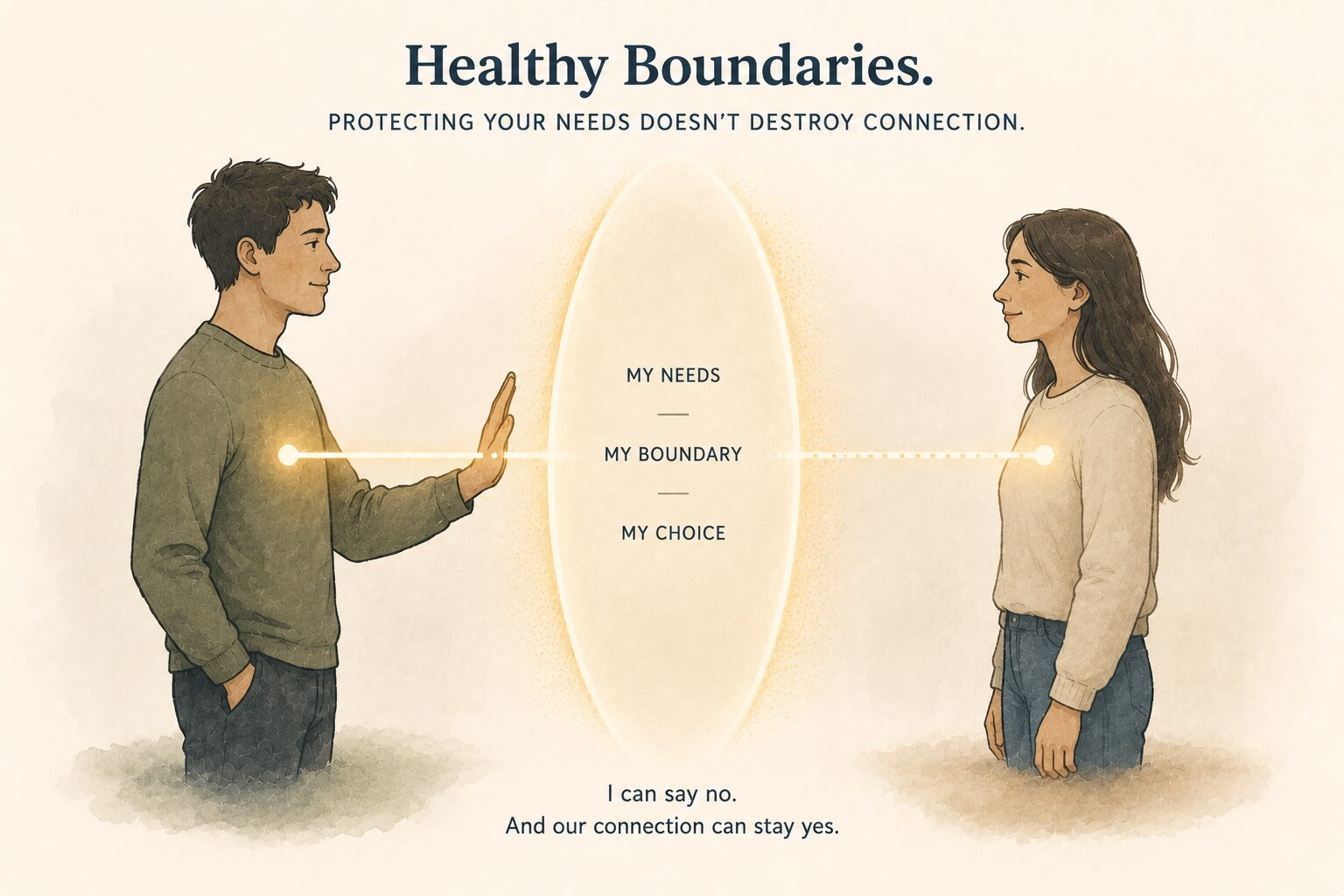
Assertiveness is the middle ground. It means expressing your needs clearly and honestly while still respecting the needs of the person in front of you. You’re not intruding on anyone’s boundaries. You’re simply protecting your own. You’re saying — calmly, with full respect for the other person — that you have needs too, and that those needs are worth honoring.
That distinction is everything. Because assertiveness isn’t about becoming louder or harder or more confrontational. It isn’t about becoming a different person. It’s about learning to take up the space you were always entitled to — without guilt, without apology, and without shrinking.
This connects directly to something I wrote about in my post on what social anxiety really is — specifically how shame teaches us that showing ourselves to others is dangerous, and how that belief quietly shapes every interaction we have. The inability to say no is one of the clearest expressions of that belief in action.
Three Scripts for Saying No
Now let’s make this practical. Here are three scripts — one for each level of assertiveness — that you can use the next time an invitation lands and your stomach drops.
Script One: Basic Assertion
Use this as your default. The simplest, cleanest way to decline — for straightforward situations with people who generally respect your boundaries.
“I really appreciate you thinking of me, but I’m not going to be able to make it.”
That’s the whole thing. No lengthy explanation. No fabricated excuse. No apology for having needs. Just a warm, honest, complete sentence that says everything it needs to say without saying anything more.
This is harder than it sounds — because everything in you will want to add more. To justify. To over-explain. To soften it so thoroughly that the no gets buried. Resist that. The sentence is complete. Let it be complete.
Script Two: Empathic Assertion
Use this when the relationship matters deeply to you and you want to make sure the other person feels seen — even as you’re protecting yourself.
“I know you’ve been looking forward to this and I really appreciate you including me, but I’m just not in a place where I can make it work today.”
What this script does is separate the no from the relationship. You’re not saying I don’t care about you. You’re saying I care about you — and because I care about you, I’m going to be honest rather than show up as a hollow version of myself who resents being there.
This distinction matters enormously for people with social anxiety, because the guilt around saying no is almost always rooted in a specific fear: that the no will be interpreted as rejection. The empathic assertion makes that misreading almost impossible. You’re not withdrawing from the person. You’re protecting the energy that makes you worth being around.
Script Three: Consequence Assertion
This one is a last resort. Use it only when someone has continued to push back after you’ve already said no — when the basic and empathic approaches haven’t been respected.
“I’ve already let you know that I’m not able to make it, and I need you to respect that.”
This will feel the most uncomfortable to use — especially if you’ve spent years on the passive end of the spectrum. But it exists for an important reason: sometimes people push. And when they do, you deserve to have a response ready.
Notice that this script is still calm. Still respectful. It isn’t aggressive. It isn’t an attack. It’s simply a boundary being held with quiet, firm clarity. The tone is everything — and the tone is: I am not negotiating, and I am not apologizing, and I am still the same person who cares about you.
What do you find hardest about saying no — the guilt beforehand, the anxiety in the moment, or the second-guessing afterward? I’d love to hear in the comments below. You might be describing exactly what someone else is struggling to name.
What These Scripts Are Actually Building
Here’s what I want you to understand about why these scripts matter beyond the individual moments they help you navigate.
Every time you use one of them — and the friendship survives — you gather a piece of evidence. Evidence that your no was received and the relationship held. Evidence that protecting yourself didn’t cost you everything you were afraid it would. Evidence that your boundaries are real and worth honoring.

According to the Anxiety and Depression Association of America, building assertiveness is one of the most consistently effective components of social anxiety treatment — not because it eliminates anxiety, but because it gradually dismantles the belief system underneath it. Each assertive act, however small, chips away at the core conviction that your needs are less important than everyone else’s.
One use of these scripts won’t change much. Ten might start to. Fifty will begin to shift something fundamental. The guilt that once felt like a wall starts to feel more like a speed bump. The fear that saying no would cost you everything starts to lose its power. And slowly, you start to build something you may never have had before: the quiet, grounded sense that you are allowed to take up space.
You Were Always Allowed to Say No
Here’s what I want to leave you with.
The reason saying no has felt so impossible isn’t that you’re weak or selfish or too anxious to function. It’s that nobody ever gave you permission. Nobody ever showed you that the middle ground between passive and aggressive existed — that there was a way to protect yourself that was also kind, also respectful, also fully compatible with being a good friend and a caring person.
You were always allowed to say no. The people who are genuinely meant to be in your life will still be there when you do. The friendships worth having are the ones that can hold your honesty — and more than that, the ones that are actually strengthened by it.
The version of you that shows up at a party they wanted to attend, with energy they actually have, present and genuine and glad to be there — that version is worth more to the people around you than the version that says yes to everything and arrives already empty.
You don’t have to keep hollowing yourself out to keep people close. You never did.
If you want to keep going deeper on this — the guilt, the people-pleasing, and what it actually looks like to rebuild a sense of self that doesn’t depend on everyone else’s approval — join the newsletter here. I write about all of it every week, and I’d love to have you along.

Hi, I’m Blake Baretz, the creator of Social Anxiety Haven. I write about my personal journey with social anxiety and share research-backed strategies to help others navigate it. If you’d like more encouragement and resources, join my weekly newsletter.
Leave a Reply