There is a moment that almost everyone with social anxiety knows.
You are in the middle of a conversation — one that isn’t even high stakes, one that should be easy — and something locks. You know what you want to say. You can feel it. But between that and actually saying it, there is a gap you can’t cross. So you say something smaller instead. Something safer. Something that costs less to offer but also gives less away.
And then you walk away from the conversation feeling like you weren’t really there.
That experience — the gap between who you are and who you allowed yourself to be — is not just a symptom of social anxiety. It has a structure. A precise one. And until you understand that structure, everything you try to fix about your social anxiety will be aimed at the wrong target.
What I’m going to lay out in this post is the most complete account I know of what social anxiety is actually doing in a live social situation. I arrived at it by reverse-engineering my own recovery and mapping it against a clinical model published by Ronald Rapee and Richard Heimberg in 1997. If you’ve read other posts on this site, you’ll recognize the mechanisms. This is where they converge.
Two Goals That Can’t Coexist
Here’s a situation that might feel familiar.
You’re at work and your boss calls you into his office. You don’t know why. You run through the possibilities on the way in and by the time you sit down across from him, the anticipatory anxiety has already been running for several minutes.
But he’s smiling. He tells you your productivity has been up this week and he wants to know what’s changed. The real answer is that you’ve started going to therapy. But something in you immediately locks down. He’s going to judge me for that. He’s going to think less of me. He’s going to use it against me somehow. So instead of telling him the truth, you deflect. “I don’t know — maybe it’s because I’ve been going to the gym.”
In that moment, a gap opened between who you actually are and who you decided it was safe to be. That gap — the distance between your authentic self and the version you presented — is not just a symptom of social anxiety. It’s the signature of a system that governs how you perceive and navigate every social situation you enter.

That system is what I call the double bind.
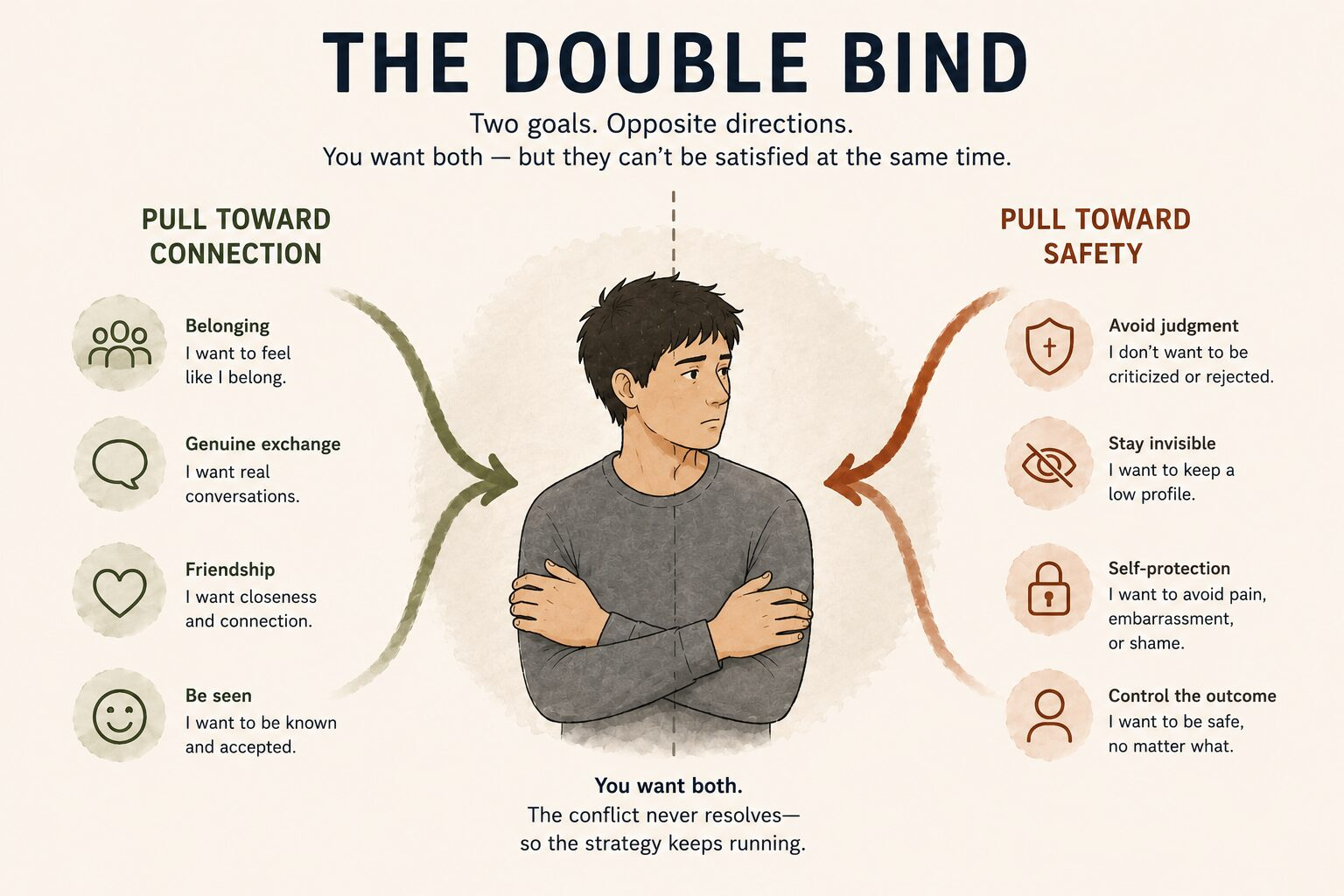
The double bind is built from two goals that run simultaneously inside every social situation, pulling in opposite directions with equal force.
The first is connection-seeking. Every time you enter a social situation, some part of you is asking: what do I need to do for this person to like and accept me? This isn’t something to be ashamed of — it’s one of the most fundamental drives human beings have. Evolutionary psychologists have consistently identified social belonging as a core need, not a preference. The desire for connection isn’t the problem. The problem is what runs alongside it.
The second goal is exclusion-avoidance. Underneath the desire for connection, there’s a second question running simultaneously: is this person going to punish me for who I am? This goal exists because your mind is trying to protect you — because past social experiences have been painful enough that the nervous system built a defense around authentic expression. The strategy it built was concealment. Don’t show too much. Don’t give them enough to use against you. Stay small enough to stay safe.
These two goals cannot coexist. Connection requires a genuine signal — it requires enough of the real you to be present that another person can actually reach it. Concealment suppresses that signal by design. So you enter the situation wanting connection and simultaneously running a system that makes connection structurally impossible. Neither goal gets what it needs. Neither system gets enough to work with. And the bind tightens with every cycle.
If this is already giving language to something you’ve been living with — join my newsletter here. Every week I write about the mechanisms underneath social anxiety and what recovery looks like when you’re finally working at the right level. I’d love to have you there.
What This Does to Your Attention
In 1997, psychologists Ronald Rapee and Richard Heimberg published a cognitive model of social anxiety disorder that identified something precise about what happens to attention inside a social situation when this bind is active.
They called it the multiple-task paradigm.
What it describes is this: when you have social anxiety and you’re in a social situation, your attention isn’t on the conversation. It’s split — forcibly, simultaneously — across two internal tracks that are both drawing from the same finite pool of cognitive resources. And because both tracks are running at full demand, neither gets enough.
The first track is internal. Instead of focusing on the other person — their expressions, what they’re communicating, how you might respond — your attention turns inward toward how you’re coming across. How your voice sounds. Whether your face is doing something you didn’t intend. Whether you’re fidgeting. Whether the anxiety is visible. Whether the sentence you just said came out the way you meant it to. The focus shifts from what you’re authentically experiencing to how your performance is landing — from the inside of the conversation to the outside surface of yourself.
The second track is external, but not in the way that helps. You’re not reading the other person with genuine curiosity. You’re scanning them for threat signals. A slight shift in posture. A gaze that moves away a half-second too soon. A pause that goes one beat too long. The entire external environment gets processed through a filter that’s looking for early warning signs of the thing the exclusion-avoidance goal is organized around preventing.

Both tracks run simultaneously. Neither gets enough attention to function properly. And the result isn’t just that social conversations feel exhausting — it’s that performance degrades in a way that feels entirely out of your control, because it is. The cognitive resources that should be going to the actual conversation have been conscripted by a system that was designed to protect you, and the conversation suffers for it.
The grocery store is where I felt this most acutely, and it’s a good example of how early the system activates. Before I’d even walked through the door — before I’d seen a single person — the compression in my chest would already be there. My attention would split immediately: inward toward the physical sensation and what it meant about how I was being perceived, outward toward the environment I was about to enter and whether it was safe. By the time I was inside, my mind was already running two parallel threat assessments simultaneously, and the simple task of picking up food for the week felt like navigating something that required my entire self just to survive.
Nothing had happened yet. Nobody had done anything. The system was already running at full capacity before the situation had even begun.
The Question That Takes Over Every Conversation
There’s a simpler way to hold what the double bind and the attentional split produce together.
If you reveal too much of yourself, you risk rejection. If you reveal too little, you come across as hollow — unreachable, cold, someone people don’t pursue. Every social situation, regardless of context or stakes, collapses into a single governing question: how much of myself can I show right now?
That question is the center of the social anxiety experience. It’s why conversations that should feel easy feel impossible. It’s why you can leave an interaction that went reasonably well and still feel more exhausted than connected. The conversation you were having on the surface was happening alongside a second, invisible negotiation — a constant real-time calibration of how much exposure was safe — and that negotiation consumed most of what you had.

The other person was never fully receiving you. They were receiving whatever the calibration allowed through. And you were never fully present with them, because the part of you that could have been present was busy managing the threshold.
Does this map onto what social conversations actually feel like for you? I’d genuinely like to hear it in the comments below — particularly whether it’s the internal track or the external scanning that tends to dominate.
Where This Sits in the Larger Picture
The double bind is the convergence point of everything this sequence has covered.
The suppression strategy that forms from early social pain — covered in the suppression trap — is what generates the exclusion-avoidance goal. The memory-driven fear retrieval covered in why your social anxiety is about the past, not the present is what fills the external scanning track with archived threat content and delivers it as present-tense data. The self-verification mechanism is what ensures that whatever happens in the interaction gets processed through an identity that was built to confirm the bind rather than escape it. And the reason exposure therapy alone hits a ceiling is that entering more social situations doesn’t interrupt the architecture — you can expose yourself to the situation indefinitely while the double bind runs underneath every interaction, producing the same outputs, tightening the same loop.

The double bind is where those mechanisms land. It’s the experience-level expression of a system that has been building for years, and it’s the level at which the condition becomes self-reinforcing — because every cycle through the bind produces more evidence for the exclusion-avoidance goal, which tightens the concealment imperative, which suppresses the connection signal further, which produces more evidence, and around again.
Understanding the architecture doesn’t dissolve it. But it does something that no amount of thought-challenging or exposure work could do first: it locates the problem correctly. And you cannot interrupt a system you can’t see.
The Layer Underneath This One
What the double bind describes is the architecture of the problem at the level of a live social encounter. What it doesn’t answer is the question that follows naturally from it: what would an intervention actually have to do to interrupt this architecture? Not at the thought level. Not at the behavior level. At the level where the bind is actually operating — the identity level, where the concealment imperative originates and where the exclusion-avoidance goal draws its force.
That’s the layer this sequence is building toward, and it’s what my newsletter is built around. The mechanism is visible now. The question of what changes it is where the deeper work lives.
Join the newsletter here. I write every week, and I’d love to have you there.

Hi, I’m Blake Baretz, the creator of Social Anxiety Haven. I write about my personal journey with social anxiety and share research-backed strategies to help others navigate it. If you’d like more encouragement and resources, join my weekly newsletter.
Leave a Reply