I remember sitting in my dorm room one afternoon, staring at my phone ring on the desk in front of me.
It was my doctor’s office. A routine call. Nothing scary on paper. But despite this, I remember just sitting there and watching it ring and go to voicemail. I began to feel this familiar wave of disappointment in myself.
You should have answered. It was just a phone call. Why couldn’t you just pick it up?
If you have this problem — the phone ringing, the panic, the relief when it goes to voicemail followed by the shame — then you already understand what phone anxiety actually is.
Why Phone Calls Are Uniquely Hard for Social Anxiety
Most people assume phone anxiety is just a milder version of social anxiety — the same fear, smaller scale. But there’s something specific about phone calls that makes them disproportionately difficult, and it comes down to what they take away from you.
Think about what happens when you talk to someone face to face. Your brain is constantly collecting information. You read their facial expressions to gauge how they’re receiving you. You interpret their body language to sense whether the connection is landing. You hear not just what they say but how they say it — the warmth in a laugh, the hesitation before an answer, the subtle signals that tell you whether you’re safe or whether you need to adjust.
Communication in person has a shape. You can read it, respond to it, calibrate in real time.
On the phone, all of that disappears.
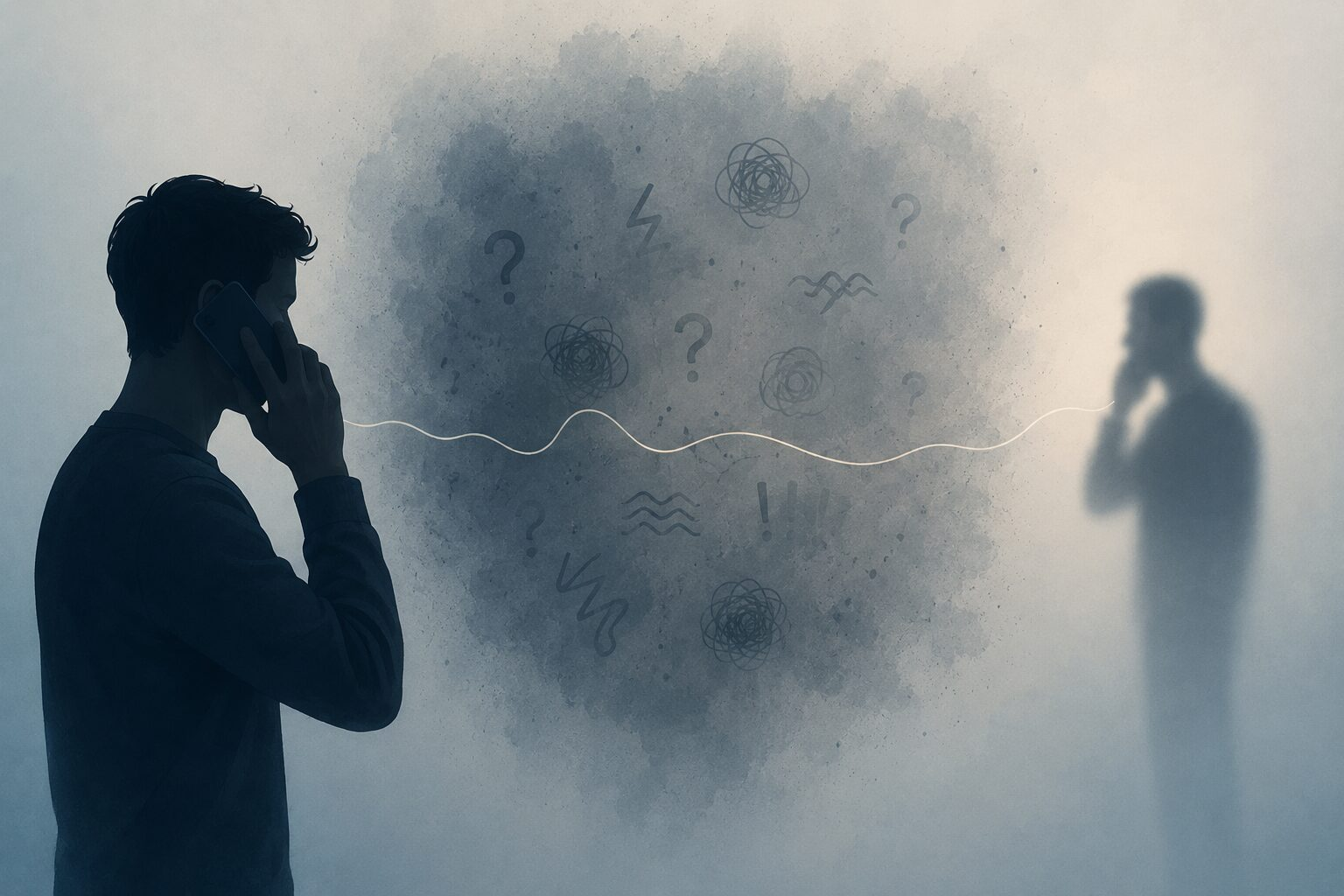
No face to read. No body to interpret. No visual information of any kind telling you how the other person is receiving what you’re saying. When there’s a pause on the other end of the line, your brain has nothing to work with — it can’t tell whether the pause means they’re thinking, annoyed, distracted, or confused. When there’s a laugh you weren’t expecting, you have no way to know whether it was warm or dismissive. Every ambiguous signal gets filled in by the most anxious interpretation available, because that’s what a hypervigilant brain does with uncertainty.

And here’s what makes it even harder. In most social situations, you can use your body to cope. You can smile to mask the fear. You can nod to buy yourself a moment. You can use your physicality to project a version of yourself that feels more composed than you actually are.
On the phone, that’s gone too. All you have is your voice. And for anyone who has struggled with social anxiety, your voice is one of the hardest things to control under pressure — the slight shake, the rushed pace, the way it can betray you at exactly the wrong moment.
This is why phone calls hit so differently. They strip away every signal your brain uses to feel safe in conversation and leave you with nothing but a voice going out into a void your nervous system isn’t equipped to handle alone.
If you want writing like this every week — honest, specific explanations of why social anxiety works the way it does — subscribe to the newsletter here. It’s what this blog is built around.
Why Avoiding Calls Makes It Worse
The most natural response to all of this is to avoid the call. In the short term, it might work — the moment you let it go to voicemail, the anxiety lifts, because the threat is gone.
But here’s what’s happening underneath that relief. Your brain is quietly logging something: avoiding the call kept me safe. And the next time your phone rings, that internal dialogue gets referenced. The pull toward not answering gets stronger. And over time, the story your brain builds becomes harder and harder to argue with: phone calls are dangerous. I can’t handle them. Something bad will happen if I answer.
According to the Anxiety and Depression Association of America, avoidance is one of the primary mechanisms that maintains anxiety over time. Each avoided situation confirms the threat rather than disconfirming it — and the anxiety doesn’t stay the same, it grows. The more calls you avoid, the less capable you feel of handling the next one. The less capable you feel, the more you avoid. The cycle feeds itself.

The only way to break it is to give your brain evidence that the story is wrong. And that means picking up the phone — but doing it in a way that’s actually manageable.
I explored this same cycle in depth in my post on why social anxiety takes so long to overcome — if you want to understand the deeper mechanism behind avoidance and why it’s so hard to break, that post goes further into the neuroscience of it.
Three Things That Actually Helped Me
These aren’t generic tips. They’re the specific things I used when phone calls were controlling my life — and they work because they address the actual problem rather than just pushing you to try harder.
One: Prepare your first two sentences and your last one.
Not a script. Not a rehearsed speech. Just an anchor — knowing what you’re going to say when the call connects and how you’re going to close it.
What this does for your brain is significant. Walking into a phone call with no idea how you’re going to open it means your brain has to generate language in real time while simultaneously managing the threat response — and that’s too much. Having two sentences ready removes the most uncertain moment of the call before it arrives. It gives your brain something concrete to hold onto, which orients your mental energy toward doing things right rather than desperately trying not to do things wrong.
When I was struggling most, something as simple as “Hi, I’m calling to schedule an appointment” or “Hi, I just had a quick question about my order” was enough to change the entire calculus of the call. The opening wasn’t a mystery anymore. And once the opening landed, the rest followed more naturally than I expected.
Two: Start with calls that don’t matter.
Before you tackle the calls that feel high-stakes, build your evidence base with calls where nothing is on the line. Call a restaurant to ask what time they close. Call a store to ask if they carry a specific product. Call a business to ask about their hours.
These calls are almost entirely scripted on both ends — there’s very little room for the ambiguous silences and unexpected reactions that make phone anxiety so unbearable. They’re short, predictable, and almost always end with a simple exchange of information and a polite goodbye.
But here’s why they matter beyond being easy wins. Remember what we talked about with the avoidance cycle — your brain has been building a story that phone calls are dangerous. The only way to dismantle that story is to give it evidence that it’s wrong. Every low-stakes call you complete is a data point against the narrative. One call won’t change much. Ten calls might start to. Fifty calls will.
Think of it like building a ladder. One rung at a time. Each one makes the next slightly less impossible.

Three: Reset your body before you dial.
This one matters because phone anxiety isn’t purely a mental experience — it’s a physical one. Your amygdala fires before your brain has had time to consciously process what’s happening, which means your body is already in threat mode before you’ve even thought about the call. No amount of mental preparation fully works if your nervous system is already running the alarm.
Before you make a call, do three things. Stand up — don’t make the call sitting down. If you can walk slowly while you talk, even better. Your body’s stress hormones are designed to move, and giving them physical movement is one of the most direct ways to discharge stored anxiety rather than let it sit and build. And before you dial, don’t take a deep breath in. Take a long, slow breath out. Exhaling activates the parasympathetic nervous system — the part of your brain responsible for calm — more directly than inhaling does.
None of these three things will eliminate your phone anxiety overnight. But they will give you a way into the calls you’ve been avoiding. And every call you complete using them is one more vote cast against the story your anxiety has been telling you.
You’re Not Incapable — You’ve Just Been Operating Without the Right Tools
Here’s what I want you to take away from all of this.
Phone calls feel so hard not because you’re weak or broken or uniquely unable to handle something everyone else does easily. They feel hard because they strip away every signal your brain uses to feel safe in social situations — and leave you with nothing but your voice going out into a void your nervous system wasn’t designed to navigate alone.
When you understand that, the shame changes. You’re not failing at something simple. You’re managing something genuinely difficult with tools that weren’t built for it.
The path forward is concrete. Prepare your opening. Build your evidence base with low-stakes calls. Reset your body before you dial. Let your brain collect the evidence it’s never been given the chance to gather — one call at a time, one rung at a time, until the story your anxiety has been telling starts to sound less convincing than the truth.
Have you struggled with phone anxiety? I’d love to hear in the comments below — whether it’s still something you’re working through or something you’ve found your way past. Your experience might be exactly what someone else needs to read today.
If you want to keep going deeper on the practical and psychological side of social anxiety recovery — what actually works, explained honestly — join the newsletter here. I’d love to have you along.

Hi, I’m Blake Baretz, the creator of Social Anxiety Haven. I write about my personal journey with social anxiety and share research-backed strategies to help others navigate it. If you’d like more encouragement and resources, join my weekly newsletter.
Leave a Reply